 Anahita Attarian
Buying property in Turkey can be a good investment when the buyer chooses a legally clean property, pays a fair local-market price, understands currency risk, and plans to hold the asset long enough to absorb market cycles. It is not automatically a good investment just because Turkish property prices may look lower than prices in parts of Europe or the Gulf. The strongest cases are usually long-term lifestyle ownership, rental property in proven areas, and citizenship-focused purchases that meet the official real estate investment rules. The weakest cases are usually overpromised off-plan projects, properties sold mainly to foreigners at inflated prices, and purchases based on guaranteed-rental or automatic-residency claims.
Is Buying Property in Turkey a Good Investment?
Buying property in Turkey is a good investment only if the property has clean title, real local demand, safe construction, realistic rental potential, and a clear resale market. It is a risky investment if the buyer depends on fast resale, ignores inflation and currency movement, or buys mainly because an agent promises residency, citizenship, or guaranteed income.
The practical answer is mixed: Turkey can be attractive, but it is not a passive, low-risk market. Investors need legal due diligence, local price comparison, building checks, tax planning, and a conservative rental calculation before buying.
Quick Verdict: Who Should and Should Not Buy
Buyer Type | Is It a Good Fit? | Reason |
|---|---|---|
Long-term lifestyle buyer | Often yes | Personal use can justify lower yield if the property is legally clean and well located |
Rental investor | Sometimes | Net yield depends on location, taxes, management, vacancy, and seasonality |
Citizenship investor | Yes, if structured correctly | Turkish citizenship by real estate has a defined threshold and documentation process |
Short-term speculator | Risky | Transaction costs, currency movement, and resale difficulty can reduce profit |
Remote buyer with no local support | Risky | Legal checks, tenants, maintenance, and taxes need reliable local handling |
Buyer expecting automatic residency | No | Buying property does not automatically give residence or work permission |
A Turkey property purchase works best when the buyer would still want the property even without a sales pitch about future price growth.
Current Turkey Property Market Context
Property Tax in Turkey: Rates, Transfer Tax and Owner Costs breaks the costs down line by line.
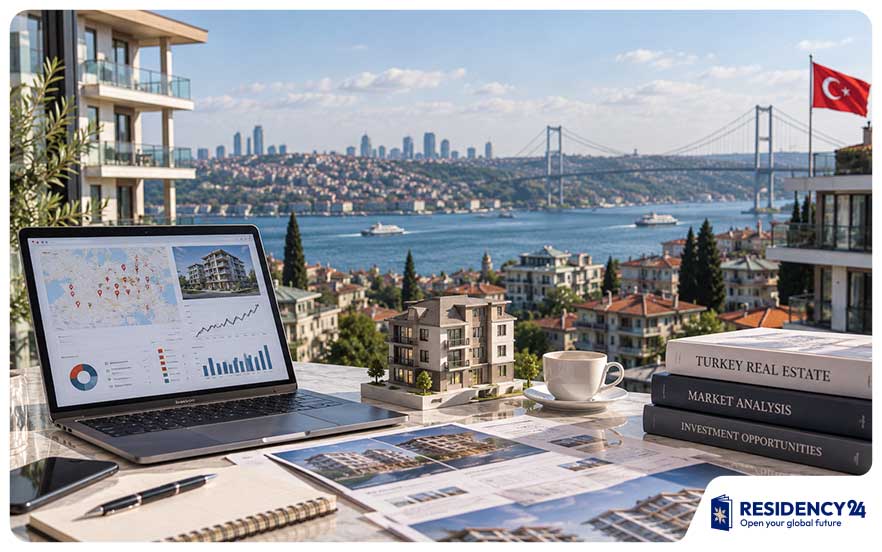
Before pricing anything, read the downside honestly - Risks of Buying Property in Turkey covers what most listings leave out. Turkey’s property market needs careful interpretation because inflation can make nominal growth look stronger than real performance. In July 2026, Turkey’s Residential Property Price Index increased by 25.0% year on year in nominal terms, but decreased by 5.1% in real terms after inflation adjustment. Istanbul, Ankara, and Izmir recorded annual nominal increases of 27.7%, 26.6%, and 23.1% respectively.
This means a property can become more expensive in Turkish lira while still losing real value after inflation. For foreign buyers, there is a second calculation: the return should also be measured in the buyer’s base currency, such as USD, EUR, GBP, or AED.
Rental data also requires caution. The New Tenant Rent Index increased by 28.4% year on year in nominal terms in July 2026, but fell by 2.6% in real terms. Istanbul’s new-tenant rent index rose by 32.4% annually, Ankara by 28.6%, and Izmir by 26.3%.
For investors, this shows two things at once: rent demand exists, but inflation-adjusted returns are not automatically strong.
Foreign Buyer Demand Has Cooled
Foreigners still buy property in Turkey, but foreign-buyer demand is weaker than during the peak years. TURKSTAT reported that house sales to foreigners in January–June 2026 fell by 9.2% compared with the same period of the previous year, reaching 9,083 units.
This is important for resale strategy. If a project is marketed mainly to foreign buyers, the future exit may depend on another foreign buyer entering the same market. When foreign demand weakens, overpriced foreign-facing projects can become harder to resell.
A safer investment usually has demand from both local and foreign buyers. That means the property should make sense to Turkish residents, tenants, families, students, professionals, or local investors, not only to international buyers looking for a second home.
Why Turkey Can Be Attractive for Property Investors
Turkey attracts property investors because it offers a mix of urban demand, coastal lifestyle, tourism, rental potential, and citizenship planning. Istanbul has scale and liquidity, Antalya has lifestyle and foreign-resident appeal, Bodrum has premium coastal demand, and Ankara offers a more local, government-and-professional tenant base.
The main attractions are:
Lower entry prices than many mature European property markets
Large domestic population and tenant demand
Strong lifestyle appeal in Istanbul, Antalya, Alanya, Bodrum, Izmir, and Fethiye
Potential rental income from long-term or short-term tenants
Citizenship by investment route for qualifying real estate
Wide choice of apartments, villas, resale homes, and new-build projects
Personal-use value for buyers who want a second home
Long-term urban renewal in selected districts
These advantages are real, but they are not enough on their own. A weak property in a poor building can still underperform in a popular city.
Citizenship by Investment Can Improve the Value Case
The threshold, timeline and family rules sit on the Turkish citizenship by investment page. One reason some investors consider Turkish property is the citizenship by investment route. Official Invest in Türkiye guidance states that foreign natural persons may acquire Turkish citizenship through exceptional procedures by purchasing real estate worth at least USD 400,000, with a title deed restriction on resale for at least three years.
This can make a property investment more valuable for buyers who also want a second citizenship. However, the property must meet the rules. The buyer should not rely only on the sale price written in a brochure.
Citizenship-focused buyers should check:
Official valuation
Title deed status
Payment route and bank receipts
Seller eligibility
No-sale annotation for three years
Whether one or multiple properties are used
Family inclusion
Legal representation
Future resale demand after the restriction period
A citizenship benefit can support the investment logic, but it should not justify overpaying for a weak property.
Residency Should Not Be Treated as Automatic

This is the single most common misunderstanding: Does Buying Property in Turkey Give You Residency? explains where the line actually falls. Buying property in Turkey can support certain residence applications, but it does not automatically grant residence. GOV.UK states clearly that “buying a property does not grant” permission to obtain residence or work authorization in Turkey.
Official Invest in Türkiye residence guidance also shows that foreigners who own real estate must still apply through the residence system and submit documents such as a residence permit application form, passport copy, biometric photographs, proof of financial sufficiency, title deed, and valid health insurance.
For buyers, this matters because a property can be legally purchased but still fail to support the intended immigration plan. If residency is part of the reason for buying, the property value, address, location, title deed, and current residence rules should be checked before payment.
Rental Income Potential
Rental income can make Turkish property attractive, especially in areas with local employment, universities, hospitals, tourism, transport, or foreign-resident demand. The strongest rental investments are usually not the most decorative units. They are practical properties in locations where tenants already want to live.
Long-term rental demand can be stronger in:
Istanbul districts with transport and employment access
Ankara neighborhoods near government, universities, and hospitals
Izmir residential and professional areas
Antalya city areas with year-round residents
University and medical districts
Areas with stable local employment
Short-term rental demand may be stronger in:
Antalya
Alanya
Bodrum
Fethiye
Selected Istanbul tourist districts
Coastal towns with seasonal demand
The rental calculation should be net, not gross. Investors should deduct management fees, tax, vacancy, repairs, site fees, furniture replacement, cleaning, and currency conversion costs.
Main Risk: Currency and Inflation
Currency risk is one of the most important issues when buying property in Turkey. A property may rise in Turkish lira but underperform in USD, EUR, GBP, or AED after exchange-rate changes.
Inflation also affects both sides of the investment. It may push nominal rents and property prices higher, but it also increases maintenance, furniture, construction, site fees, and tenant affordability pressure.
Foreign buyers should calculate:
Return in Turkish lira
Return in their own currency
Real return after inflation
Net rent after taxes and costs
Exit value after transaction costs
Exchange-rate loss when converting money back
Whether the property still works without strong price growth
A Turkey property investment should not be judged only by nominal price appreciation.
Istanbul Property Investment
If you are weighing that against the alternative, Istanbul vs Antalya: Which Is Better for Property Investment? sets them side by side.
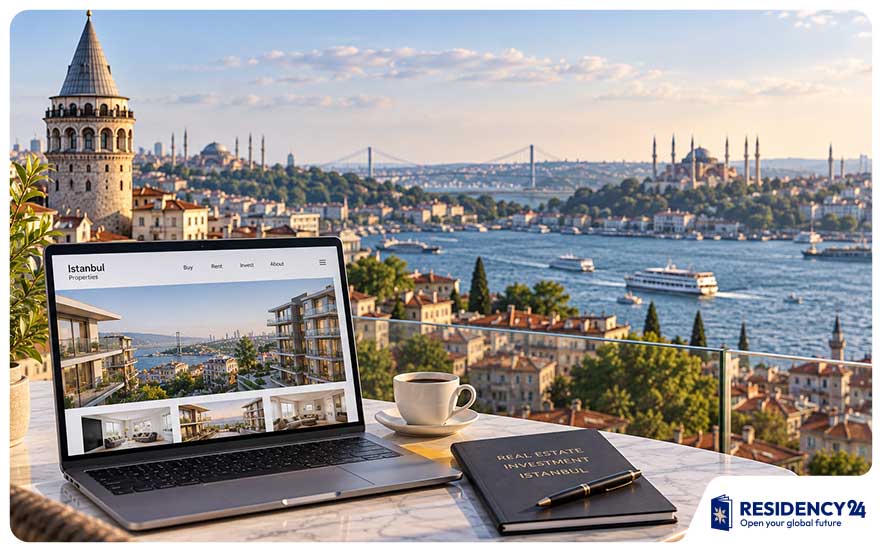
Istanbul can be a good investment because it is Turkey’s largest and most liquid property market. It has business districts, universities, hospitals, transport infrastructure, local tenant demand, and citizenship-focused investor interest.
Istanbul is suitable for:
Long-term rental investors
Buyers who want resale liquidity
Citizenship investors
Urban lifestyle buyers
Families planning to live in Turkey
Investors who can analyze district-level differences
The risk is complexity. Istanbul is not one market. Building safety, earthquake risk, transport access, title structure, price level, tenant demand, and resale liquidity can vary sharply between districts.
A good Istanbul property usually has:
Clean title
Strong transport access
Earthquake-conscious construction
Realistic price compared with local transactions
Local tenant demand
Manageable building fees
Clear resale market
Buying in Istanbul without district-level research is risky.
Antalya and Alanya Property Investment
Antalya can be attractive for lifestyle buyers, foreign residents, retirees, and rental investors. It has tourism demand, international visibility, and year-round city life in some areas. Alanya can offer lower entry prices and strong foreign-buyer appeal, but it may be more dependent on seasonal and foreign demand.
Antalya and Alanya can work well for:
Lifestyle buyers
Holiday-home buyers
Long-stay rental investors
Retirees
Remote workers
Buyers who want personal use plus rental income
The main risks are oversupply, seasonality, and resale depth. A property that rents well in summer may not perform the same in winter. A project sold mainly to foreigners may also be harder to resell if foreign demand slows.
Bodrum Property Investment
Bodrum is more of a premium lifestyle market than a simple rental-yield market. It can be attractive for buyers looking for villas, sea views, marinas, luxury seasonal demand, and personal use.
Bodrum may be suitable for:
High-budget lifestyle buyers
Villa investors
Seasonal rental operators
Buyers seeking premium coastal property
Investors who value scarcity in strong locations
The risk is that entry prices, maintenance, pool costs, garden costs, site fees, and seasonality can reduce net return. Bodrum should be judged as a lifestyle-led investment, not as a high-yield apartment market.
Izmir and Ankara Property Investment
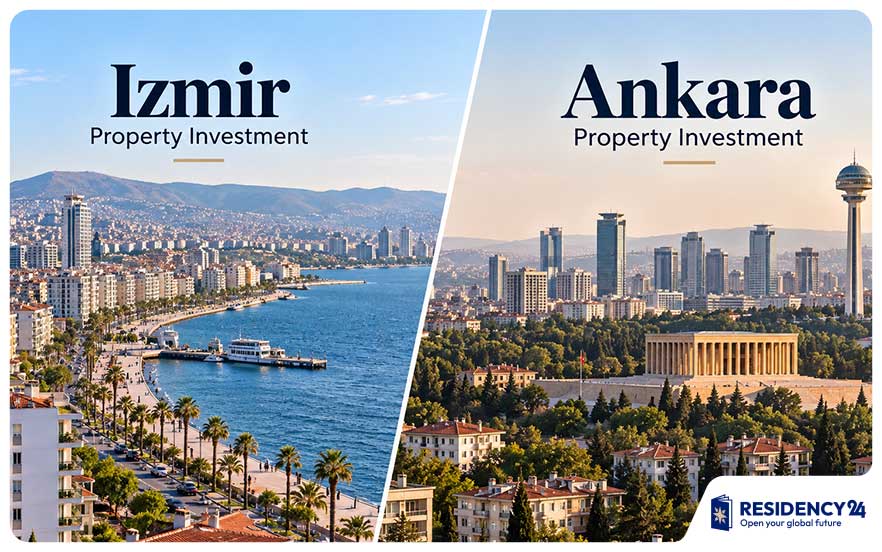
Izmir can be a practical choice for buyers who want a large urban market with coastal lifestyle appeal. It has local demand, universities, residential neighborhoods, and a more relaxed city profile than Istanbul.
Ankara is less popular with foreign lifestyle buyers, but it can offer stable rental demand connected to government, universities, embassies, healthcare, and professional employment.
City | Best For | Main Risk |
|---|---|---|
Izmir | Urban coastal living, families, long-term tenants | Building age, earthquake safety, district variation |
Ankara | Stable local rental demand, professionals, students | Lower foreign lifestyle appeal |
Istanbul | Liquidity, scale, citizenship buyers | Earthquake risk, overpricing, district complexity |
Antalya | Lifestyle, tourism, foreign residents | Seasonality and oversupply |
Bodrum | Premium coastal ownership | High entry cost and lower yield |
The best city depends on the buyer’s goal. A rental investor, citizenship investor, retiree, and lifestyle buyer should not choose the same property type by default.
Ready Property vs Off-Plan Property
Ready property is usually safer for foreign buyers because the title, building, neighborhood, rent, and resale comparables can be checked before purchase. Off-plan property can be attractive because of payment plans and possible price growth, but it carries more risk.
Factor | Ready Property | Off-Plan Property |
|---|---|---|
Legal clarity | Easier to verify | Depends on project registration and developer |
Rental income | Can start quickly | No income until completion |
Inspection | Physical inspection possible | Based on plans and promises |
Payment | More upfront capital may be needed | Staged payment may be available |
Main risk | Hidden defects or overpricing | Delay, quality, title, and resale risk |
Best for | Conservative buyers | Higher-risk buyers with strong due diligence |
For most foreign investors, ready property in a proven area is safer. Off-plan can work, but only when the developer, permits, title structure, delivery history, and contract protections are clear.
Legal Due Diligence Matters More Than Discount

Title checks, valuation reports and the deed transfer itself are handled on the buy property in Turkey page. Legal safety is more important than a low price. GOV.UK warns that Turkish property procedures and safeguards can differ from those in the UK and recommends using an independent lawyer before committing to a purchase or paying a deposit.
Before buying, check:
Seller ownership
Title deed status
Mortgage, lien, debt, or seizure
Habitation certificate
Zoning and building permits
Earthquake safety
Foreign ownership eligibility
Military or security-zone restrictions
Local residence-registration suitability, if relevant
Payment documentation
Contract terms
Power of attorney wording
Official Invest in Türkiye guidance also notes that property inquiries can be made online through parcel information, and that foreigners may not acquire real estate in prohibited military or military security zones.
A property that cannot pass basic title and legal checks should not be treated as a bargain.
Earthquake and Building Safety Risk
Earthquake risk is a serious investment factor in Turkey. A property’s interior design, view, and price do not matter if the building is structurally weak. This is especially important in Istanbul, Izmir, and other areas with known seismic exposure.
Buyers should check:
Construction year
Building permit
Habitation certificate
Earthquake regulation compliance
Soil and foundation conditions
Structural inspection
Damage history
Retrofitting records
Municipality status
Insurance and management records
A renovated apartment in an old unsafe building may be more dangerous and less investable than a simpler unit in a structurally stronger building.
Buying Property Mainly for Rental Yield
Turkey property can generate rental income, but investors should calculate returns conservatively. Gross rental claims often exclude important costs.
A proper rental-yield calculation should include:
Purchase price
Title deed and purchase costs
Furniture
Annual property tax
Site maintenance fee
Insurance
Repairs
Property management
Vacancy
Rental income tax
Short-term rental compliance, if relevant
Currency conversion
Selling costs later
GOV.UK notes that annual rental income should be declared through a tax return, while short-term rentals may be treated as commercial income and can require a tax account, accountant, and financial books.
A rental property is a business asset. It should be analyzed after tax and operating costs.
Buying Property Mainly for Resale Profit
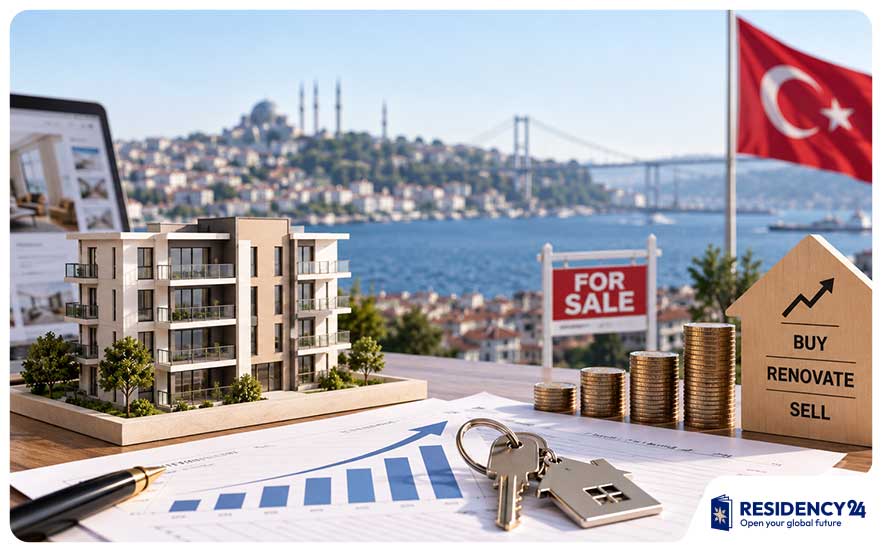
Short-term resale profit is risky in Turkey. Transaction costs, currency movement, valuation gaps, and changes in foreign-buyer demand can reduce the expected gain.
A resale-focused buyer should ask:
Are local buyers also interested in this property?
How many similar units are listed nearby?
How long do resale units stay on the market?
Was the original price inflated for foreigners?
Is the project oversupplied?
Can the buyer hold the property for several years if needed?
Will selling after tax and costs still produce profit?
The best resale properties usually have local demand, clean title, strong location, practical layout, and reasonable maintenance fees.
When Buying Property in Turkey Is a Good Investment
Buying property in Turkey may be a good investment when the property works financially, legally, and practically.
It can make sense if:
The property is in a proven district.
The title deed is clean.
The price is supported by local comparables.
The building is structurally safe.
Rental demand is realistic.
The buyer can hold for several years.
Currency risk is understood.
The property has a real resale market.
The buyer has independent legal support.
The investment still works without exaggerated sales promises.
The best property is usually one that local buyers and tenants also understand and value.
When Buying Property in Turkey Is Not a Good Investment
Buying property in Turkey may not be a good investment if the buyer is relying on weak assumptions.
It may be risky if:
The property is sold mainly to foreigners at a premium.
The title deed is unclear.
The building has no proper habitation certificate.
The project is off-plan with weak protections.
Rental income is guaranteed only verbally.
The buyer expects automatic residency.
The citizenship structure is not properly documented.
The area is oversupplied.
The buyer needs fast resale.
Returns are calculated only in Turkish lira.
The buyer skips legal due diligence to save money.
A missed deal is usually cheaper than a bad property purchase.
Investment Checklist Before Buying
If the goal is a return rather than a specific country, compare markets first - UAE vs Oman vs Turkey sets them side by side, and Residency24 works across residency, property purchase, company formation and investment planning. Before buying property in Turkey, use a strict checklist.
Confirm the seller is the registered owner.
Check the title deed through official channels.
Verify there is no debt, mortgage, lien, or seizure.
Confirm foreign ownership eligibility.
Check whether the property is in a restricted area.
Review habitation certificate and building permits.
Inspect earthquake safety and construction quality.
Compare recent local sale prices.
Calculate net rental income, not gross rent.
Include tax, management, vacancy, and maintenance.
Check short-term rental rules if relevant.
Confirm residence or citizenship rules separately.
Review all documents with an independent lawyer.
Avoid informal payments and under-declared values.
Plan the exit before buying.
If the property fails several of these checks, the investment case is weak.
Conclusion
Buying property in Turkey can be a good investment for buyers who choose a strong location, verify the legal status, calculate returns conservatively, and understand inflation, currency, rental, and resale risks. Turkey offers lifestyle value, large domestic demand, coastal and urban markets, and a citizenship-by-investment route for qualifying real estate purchases. At the same time, real property prices have recently been weaker after inflation adjustment, foreign-buyer demand has declined, and poor due diligence can expose buyers to title, construction, tax, and resale problems. The best opportunities are usually properties that local buyers and tenants also value, not projects sold only through foreign-buyer marketing. Turkey property is worth considering, but it should be treated as a medium- to long-term investment with legal review, technical inspection, and realistic financial modeling.