 Anahita Attarian
Property tax in Turkey is an annual municipal tax paid by owners of real estate such as apartments, villas, commercial buildings, land, and plots. The main tax is called Emlak Vergisi, and it is calculated on the municipal tax value of the property, not necessarily on the market price or the price paid by the buyer. For residential property, the standard annual rate is usually 0.1% outside metropolitan municipalities and 0.2% inside metropolitan municipalities such as Istanbul, Ankara, Izmir, Antalya, Bursa, and other metropolitan areas. Property owners may also face other real estate-related taxes, including title deed transfer tax when buying or selling, rental income tax if the property is rented out, capital gains tax if sold within five years, and valuable housing tax for high-value residential properties.
What Is Property Tax in Turkey?
Property tax in Turkey is an annual local tax charged on real estate located within Turkey. It is paid to the municipality where the property is registered and is based on the property’s official municipal tax value.
For a normal residential home, the annual property tax rate is usually low compared with many other countries. A residence outside a metropolitan municipality is taxed at 0.1%, while a residence inside a metropolitan municipality is taxed at 0.2%. The tax is paid in two instalments, with the first instalment payable during March, April, and May, and the second in November.
Property Tax in Turkey: Quick Summary
Tax Type | When It Applies | Typical Rate or Rule |
|---|---|---|
Annual property tax | Every year on buildings, land, and plots | 0.1%–0.6%, depending on property type and municipality |
Title deed transfer tax | When buying or selling property | 2% buyer + 2% seller, usually 4% total |
Valuable housing tax | High-value residential properties | Applies above the official threshold, with progressive rates |
Rental income tax | If the property is rented out | Based on declared rental income after exemptions and deductions |
Capital gains tax | If property is sold within five years | Applies to taxable gain, after indexation and exemptions |
DASK earthquake insurance | Required for many buildings | Insurance cost, not a tax, but usually part of ownership costs |
The annual property tax is the main recurring tax. The other items are related costs that property owners should understand before buying, renting, or selling.
Annual Property Tax Rates in Turkey
Annual property tax rates in Turkey depend on the type of property and whether it is located inside a metropolitan municipality. Metropolitan municipality rates are generally double the non-metropolitan rates.
Property Type | Outside Metropolitan Municipality | Inside Metropolitan Municipality |
|---|---|---|
Residence | 0.1% | 0.2% |
Other buildings | 0.2% | 0.4% |
Land | 0.1% | 0.2% |
Vacant land allocated for construction | 0.3% | 0.6% |
Farming land | 0% | Usually treated separately depending on status |
GOV.UK’s Turkey property guidance lists these local property tax rates and explains that local property tax is calculated based on the property value and paid to the local municipality.
What Counts as a Metropolitan Municipality?
A metropolitan municipality is a larger administrative municipality covering major cities and their connected districts. For property tax, this matters because rates are generally doubled in metropolitan areas.
Major metropolitan areas include:
Istanbul
Ankara
Izmir
Antalya
Bursa
Kocaeli
Konya
Mersin
Adana
Muğla
Aydın
Gaziantep
Kayseri
Samsun
Trabzon
A home in Istanbul usually pays residential property tax at 0.2%, while a similar home outside a metropolitan municipality may pay 0.1%. The exact municipality should always be checked from the property’s registered address.
How Property Tax Is Calculated in Turkey
Property tax in Turkey is calculated on the official tax value determined by the municipality. This value can be different from the actual market price, bank valuation, sale price, or citizenship valuation.
The basic formula is:
Annual property tax = Municipal tax value × applicable property tax rate
Example for a residence in Istanbul:
Item | Amount |
|---|---|
Municipal tax value | TRY 5,000,000 |
Residential tax rate in metropolitan municipality | 0.2% |
Annual property tax | TRY 10,000 |
Example for a residence outside a metropolitan municipality:
Item | Amount |
|---|---|
Municipal tax value | TRY 5,000,000 |
Residential tax rate outside metropolitan municipality | 0.1% |
Annual property tax | TRY 5,000 |
The municipal tax value is important because it is also connected to the declared value used in title deed transactions. GOV.UK notes that the declared value of a property cannot be lower than the tax value determined by the local municipality, which is also used as the base for local property tax.
Who Pays Property Tax in Turkey?
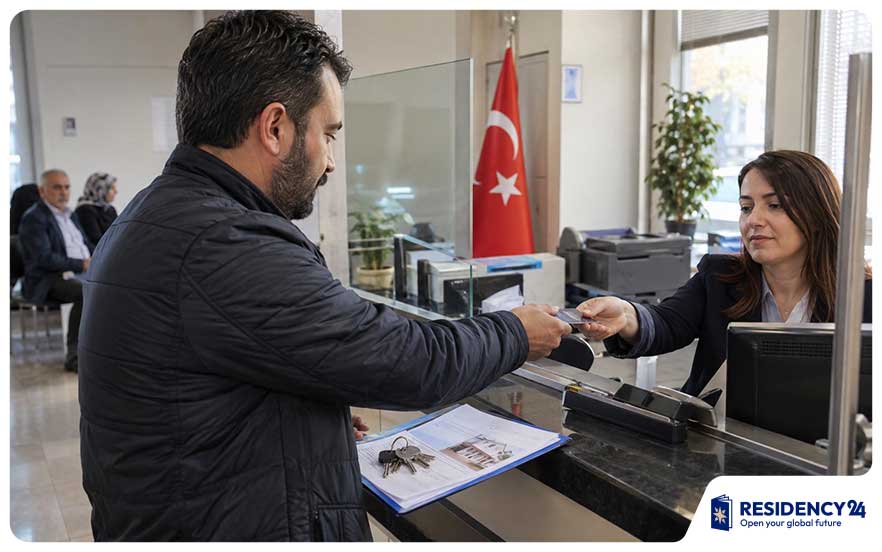
The property owner pays property tax in Turkey. If the property is jointly owned, each owner is generally responsible according to their ownership share, unless another legal arrangement applies.
For a foreign buyer, the obligation starts after the purchase is registered. The buyer should notify the relevant municipality after acquiring the property. The Revenue Administration’s guidance explains that if a property is bought during the year, the buyer must submit the property tax notification by the end of that year; if bought in the last three months, the notification must be submitted within three months from the acquisition date. The tax liability generally begins from the following year.
This is a common point foreign buyers miss. Receiving the Tapu is not the end of the process. The municipality also needs the property tax record to be updated.
When Is Property Tax Paid in Turkey?
Property tax in Turkey is normally paid in two equal instalments each year. The first instalment is paid during March, April, and May, and the second instalment is paid in November. Property owners can usually pay the full annual amount during the first payment period if they prefer.
A practical payment calendar looks like this:
Instalment | Payment Period |
|---|---|
First instalment | March, April, and May |
Second instalment | November |
Optional full payment | Usually during the first instalment period |
The exact payment channels can differ by municipality. Many municipalities allow payment through municipal offices, online municipality systems, e-government-linked services, or bank channels.
Where Do You Pay Property Tax in Turkey?
Property tax is paid to the municipality where the property is located. It is not paid to the land registry office, the estate agent, the building management company, or the tenant.
A property owner can usually pay through:
The municipality’s tax office
The municipality’s online payment system
E-government services, where supported
Contracted banks
In-person municipal payment counters
Foreign owners who live outside Turkey should make sure they can access the municipality’s online payment system or appoint a trusted representative. Missing payments can create debt, late fees, and complications during resale.
Property Tax for Foreigners in Turkey

Ownership rules and the purchase process itself sit on the buy property in Turkey page. Foreigners generally pay the same local property tax rates as Turkish owners. There is no separate annual property tax rate only because the owner is foreign.
Foreign buyers should still be careful with three points:
The property must be registered correctly at the municipality after purchase.
The owner should keep track of payment dates even if they live abroad.
If the property is rented out, rental income tax may also apply.
Foreign ownership itself does not remove tax obligations. A foreign owner with a holiday home in Antalya, an apartment in Istanbul, or a villa in Bodrum is still responsible for municipal property tax.
Property Tax on Apartments
Apartments are usually taxed as residential buildings if they are registered as homes. The rate is generally 0.1% outside metropolitan municipalities and 0.2% inside metropolitan municipalities.
Apartment owners should also distinguish between property tax and building management fees. Property tax goes to the municipality. Building fees, often called aidat, go to the apartment or site management for services such as cleaning, security, elevators, gardens, pools, and common-area maintenance.
An apartment owner may pay:
Annual municipal property tax
Monthly or annual aidat
DASK earthquake insurance
Private home insurance, if chosen
Rental income tax, if rented out
Valuable housing tax, if the property is high-value and qualifies
These are different obligations and should not be grouped as one tax.
Property Tax on Villas
Villas are usually taxed as residential property if they are legally registered as homes. The same residence rates apply, but the municipal tax value may be higher because villas often include more land, larger construction area, private gardens, pools, or premium locations.
Villa owners should check:
Whether the villa is registered as residential
Whether the land and building values are recorded correctly
Whether extensions, pools, or additional structures are legal
Whether the property is inside a metropolitan municipality
Whether the municipal tax record matches the Tapu
A villa with unregistered additions can create problems during tax registration, insurance, resale, or legal due diligence.
Property Tax on Land and Plots
Land and plots are taxed differently from residential homes. Standard land is generally taxed at 0.1% outside metropolitan municipalities and 0.2% inside metropolitan municipalities. Vacant land allocated for construction is taxed at a higher rate: 0.3% outside metropolitan municipalities and 0.6% inside metropolitan municipalities.
This matters for investors buying land instead of completed property. A land buyer should check:
Zoning status
Whether the land is allocated for construction
Municipality tax value
Development obligations
Foreign ownership eligibility
Agricultural classification
Building permit potential
Future tax exposure
Land can look cheaper than a completed apartment, but ownership and tax treatment can be more complex.
Property Transfer Tax Is Not the Same as Annual Property Tax
Confusing the two is one of the recurring cost surprises listed in Risks of Buying Property in Turkey. Property transfer tax is paid when buying or selling property. Annual property tax is paid every year after ownership begins. These two are often confused by foreign buyers.
Turkish property transfer tax is generally 2% payable by the buyer and 2% payable by the seller, making 4% in total. GOV.UK states that these fees are based on the expert evaluation report, and that the valuation submitted to the title deed office becomes the declared value, subject to the municipal tax value floor.
Tax | When Paid | Who Pays | Main Basis |
|---|---|---|---|
Property transfer tax | At purchase or sale | Buyer and seller, unless negotiated differently | Declared transaction value |
Annual property tax | Every year | Property owner | Municipal tax value |
In practice, some sale agreements require the buyer to pay the full 4% transfer tax. This is a commercial negotiation point and should be written clearly before paying a deposit.
Valuable Housing Tax in Turkey
Turkey also has a valuable housing tax, called Değerli Konut Vergisi, for high-value residential properties. This is separate from normal annual property tax.
For 2026, the Revenue Administration’s valuable housing tax guide states that residential properties in Turkey with a building tax value above TRY 17,711,000 fall within the scope of valuable housing tax.
The 2026 valuable housing tax brackets are:
2026 Building Tax Value | Tax Treatment |
|---|---|
Up to TRY 17,711,000 | Outside valuable housing tax |
TRY 17,711,000 to TRY 26,567,000 | 0.3% on the amount exceeding TRY 17,711,000 |
Above TRY 26,567,000 up to TRY 35,425,000 | TRY 26,568 plus 0.6% on the amount above TRY 26,567,000 |
Above TRY 35,425,000 | TRY 79,716 plus 1% on the amount above TRY 35,425,000 |
This tax is based on the official building tax value, not necessarily the market value. A luxury home can have a market value above the threshold but may need its official tax value checked to confirm whether the tax applies.
Who Is Affected by Valuable Housing Tax?

Valuable housing tax applies only to residential properties that exceed the official threshold. It does not apply to every property owner in Turkey.
It may affect:
Owners of luxury villas
Owners of high-value apartments
Owners of multiple high-value residential properties
Investors in prime Istanbul, Bodrum, Antalya, Izmir, and coastal areas
Owners whose municipal building tax value has increased above the threshold
The Revenue Administration’s guide states that for multiple valuable residential properties, certain exemptions can apply, including exemption treatment for the lowest-value property in some multi-property situations. The calculation should be checked with a Turkish tax adviser if the owner has more than one high-value home.
Rental Income Tax for Property Owners
Rental income tax is separate from annual property tax. If a property owner rents out a Turkish property, the rental income may need to be declared and taxed.
The Revenue Administration states that the residential rental income exemption is TRY 58,000 for 2026. If residential rental income exceeds the annual exemption, the owner may need to file a tax return and pay income tax after applying the relevant deduction method.
Rental taxation depends on:
Whether the property is residential or commercial
Whether the owner is resident or non-resident for tax purposes
Whether rent is annual or short-term
Whether withholding tax applies
Which expense method is selected
Whether the income exceeds the exemption or declaration threshold
Short-term rentals can be more complex. Continuous daily, weekly, or short-period rental activity may be treated as commercial activity depending on the structure, services, and operating model.
Capital Gains Tax When Selling Property
Capital gains tax can apply if a property in Turkey is sold within five years of acquisition. The Revenue Administration states that gains from disposing of real estate such as land and buildings within five years from the acquisition date are treated as capital appreciation gains.
The taxable gain is not simply the difference between sale price and purchase price. It can involve:
Acquisition cost
Indexed cost adjustment
Expenses borne by the seller
Taxes and fees related to disposal
Annual exemption amount
Progressive income tax rates
If the property is held for more than five years, ordinary individual capital gains treatment may be more favorable. However, business activity, company ownership, inheritance, donation, and repeated trading can change the analysis.
Is There Inheritance Tax on Turkish Property?
Inheritance and gift taxation can apply when Turkish property passes by inheritance or donation. This is not part of the annual property tax system, but it matters for long-term owners and foreign families.
Foreign buyers should consider succession planning before buying, especially if:
The property is jointly owned
The buyer has heirs outside Turkey
The property is part of a citizenship plan
The buyer owns multiple properties
The property is mortgaged
The family needs clear inheritance handling
A Turkish will, local legal advice, and clear ownership structure can reduce later complications. This is especially important for foreign owners who do not live in Turkey permanently.
DASK Is Not a Tax, but It Is an Ownership Cost

DASK is compulsory earthquake insurance for many buildings in Turkey. It is not a tax, but it is usually part of owning property and is often needed for utility and title-related procedures.
For a foreign buyer, DASK should be treated as a standard recurring property cost alongside property tax, site fees, insurance, and maintenance. The cost depends on property size, structure, location, and risk classification.
DASK does not replace private home insurance. It is mainly earthquake-related compulsory coverage and may not cover furniture, rental loss, personal belongings, or all damage types.
Property Tax and Tapu Transfer
The Tapu, or title deed, is connected to tax in several ways. During a sale, the declared property value cannot be lower than the municipal tax value. Transfer tax is calculated from the declared value, while annual property tax is calculated from the municipal tax value.
Before completing Tapu transfer, the buyer should check:
Municipal tax value
Unpaid property tax debt
Transfer tax responsibility
DASK status
Seller’s ownership record
Mortgages, liens, or restrictions
Whether the property is residential, commercial, or land
Whether the Tapu matches the physical property
Invest in Türkiye states that ownership transfer is completed only through registration at land registry directorates, and that mortgages, liens, and similar restrictions should be checked before starting the land registry procedure.
Example: Property Tax on an Apartment in Istanbul
An apartment in Istanbul has a municipal tax value of TRY 4,000,000. Istanbul is a metropolitan municipality, so the residential property tax rate is 0.2%.
Item | Amount |
|---|---|
Municipal tax value | TRY 4,000,000 |
Tax rate | 0.2% |
Annual property tax | TRY 8,000 |
First instalment | TRY 4,000 |
Second instalment | TRY 4,000 |
This is a simplified example. The actual amount may differ if the municipality updates the tax value, the property has a different classification, or other taxes apply.
Example: Property Tax on a Villa Outside a Metropolitan Municipality
A villa outside a metropolitan municipality has a municipal tax value of TRY 6,000,000. The standard residential property tax rate outside metropolitan municipalities is 0.1%.
Item | Amount |
|---|---|
Municipal tax value | TRY 6,000,000 |
Tax rate | 0.1% |
Annual property tax | TRY 6,000 |
First instalment | TRY 3,000 |
Second instalment | TRY 3,000 |
The same villa inside a metropolitan municipality would usually pay 0.2%, which would double the annual tax to TRY 12,000.
Example: Property Tax on Construction Land
A plot of vacant land allocated for construction inside a metropolitan municipality has a municipal tax value of TRY 3,000,000. The applicable rate is 0.6%.
Item | Amount |
|---|---|
Municipal tax value | TRY 3,000,000 |
Tax rate | 0.6% |
Annual property tax | TRY 18,000 |
This is why land classification matters. Construction-allocated vacant land can have a higher annual tax rate than a standard residence.
Property Tax Exemptions and Reduced Rates
Turkey has some reduced or zero-rate property tax rules for specific taxpayers and properties, but these rules are not automatic and may require application to the municipality.
Potential reduced-rate situations can include:
Certain retirees
People with no income, under specific conditions
Disabled persons
Veterans
Widows and orphans of martyrs
Certain public-interest or protected properties
Some diplomatic or international organization properties, under reciprocity conditions
Foreign buyers should not assume they qualify for an exemption. The municipality should confirm eligibility in writing before the owner relies on a reduced rate.
Property Tax for Companies
A company that owns Turkish property may face different tax treatment from an individual owner. Annual municipal property tax still applies, but rental income, VAT, corporate tax, accounting, withholding tax, and capital gains treatment may differ depending on the company structure and use of the property.
Company ownership should be reviewed if the buyer plans to:
Buy commercial property
Operate short-term rentals
Hold multiple properties
Use property for business activity
Buy through a foreign company
Develop land
Sell properties regularly
Use the asset for corporate accounting purposes
Individual ownership is often simpler for personal homes and ordinary rental properties. Company ownership can be useful in some cases, but it should be chosen for legal and tax reasons, not only convenience.
Property Tax for Rental Investors

Rental investors should calculate annual property tax as one line in a full net-yield model. Property tax is usually not the largest cost, but it still affects net return.
A rental investor should include:
Annual property tax
Site maintenance fee
DASK and private insurance
Rental income tax
Property management fee
Tenant-finding fee
Repairs and furniture replacement
Vacancy allowance
Currency conversion cost
Capital gains tax risk if selling within five years
The rental income exemption and declaration rules should be reviewed each year because thresholds can change. For 2026, the residential rental income exemption is listed as TRY 58,000 by the Revenue Administration.
Property Tax for Buyers Seeking Residency
Owning and residing are separate matters - Does Buying Property in Turkey Give You Residency? explains the distinction. Property tax itself does not give residency. Owning property may support a residence permit application if the property and applicant meet the immigration rules, but residence is a separate process.
Buyers who purchase property for residence purposes should check:
Property value requirement
Title deed status
Whether the property is residential
Whether the address can be registered
Whether the neighborhood is open for foreign residence registration
Health insurance
Financial proof
Family-member rules
Renewal conditions
GOV.UK notes that buying property in Turkey does not grant permission to obtain a residence or work permit. This does not mean property ownership is irrelevant, but it means tax, Tapu, and immigration rules should be treated separately.
Property Tax for Citizenship Buyers
The qualifying amount and holding period are covered under Turkish citizenship by investment. For Turkish citizenship by property investment, the main tax issue is not annual property tax alone. The buyer must also consider title deed transfer tax, valuation, payment documentation, tax value, no-sale restriction, and future resale.
Invest in Türkiye states that foreign natural persons may apply for citizenship through real estate worth at least USD 400,000, with a restriction that the property will not be sold for at least three years.
Citizenship buyers should check:
Transfer tax
Valuation report
Declared value
Bank payment records
Tapu annotation
Annual property tax after purchase
Valuable housing tax if applicable
Rental income tax if rented
Capital gains implications after resale
A citizenship property can still create recurring tax and ownership obligations.
Common Mistakes Foreign Owners Make
Many foreign owners misunderstand Turkish property tax because they focus only on the purchase process. After Tapu transfer, annual tax, rental tax, insurance, and municipality registration still need attention.
Common mistakes include:
Thinking Tapu transfer tax is the only tax
Forgetting annual municipal property tax
Not registering the property with the municipality after purchase
Assuming tax is based on market price
Ignoring metropolitan municipality rate differences
Confusing aidat with property tax
Renting out the property without declaring income
Selling within five years without checking capital gains tax
Ignoring valuable housing tax on high-value homes
Missing payment deadlines while living abroad
Not checking unpaid municipal debts before buying
Most of these problems are avoidable with a municipality check and basic tax planning.
Checklist for Property Tax in Turkey
Tax, title and residency planning are best handled as one file: Residency24 works across property purchase, residency, company formation and investment planning. Before and after buying property in Turkey, use this checklist:
Confirm the property’s municipality.
Check whether the property is inside a metropolitan municipality.
Confirm the municipal tax value.
Check the correct tax category: residence, building, land, or construction land.
Ask whether there is unpaid property tax debt.
Confirm who pays title deed transfer tax.
Submit property tax notification after purchase.
Mark the March–May and November payment periods.
Check whether valuable housing tax applies.
Check rental income tax if the property is rented out.
Check capital gains tax if selling within five years.
Keep Tapu, tax receipts, DASK, and payment records.
Use a Turkish accountant if the property generates income.
This checklist is especially important for foreign owners who do not live in Turkey full-time.
Conclusion
Property tax in Turkey is mainly an annual municipal tax called Emlak Vergisi, calculated on the official municipal tax value of the property. Residential properties are usually taxed at 0.1% outside metropolitan municipalities and 0.2% inside metropolitan municipalities, while other buildings, land, and construction plots can have higher rates. The tax is generally paid in two instalments: the first during March, April, and May, and the second in November. Buyers should also understand related real estate taxes, including the 4% total title deed transfer tax, rental income tax, capital gains tax on some sales within five years, and valuable housing tax for high-value residential properties. Foreign owners usually pay the same annual property tax rates as Turkish owners, but they must keep track of municipality registration, payment dates, rental declarations, and resale tax exposure.