 Anahita Attarian
Ejari registration in Dubai is the official process of registering a tenancy contract with Dubai Land Department’s rental system. It applies to residential and commercial rental contracts in Dubai and gives the lease a formal record in the emirate’s rental system. For tenants, Ejari is needed for practical services such as DEWA move-in, rental dispute protection, renewal records, and official proof of tenancy. For landlords and property managers, it helps document the lease, rent value, contract dates, tenant details, and property details in a recognized government system.
What Is Ejari Registration in Dubai?
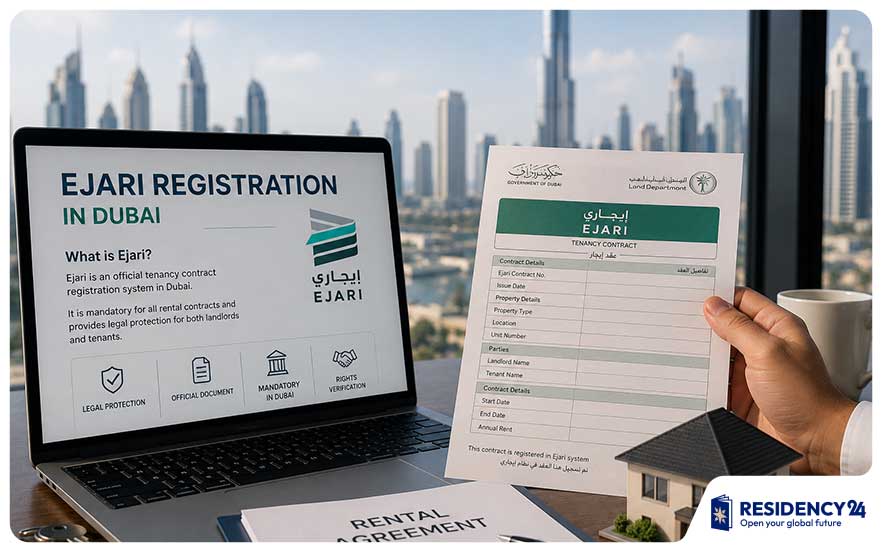
Ejari registration is the registration or renewal of a tenancy contract in Dubai through Dubai Land Department’s approved systems and channels. Dubai Land Department describes the service as allowing customers to register or renew a tenancy contract in the Emirate of Dubai.
The legal basis matters because Dubai rental law requires lease contracts covered by the law to be registered with RERA. Law No. 26 of 2007 states that all lease contracts related to real property governed by the law must be registered with RERA, and that judicial authorities and government departments may not consider a dispute or take action relating to a lease contract unless it is registered according to the relevant rules.
Ejari Registration in Dubai: Quick Summary
Point | What It Means |
|---|---|
Issuing authority | Dubai Land Department / RERA system |
Main purpose | Official registration of Dubai tenancy contracts |
Applies to | Residential and commercial leases in Dubai |
Main channels | Dubai REST app, DLD website / Ejari system, Real Estate Services Trustee Centers |
Online fee | AED 177.75 total through Dubai REST app or DLD website |
Trustee centre fee | AED 220 total through Real Estate Services Trustee Centers |
Main document via app | Copy of the Unified Tenancy Contract |
Main documents via trustee centre | Original Unified Tenancy Contract, applicant Emirates ID, Power of Attorney if representative |
Service time at trustee centres | 25 minutes, excluding waiting time |
Tenant registration | Possible with landlord approval |
Landlord approval delay | If landlord does not approve within five days, the request is automatically cancelled |
DEWA link | Ejari issuance automatically sends data to DEWA for move-in processing |
Legal importance | Unregistered lease may be difficult to use in formal rental disputes or government procedures |
The practical rule is simple: a signed tenancy contract is not enough for normal Dubai rental life. It should be registered in Ejari.
Why Ejari Registration Is Important
Ejari sits underneath most tenancy decisions, including the one covered in Renting vs. Buying in the UAE. Ejari matters because it turns a private rental agreement into an officially registered tenancy record. Without Ejari, a tenant may struggle with DEWA activation, rental dispute filing, official rental proof, and certain government or property-related procedures.
DEWA states that when an Ejari certificate is issued, DEWA automatically receives the required customer and property information and proactively processes electricity and water activation. DEWA also states that all tenant customers are required to submit Ejari for DEWA move-in service, and that Ejari replaces the traditional tenancy contract for DEWA move-in.
Ejari is also important for disputes. Dubai Law No. 26 of 2007 states that government departments and judicial authorities may not consider a dispute or claim related to a lease contract unless the contract is registered with RERA according to relevant rules.
Who Can Register Ejari?
Ejari can be registered by the landlord, tenant, owner’s representative, property management company, or authorized party depending on the property and channel. Dubai Land Department’s FAQ states that owners, real estate companies, owners’ representatives, or holding companies can access the Ejari system, and that through trustee centres an owner, tenant, or officially authorized representative may register Ejari.
DLD’s campaign guide also explains that landlords can register Ejari through the Ejari system for business users, Real Estate Trustee Centers, or Dubai REST app. Tenants can register Ejari with landlord approval through Real Estate Trustee Centers or Dubai REST app.
This means tenants can often complete the process, but landlord approval and correct property-owner data remain important.
Ejari Registration Channels
Dubai Land Department lists several channels for registering or renewing a tenancy contract. The main channels are the Dubai REST app, the Land Department website through the Ejari system, and Real Estate Services Trustee Centers.
Main channels include:
Dubai REST app
Dubai Land Department website / Ejari system
Real Estate Services Trustee Centers
Authorized real estate management companies where applicable
Ejari system for licensed business users and property management companies
The best channel depends on the case. A simple individual landlord-and-tenant contract may work through Dubai REST. A managed property, corporate tenant, representative, or power-of-attorney case may require a trustee centre or system-user route.
Ejari Registration Cost in Dubai
The official Ejari registration fee depends on the channel. Dubai Land Department lists the total fee through Dubai REST app or the Department’s website as AED 177.75, including AED 100 registration fee, AED 10 knowledge fee, AED 10 innovation fee, AED 55 service partner fee, and AED 2.75 VAT on the service partner fee.
For Real Estate Services Trustee Centers, DLD lists the total as AED 220, including AED 100 registration fee, AED 10 knowledge fee, AED 10 innovation fee, AED 95 service partner fee, and VAT on the service partner fee.
Channel | Official Cost |
|---|---|
Dubai REST app / DLD website | AED 177.75 |
Real Estate Services Trustee Center | AED 220 |
These are Ejari registration costs. They do not include rent, security deposit, agency commission, DEWA security deposit, district cooling deposits, building move-in fees, or property-management admin charges.
Who Pays for Ejari Registration?
Who pays for Ejari depends on the tenancy contract and the arrangement between landlord and tenant. Dubai rental law states that unless the lease contract says otherwise, the tenant must pay all fees and taxes due to government entities and departments for use of the property, as well as fees or taxes for any sub-lease.
In practice, many Dubai tenants pay the Ejari fee, especially for residential leases. However, the contract wording matters. If the lease says the landlord pays, or if the property management arrangement includes Ejari handling, the payment responsibility may be different.
The safest approach is to confirm the Ejari fee and any admin fee before signing the tenancy contract. Government Ejari fees are clear; extra agent or property-management charges should be checked against the contract.
Documents Required for Ejari Registration
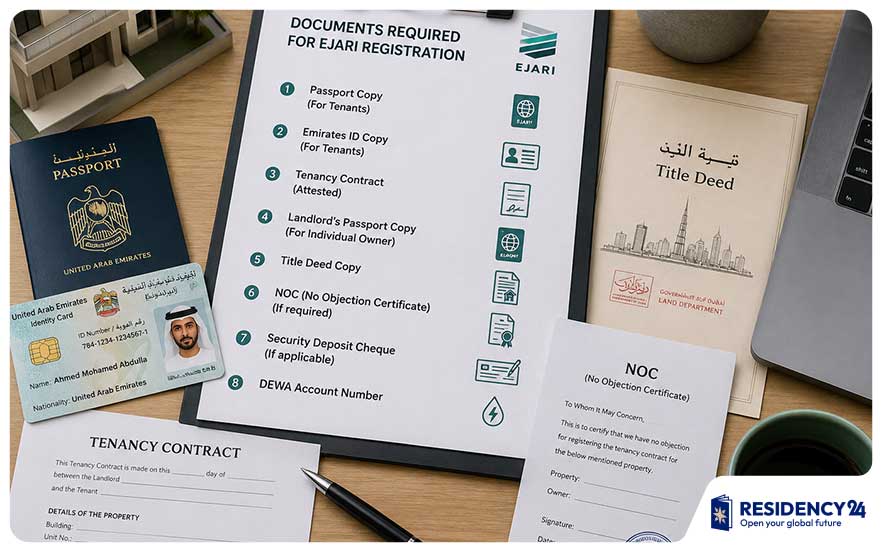
Dubai Land Department lists different required documents depending on the channel. Through the app, the required document is a copy of the Unified Tenancy Contract for individuals and companies. Through Real Estate Services Trustee Centers, the applicant must present the original Unified Tenancy Contract, Emirates ID, and official Power of Attorney if the applicant is a representative.
Typical documents include:
Unified Tenancy Contract
Applicant Emirates ID
Passport and residence visa details where required
Landlord or owner details
Tenant details
Property details
DEWA premise number
Power of Attorney if a representative applies
Company trade license if tenant is a company
Authorized signatory documents for company tenants where required
The UAE government portal also notes that to conclude a lease contract, tenants usually provide identification documents such as passport copy, valid residence visa, Emirates ID, and post-dated cheques covering the agreed lease period.
Ejari Registration Through Dubai REST App
Dubai REST is one of the main digital channels for Ejari registration. DLD’s Ejari campaign guide states that landlords can register through Dubai REST by logging in as an individual user, going to the Property Wallet, selecting the owned property, accessing property services, selecting Ejari services, entering contract details, submitting the request, and paying fees.
A typical Dubai REST process:
Log in to Dubai REST.
Go to the property wallet.
Select the property.
Choose Ejari services.
Select register new contract or renewal.
Enter tenant type.
Add contract details.
Upload the required contract copy.
Submit the request.
Wait for landlord approval if tenant initiated.
Pay the fee.
Download the Ejari certificate.
DLD states that if the landlord does not approve a tenant-submitted request within five days, the request is automatically cancelled.
Ejari Registration Through Trustee Centers
Real Estate Services Trustee Centers are useful when the case cannot be completed easily through the app. This may happen when a representative is involved, documents need verification, the tenant needs in-person support, or the property is not suitable for app-based registration.
DLD lists the trustee-centre required documents as original Unified Tenancy Contract, Emirates ID of the applicant, and Power of Attorney if the applicant is a representative. The listed service time through real estate service trustees is 25 minutes, excluding waiting time.
Trustee centres are often practical for:
Tenants who cannot complete approval through the app
Corporate tenants
Representative or POA cases
Documents that need checking
Older or complicated property records
Cases involving owner data updates
People who want staff support rather than self-service
The trustee centre route costs more than the app route, but it can be easier for non-standard cases.
Ejari Registration Terms and Conditions
Dubai Land Department sets conditions for each registration route. For registration through trustee offices, the property must not be managed by a real estate company or by an owner who has Ejari system access. The applicant must be the tenant or legal representative, and the landlord must be the owner or legal representative.
For mobile application registration, DLD states that the tenant and landlord must be individuals and the owner’s data must be up to date. For system registration, companies must be licensed for one of the property management activities, individual owners must own and manage their own properties, and representatives must have legal power of attorney.
This is why some tenants cannot register through the app even when they have a signed contract. The channel depends on the property ownership, manager access, landlord data, and applicant type.
Ejari Renewal in Dubai
Tenancy, visa and licence renewals tend to fall due together: Residency24 works across residency, property purchase, company formation and investment planning, and the wider conditions for UAE residency sit on one page. Ejari renewal is required when the tenancy contract is renewed. DLD’s service covers both registration and renewal of tenancy contracts.
For renewal, tenants should check:
New rent amount
Contract start and end date
Payment schedule
Cheque details
Landlord details
Tenant details
Property details
Special conditions
Rent increase notice
Ejari cancellation or old contract status
DEWA and housing fee implications
Dubai Law No. 33 of 2008 states that for renewal, landlord and tenant may amend lease terms or reconsider rent before expiry; if they do not agree, the tribunal may determine fair rent according to the relevant criteria. It also states that unless agreed otherwise, a party wishing to amend lease terms must notify the other party at least 90 days before expiry.
Rent Increase and Ejari
Which area you signed in shapes how much room a landlord has - see Best Neighborhoods in Dubai for Families and, for short-let stock, Best Area for Short-Term Rental in Dubai. Ejari is closely connected to rent renewal records. DLD’s campaign guide states that tenants and landlords can check rent increase eligibility using the Rent Index Calculator on the official Dubai Land Department website, based on the difference between current rent and average rent for similar properties in the area.
This matters because Dubai rent increases should not be treated as arbitrary. For renewal disputes, the registered tenancy contract, current rent, area, unit type, and rental index data can all become relevant.
Before accepting a rent increase, tenants should check:
Was notice given within the required period?
Is the increase supported by the DLD Rent Index Calculator?
Does the contract contain different notice terms?
Is the unit type entered correctly?
Is the area entered correctly?
Is the current rent correctly reflected in Ejari?
Is the renewal date accurate?
Ejari is not only a registration certificate; it also creates a rental history.
Ejari and DEWA Activation
Utility and housing costs feed straight into the monthly figures in Cost of Living in Dubai in 2026. Ejari is one of the most practical documents for moving into a Dubai rental property. DEWA states that after Ejari issuance, it automatically receives customer and property information and sends the customer a welcome notification with the new account number, security deposit details, and payment link.
DEWA also states that electricity and water supply are connected within 15 working hours after payment of the security deposit and connection fees. It lists refundable security deposits of AED 2,000 for apartments and AED 4,000 for villas, plus AED 155 supply activation fee.
This means the normal order is:
Sign tenancy contract.
Register Ejari.
Receive DEWA account details.
Pay DEWA deposit and activation fee.
Wait for electricity and water activation.
If Ejari is delayed, DEWA move-in can also be delayed.
Ejari and Rental Disputes
Ejari protects both tenant and landlord by creating a formal record of the lease. Dubai Law No. 26 of 2007 says judicial authorities and government departments may not consider a dispute or claim related to a lease contract unless the contract is registered with RERA according to relevant rules.
For tenants, this matters if there is a dispute over:
Rent increase
Non-renewal
Eviction notice
Maintenance
Security deposit
Contract terms
Unpaid rent
Subletting
Early termination
Property access
Handover condition
For landlords, Ejari creates a formal contract record that can support rent claims, eviction proceedings, and official communication when the tenant breaches the contract.
Ejari for Company Tenants
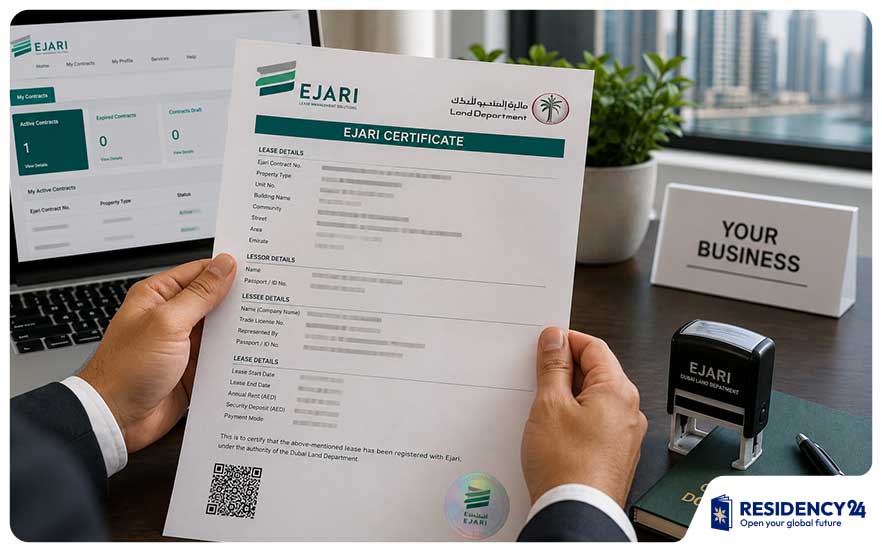
A company tenancy is usually tied to a licence address, which is part of company registration in Dubai. Commercial tenants also need Ejari registration. For companies, the process can be more document-heavy because the tenant is a legal entity rather than an individual. DLD’s service page says the Unified Tenancy Contract can be used for individuals and companies through the app, while system access for companies is tied to property management licensing and relevant regulations.
A company tenant may need:
Trade license
Unified Tenancy Contract
Authorized signatory passport and Emirates ID
Company stamp, where required
Power of Attorney or board authorization
Manager or shareholder documents
Premises details
DEWA premise number
Ejari certificate for trade license renewal or business address proof
For Dubai mainland companies, a valid Ejari is often tied to trade license renewal, immigration file, bank KYC, and business-address verification.
Ejari and Dubai Trade License
Ejari can be important for business licensing because Dubai businesses often need a registered lease for their licensed premises. A Dubai trade license, commercial office, warehouse, shop, clinic, restaurant, or service outlet usually needs a valid premises record that matches the licensed address.
Commercial Ejari helps with:
Trade license issuance
Trade license renewal
Establishment card
Labour and immigration file
Corporate bank account KYC
VAT and corporate tax address records
Municipality or external approvals
Warehouse or shop verification
If the business is linked to company setup, property lease, or Dubai residence planning, Residency24 can help investors check how Ejari fits into the wider company, visa, and property file.
Ejari Cancellation
Ejari should be cancelled when the tenancy ends or when a new tenant needs to register a contract for the same unit. An active old Ejari can block a new registration, especially if the previous tenancy was not closed properly.
DLD’s cancellation service allows cancellation through service centres, the online system, or Dubai REST app. DLD lists cancellation via app or system as free of charge, while cancellation through trustee centres has a service partner fee of AED 40 plus VAT.
For cancellation through trustee offices, DLD lists documents such as the original tenancy contract to be cancelled, applicant Emirates ID, Power of Attorney if the applicant is a representative, and a letter from the property owner requesting cancellation if the contract is still active.
DLD’s campaign guide also states that if the lease has expired, landlord approval is not required for tenant cancellation, while an active lease may require landlord approval or NOC.
Can Ejari Be Registered Without Emirates ID?
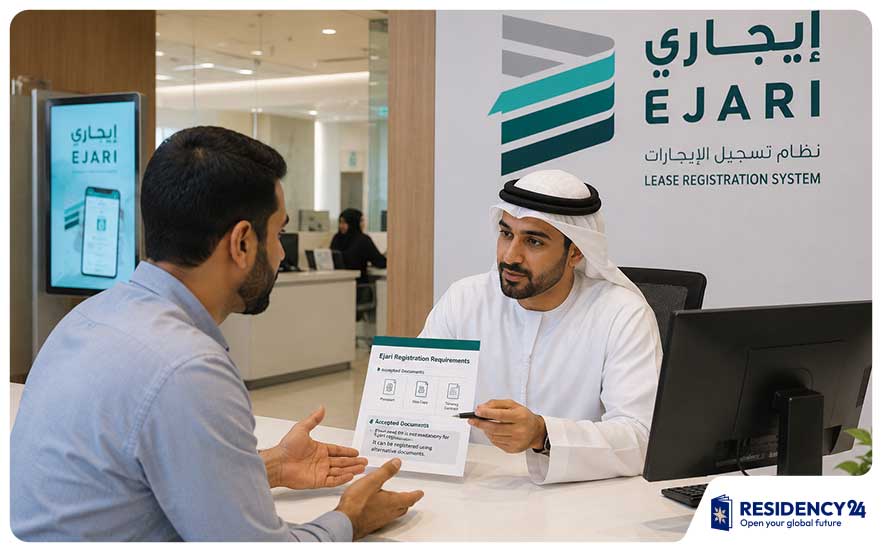
For trustee centre registration, DLD states that the Emirates ID of the applicant must be presented. In practice, Dubai residents usually need Emirates ID for smooth Ejari processing.
New arrivals may sometimes sign a lease while their Emirates ID is still under process, but the registration channel and acceptance depend on the applicant’s status, landlord, property manager, and current system requirements. Tenants should clarify this before paying rent cheques or deposits.
If the tenant is new to Dubai, the safest sequence is:
Confirm residence or visa status.
Check whether Emirates ID is available or under process.
Confirm with landlord or property manager how Ejari will be registered.
Avoid signing if registration is impossible for the property or tenant profile.
Get all special arrangements written in the contract.
Minimum Ejari Term
DLD’s Ejari campaign guide states that the minimum lease term is one year.
This matters because some short-term stays, hotel apartments, holiday homes, and informal subleases may not be handled the same way as a standard annual tenancy contract. Tenants should not assume every accommodation arrangement can be registered as Ejari.
If the stay is short-term, check whether it is:
A standard annual tenancy
A holiday home arrangement
A serviced apartment
A hotel apartment
A sublease
Company accommodation
Shared accommodation
A free zone property exempt from standard Ejari handling
The legal protections and registration routes may differ.
Ejari for Shared Accommodation and Co-Occupants
Dubai residents can add co-occupants through Dubai REST, but DLD’s campaign guide states that no certificates are issued for registering co-occupants and their names do not appear in the rental contract. Co-occupant information can be viewed through Dubai REST under “Manage Occupants” in the contract details.
For shared housing, tenants should check:
Is sharing allowed by the tenancy contract?
Is landlord permission required?
Are co-occupants registered where needed?
Is subletting allowed?
Does the building have occupancy rules?
Are utilities and rent responsibilities clear?
Is the arrangement legal for the property type?
Article 24 of Dubai Law No. 26 of 2007 states that unless the parties agree otherwise, the tenant may not assign use of or sublease the property to third parties unless written consent of the landlord is obtained.
Ejari for Subleasing
Subleasing requires caution. A tenant cannot usually sublease the property or part of it without the landlord’s written consent. Dubai rental law states that, unless otherwise agreed, the tenant may not assign use of or sublease the property to third parties unless the landlord gives written consent.
Before entering a sublease, check:
Does the original tenancy contract allow subleasing?
Is landlord written consent available?
Is the sublease term within the main lease term?
Can the sublease be registered?
Who pays government fees?
What happens if the main lease ends?
Who is responsible for DEWA, cooling, and building access?
A cheap informal sublease can create problems if it cannot be registered or if the landlord later objects.
Ejari Certificate Download
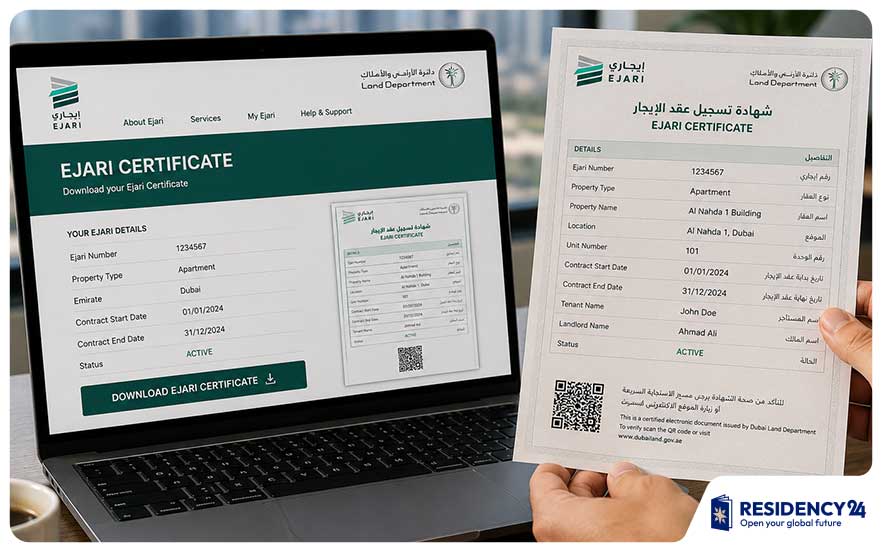
After registration, tenants and landlords may need to download the Ejari certificate. DLD’s campaign guide states that the certificate can be downloaded through the DLD website if the user has the Ejari contract number, or through the Dubai REST app by accessing the property wallet, selecting the property, going to contract details, and downloading the certificate.
Keep the certificate because it may be needed for:
DEWA
Internet and telecom setup
Employer address proof
Bank KYC
Family visa applications
School registration
Rental dispute filing
Trade license renewal
Building move-in permits
Proof of residence
Save both the tenancy contract and the Ejari certificate in a secure digital folder.
Ejari and Rent Payment Records
Ejari records the tenancy contract, but tenants should still keep rent payment proof. Post-dated cheques, bank transfers, receipts, and payment acknowledgements can become important if a dispute arises.
Keep:
Signed tenancy contract
Ejari certificate
Payment receipts
Cheque copies
Bank transfer proof
Security deposit receipt
Handover report
DEWA account details
Move-in permit
Email communication with landlord or agent
Rent increase notices
Maintenance requests
Ejari is important, but it does not replace payment documentation.
Common Ejari Registration Problems
Ejari problems usually happen because property data, landlord approval, previous contract cancellation, Emirates ID, Power of Attorney, or management-company access is incomplete.
Common problems include:
Landlord does not approve tenant request.
Previous Ejari is still active.
Owner data is not updated.
Property is managed by a company with system access.
Tenant tries the wrong channel.
Emirates ID is unavailable.
Power of Attorney is missing.
Contract details do not match title or property records.
Rent amount is entered incorrectly.
Contract dates are wrong.
Company tenant documents are incomplete.
DEWA premise number is wrong.
Property is in a free zone or exempted category requiring a different DEWA process.
DLD’s service terms show why channel selection matters: app registration is limited to individual tenant and landlord cases with updated owner data, while trustee-centre registration has its own conditions and system access rules.
What to Check Before Signing a Tenancy Contract
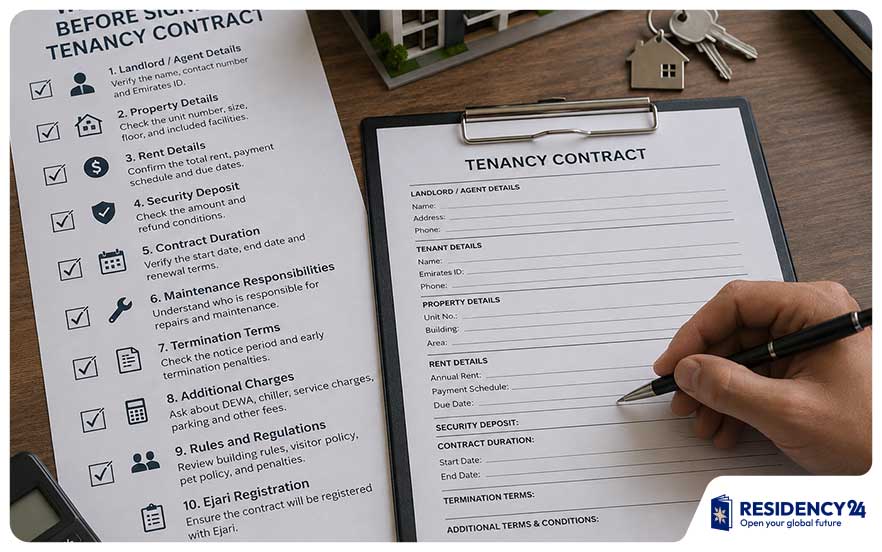
Ejari registration becomes easier when the contract is clean before signing.
Before signing, check:
Landlord is the actual owner or authorized representative.
Property details match the title and unit.
Tenant name matches passport and Emirates ID.
Rent amount is correct.
Payment schedule is clear.
Contract dates are correct.
Security deposit is written.
Maintenance responsibility is written.
Cooling, gas, internet, and chiller costs are clear.
Early termination clause is written.
Renewal notice terms are written.
Special conditions are attached.
Ejari fee responsibility is clear.
Agent commission and admin fees are written.
Previous Ejari will be cancelled if needed.
A tenancy contract that is unclear before signing becomes harder to fix after Ejari registration.
Step-by-Step Ejari Registration Process
A simple process for a residential tenant looks like this:
Agree rent, payment terms, and contract dates.
Confirm landlord ownership or authorized representative status.
Sign the Unified Tenancy Contract.
Prepare Emirates ID and required documents.
Choose Dubai REST app, DLD website, trustee centre, or property manager route.
Submit contract details and documents.
Wait for landlord approval if tenant initiated the request.
Pay Ejari registration fee.
Download Ejari certificate.
Receive DEWA move-in details.
Pay DEWA deposit and activation fee.
Keep the contract, Ejari, receipts, and DEWA confirmation.
DLD’s official service page lists registration channels and fees, while DEWA confirms that Ejari issuance triggers the move-in process through its integration with Dubai Land Department.
Ejari Registration Checklist
Before registering Ejari, prepare:
Unified Tenancy Contract
Tenant Emirates ID
Tenant passport and visa details where needed
Landlord or owner details
Property title or owner data confirmation
DEWA premise number
Rent amount
Contract start and end dates
Payment schedule
Security deposit details
Power of Attorney if representative applies
Company documents if tenant is a business
Confirmation that previous Ejari is cancelled
Correct mobile number and email
Payment card or payment method
After registration, download the Ejari certificate and check all details immediately.
Mistakes to Avoid
Avoid these Ejari mistakes:
Signing a contract before confirming the property can be registered.
Accepting a lease without checking landlord authorization.
Paying high admin fees without contract basis.
Not confirming who pays Ejari.
Entering the wrong rent amount.
Entering wrong contract dates.
Ignoring previous active Ejari.
Waiting until move-in day to register.
Assuming DEWA can be activated without Ejari.
Not keeping rent payment proof.
Subleasing without written consent.
Ignoring rent increase notice rules.
Not cancelling Ejari after moving out.
Not downloading the Ejari certificate.
Using unofficial agents or unverified payment links.
Ejari is simple when documents are correct. Most delays come from incomplete or inconsistent records.
Conclusion
Ejari registration in Dubai is the official registration of a tenancy contract through Dubai Land Department’s approved rental system. It is legally important because Dubai rental law requires lease contracts to be registered with RERA, and unregistered lease contracts may be difficult to use in formal disputes or government procedures. The official registration cost is AED 177.75 through Dubai REST or the DLD website and AED 220 through Real Estate Services Trustee Centers. The main required document through the app is the Unified Tenancy Contract, while trustee centres require the original Unified Tenancy Contract, Emirates ID, and Power of Attorney if the applicant is a representative. Ejari is also connected to DEWA move-in because DEWA automatically receives tenancy data after Ejari issuance and sends the customer the account and deposit payment details. For tenants, landlords, property managers, and business owners, a clean Ejari file protects the rental relationship and prevents delays with utilities, renewals, disputes, and official services.