 Anahita Attarian
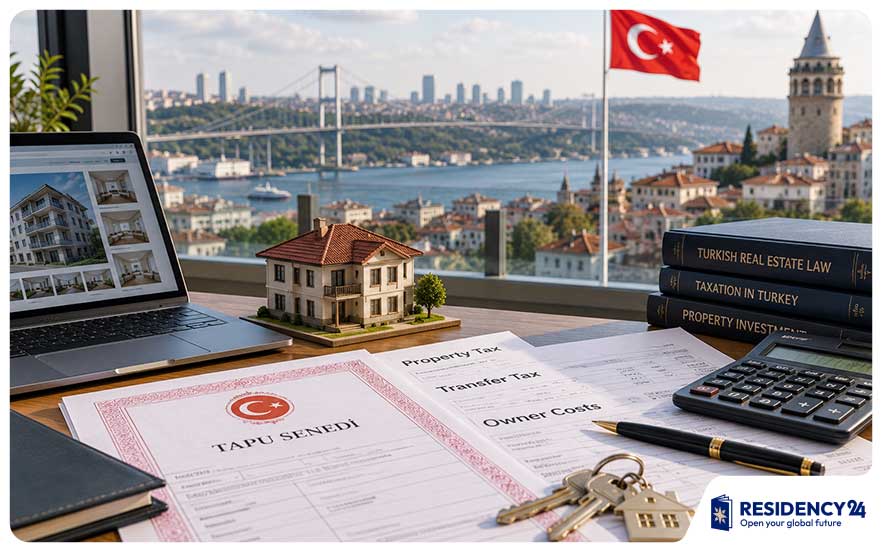
Tapu in Turkey means the official title deed that proves legal ownership of a property. A buyer does not become the legal owner only by signing a private contract, paying a deposit, or receiving keys; ownership is completed through registration at the Land Registry Directorate. For foreign buyers, the Tapu is the most important document in a Turkish property purchase because it confirms the property, the owner, the land share, and the registered legal status. Before buying, the buyer should check the Tapu record, seller identity, mortgages, liens, habitation certificate, property type, foreign ownership eligibility, taxes, and whether the property supports any residence or citizenship goal.
What Is Tapu in Turkey?
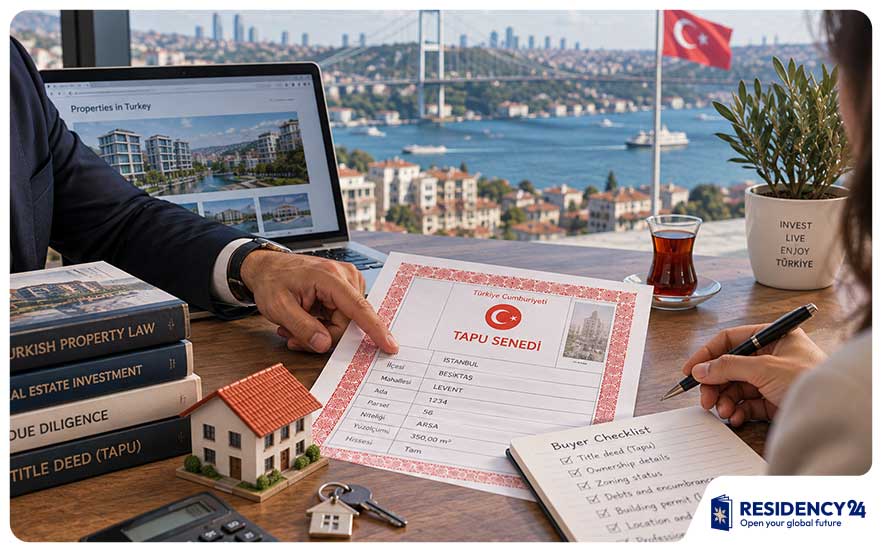
Tapu in Turkey is the official title deed document issued after a property is registered in the buyer’s name at the Land Registry Directorate. It is the core legal proof of property ownership, but buyers should also check the official land registry record behind the document, not only a photo or copy of the Tapu.
Turkey’s official investment guidance states that property ownership titles may only be approved after registration at land registry directorates. It also states that preliminary real estate contracts or written agreements do not transfer property ownership by themselves. Why Tapu Matters When Buying Property in Turkey
Most of the problems catalogued in Risks of Buying Property in Turkey are, at root, title problems. The Tapu matters because it is the document that connects the buyer to the registered property. Without proper Land Registry registration, a buyer may have only a contractual claim, not legal ownership.
This distinction is important for foreign buyers. A sales agreement, reservation form, payment receipt, or developer promise is not the same as registered ownership. GOV.UK’s Turkey property guidance also states that transfer of ownership is only possible at the Land Registry Directorates, known as Tapu Dairesi.
Tapu affects:
Legal ownership
Resale rights
Inheritance
Mortgage registration
Residence permit applications
Citizenship by investment applications
Utility registration
Tax registration
Rental management
Dispute resolution
A clean Tapu is not the only requirement for a safe purchase, but without it the transaction is not complete.
Tapu vs Sales Contract
A sales contract records an agreement between buyer and seller. Tapu registration records legal ownership. These are not the same.
A private contract may define price, deposit, payment schedule, delivery date, furniture, penalties, and obligations. It can be useful, but it does not transfer the title unless the Land Registry process is completed.
Document | What It Does | What It Does Not Do |
|---|---|---|
Reservation form | Holds the property for a short period | Does not transfer ownership |
Private sale contract | Records agreed terms | Does not by itself make the buyer owner |
Notarized promise to sell | Creates a formal commitment | Still not the final Tapu transfer |
Tapu registration | Transfers and proves ownership | Does not replace due diligence |
Power of attorney | Allows someone to act for the buyer | Does not prove ownership |
The key point is simple: the buyer becomes the registered owner only after the Tapu transfer is completed through the land registry system.
Main Information Shown on a Tapu
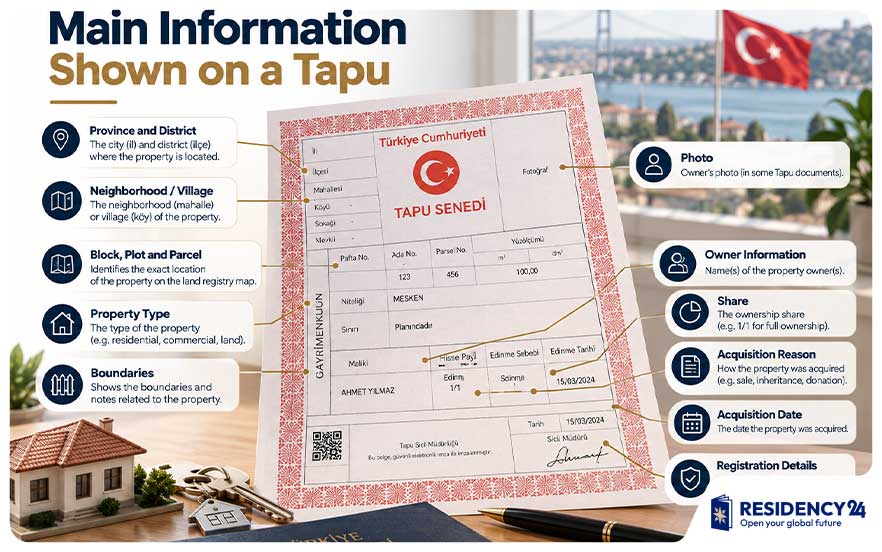
A Turkish Tapu contains property and ownership information. The exact format may vary, but buyers should understand the main fields before signing.
Common Tapu details include:
Province
District
Neighborhood or village
Street or location details
Block or parcel number
Plot number
Land area
Property type
Independent section number, if it is an apartment or unit
Floor or unit details
Land share
Owner name
Acquisition reason
Registration date
Registry volume and page details
Official seal and signatures
For apartments, the independent section number and land share are especially important. The buyer should confirm that the Tapu details match the physical unit being purchased.
Key Turkish Tapu Terms Buyers Should Know
Foreign buyers often see Turkish terms in title documents, contracts, or land registry extracts. Knowing these terms reduces the risk of misunderstanding the property status.
Term | Meaning | Why It Matters |
|---|---|---|
Tapu | Title deed | Main ownership document |
Tapu Dairesi | Land Registry Directorate | Official place of title transfer |
Tapu Senedi | Title deed certificate | Physical or digital title document |
Malik | Owner | Must match the real seller |
Ada | Block | Identifies the land block |
Parsel | Parcel | Identifies the specific land parcel |
Bağımsız Bölüm | Independent section | Unit number in apartment or complex property |
Arsa Payı | Land share | Buyer’s proportional share in the land |
Niteliği | Property qualification | Shows whether it is land, residence, shop, etc. |
Kat İrtifakı | Construction servitude | Common in projects before full condominium ownership |
Kat Mülkiyeti | Condominium ownership | Stronger title status for completed independent units |
İpotek | Mortgage | A debt or security registered on the property |
Şerh | Annotation | Restriction or note affecting the title |
İskan | Habitation certificate | Shows the building is approved for use |
A buyer should not rely on translation apps for these terms during a purchase. A sworn translator or independent lawyer should review the actual file.
Main Types of Tapu in Turkey
Turkey property buyers usually need to understand the difference between land title, construction servitude, and condominium ownership. This is especially important when buying apartments, new-build projects, villas, and off-plan property.
Arsa Tapusu
Arsa Tapusu usually refers to land title. It may show that the buyer owns land or a share of land, not necessarily a completed and legally approved residential unit.
This can be normal for land purchases, but it can be risky if the buyer thinks they are buying a finished home. If a property is sold as an apartment or villa but the Tapu only reflects land, the buyer should check construction permits, zoning, habitation certificate, and title conversion status.
Kat İrtifakı Tapusu
Kat İrtifakı means construction servitude. It is common before a building is fully completed or before the final condominium ownership is established. It can show rights connected to a planned independent section, but it is not the same as full completed-unit ownership.
This title type should be checked carefully for off-plan or newly built property. The buyer should confirm the developer’s permits, approved project, completion timeline, habitation certificate process, and conversion to Kat Mülkiyeti.
Kat Mülkiyeti Tapusu
Kat Mülkiyeti means condominium ownership. It is generally the preferred title status for a completed apartment or independent unit because it shows that the unit is legally established in the condominium system.
For most foreign buyers purchasing a ready apartment, Kat Mülkiyeti is usually clearer than land share or construction servitude. It does not remove all risk, but it usually gives stronger confidence that the unit is legally recognized as an independent property.
Tapu and Habitation Certificate
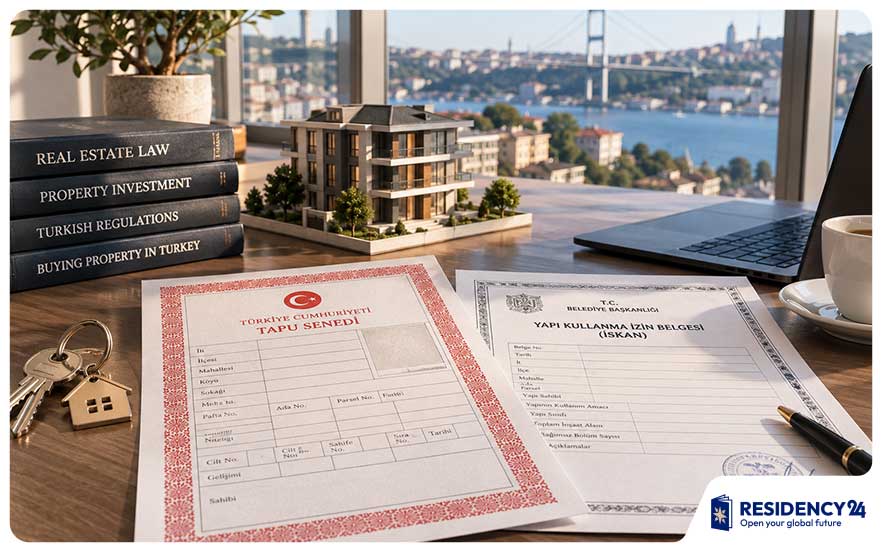
A habitation certificate, often called İskan, is important because it shows that the building has been approved for use by the local municipality. GOV.UK notes that Turkey has land deeds and proper title deeds, and that the proper title deed can be obtained once the habitation certificate is available. It also warns that buyers should consider the possible challenges before buying property without a habitation certificate.
This matters because a property may physically exist but still have incomplete legal or municipal status. A missing İskan can affect utilities, mortgage approval, resale, insurance, occupation, and future title conversion.
Before buying, ask:
Does the building have İskan?
Is the unit registered as an independent section?
Does the Tapu match the approved architectural project?
Are there illegal extensions or alterations?
Is the property officially residential?
Can utilities be transferred normally?
Can the property be mortgaged or resold easily?
A low price may not be attractive if the title or habitation status creates long-term problems.
Tapu Transfer Process in Turkey
The full purchase sequence around that appointment is set out on buy property in Turkey. The Tapu transfer process is the formal legal procedure that moves ownership from the seller to the buyer. It is usually handled through the Land Registry Directorate, with the buyer and seller present or represented through a valid power of attorney.
A typical Tapu transfer process includes:
Buyer and seller agree on the property and price.
The buyer checks the Tapu and legal status.
The buyer obtains a Turkish tax number.
Documents are prepared and translated where needed.
A valuation report is arranged if required.
Foreign exchange and payment documents are prepared where applicable.
The application is submitted to the Land Registry Directorate.
Transfer taxes and fees are paid.
Buyer and seller attend the Tapu appointment.
The official transfer is signed.
The buyer is registered as the new owner.
The updated Tapu is issued or made available.
Invest in Türkiye lists required land registry documents such as property registry information, passport or photo ID, municipal current market value document, mandatory earthquake insurance policy for buildings, buyer and seller photos, and a certified interpreter if a party does not speak Turkish.
Documents Needed for Tapu Transfer
Required documents can vary depending on the buyer, seller, property type, nationality, and whether a power of attorney is used. Still, most foreign buyers should expect a standard document set.
Common documents include:
Passport
Passport translation, if required
Turkish tax number
Biometric photos
Seller identification
Current Tapu information
Municipal value document
Valuation report, if required
DASK earthquake insurance for buildings
Certified interpreter, if the buyer does not speak Turkish
Power of attorney, if someone represents the buyer
Bank receipts and payment proof
Foreign exchange purchase certificate, where required
Residence or citizenship-related documents, if relevant
The buyer should not wait until the appointment day to review these documents. Any mismatch in names, passport numbers, property details, or power of attorney wording can delay or block transfer.
Tapu Fees and Transfer Tax
The main official cost connected to Tapu transfer is property transfer tax. GOV.UK states that Turkish property transfer taxes are 2% payable by the buyer and 2% payable by the seller, making 4% in total, based on the property evaluation report. It also states that the declared value cannot be lower than the municipal tax value.
In practice, buyer and seller may negotiate who pays what. In some foreign-buyer transactions, the buyer may be asked to pay the full 4%. This should be written into the sale agreement before the buyer pays a deposit.
Other Tapu-related costs may include:
Valuation report
Sworn translation
Notary fees
Power of attorney
DASK insurance
Administrative fees
Legal review
Bank transfer and currency conversion costs
The buyer should calculate the full closing cost, not only the sale price.
Tapu and DASK Earthquake Insurance
DASK is Turkey’s compulsory earthquake insurance for qualifying buildings. It is commonly required during title deed and utility procedures. Invest in Türkiye lists mandatory earthquake insurance among documents required for land registry procedures involving buildings.
DASK explains that compulsory earthquake insurance covers material losses directly caused by earthquakes and earthquake-related fire, explosion, tsunami, or landslide within policy limits. It also lists covered building sections such as foundations, main walls, floors, stairs, elevators, corridors, roofing, and similar structural parts.
DASK is not full home insurance. It does not cover every financial loss, furniture, rental loss, alternative accommodation, or all types of building defect. Buyers who want broader protection should also consider private home insurance.
Tapu Checks Before Buying
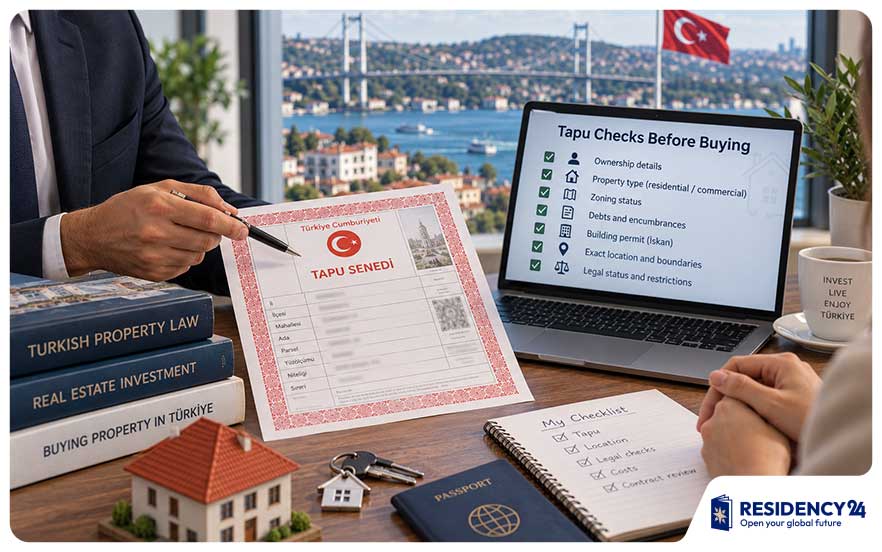
The most important part of a Turkish property purchase is not receiving a Tapu copy; it is checking whether the title is clean and consistent with the real property.
Before buying, check:
The seller is the registered owner.
The Tapu matches the physical unit.
There is no mortgage.
There is no lien, seizure, or court restriction.
There is no unresolved inheritance dispute.
Co-owners have approved the sale.
The property is not in a prohibited military or security zone.
The property type is suitable for the buyer’s purpose.
The building has proper permits and habitation status.
The land share and independent section details are correct.
The municipal value document is consistent.
The property can support residence or citizenship goals, if relevant.
Invest in Türkiye specifically warns that mortgages, liens, and similar restrictions that may prevent sale should be checked before starting procedures at the land registry directorate. (invest.gov.tr)
Tapu for Foreign Buyers
Foreigners can buy property in Turkey, but there are limits and location restrictions. Invest in Türkiye states that foreign natural persons may acquire real estate in areas where private property is allowed, but foreign natural persons may not acquire or lease real estate within prohibited military zones or military security zones. It also states that foreign natural persons may acquire up to 30 hectares, and foreign acquisition may not exceed 10% of the district area where private property is allowed.
This means the buyer should not assume every property is available for foreign ownership. The Land Registry check is essential before payment.
Foreign buyers should check:
Nationality eligibility
Location restrictions
Military or security zone restrictions
District foreign ownership limits
Property type
Land size
Zoning status
Whether the seller is allowed to transfer the property
Whether the property supports the buyer’s immigration goal
Foreign ownership is possible in Turkey, but it is not unlimited.
Tapu and Residence Permit
A deed alone does not grant status - see Does Buying Property in Turkey Give You Residency?. Buying property in Turkey can support some residence applications, but Tapu ownership does not automatically give a residence permit. GOV.UK states that having a residence permit is not necessary to buy property, and that buying property does not grant permission to obtain a residence or work permit. (gov.uk)
This distinction is important. A buyer may own a property but still need to meet separate immigration requirements, including property value, address suitability, health insurance, financial proof, and application documents.
For residence planning, check:
Is the property residential?
Is the buyer registered on the Tapu?
Is the property value sufficient for the current residence route?
Is the address open for foreign residence registration?
Will the buyer actually live in the property?
Are family members included properly?
Does the buyer have valid health insurance?
Are all documents consistent?
A Tapu helps prove ownership, but it does not replace the residence permit process.
Tapu and Turkish Citizenship by Investment
The valuation, three-year annotation and family rules are on the Turkish citizenship by investment page. Tapu is also central to Turkish citizenship by property investment. For citizenship purposes, the Tapu must support the official investment claim, and the property must meet the required value and no-sale condition.
Invest in Türkiye states that foreign natural persons may acquire Turkish citizenship by purchasing real estate worth at least USD 400,000, and that the title deed should include the purpose and a declaration that the property will not be sold for three years. It also lists real estate worth at least USD 400,000 with a title deed restriction on resale for at least three years among the investment routes for citizenship.
Citizenship-focused buyers should confirm:
The official valuation supports the threshold.
Payment records match the rules.
The Tapu is registered correctly.
The no-sale annotation is added.
The seller and property are eligible.
The ownership structure is correct.
Family members are handled correctly.
The buyer has legal support before payment.
A property purchase and a citizenship application are connected but not identical. A clean Tapu is necessary, but it is not the only requirement.
Tapu and Mortgages
If there is a mortgage on the property, it should appear as an encumbrance on the registry record. A seller may promise to remove the mortgage after payment, but the buyer should not rely on verbal promises.
Before transfer, check:
Is there an existing mortgage?
Which bank or creditor holds it?
What is the payoff amount?
Who pays it?
When will it be removed?
Will the release be completed before or during transfer?
Is the buyer’s payment protected until the mortgage is removed?
Are there other liens or restrictions?
If the buyer uses a mortgage, the bank’s mortgage will also be registered against the property. This should be reflected correctly in the Tapu record.
Tapu and Inheritance
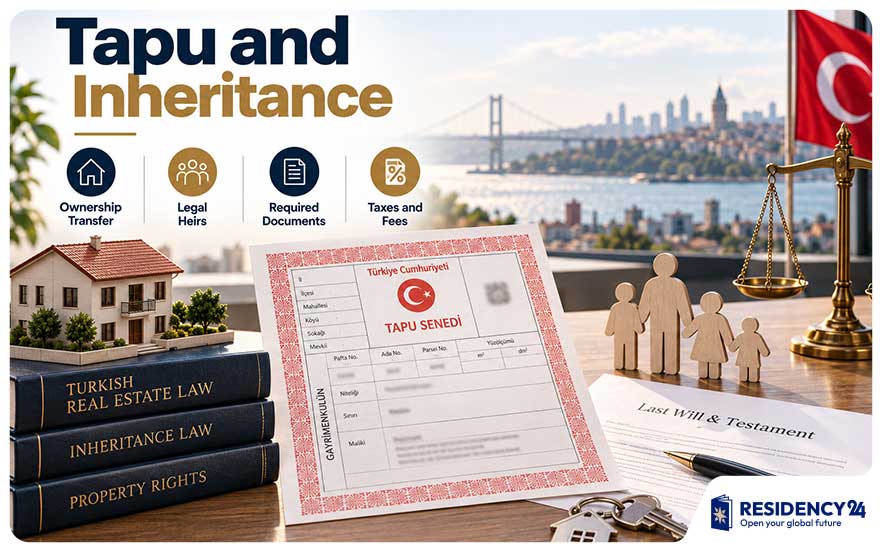
Tapu also matters for inheritance. If the property owner dies, heirs must deal with Turkish inheritance procedures and registry updates before the property can be transferred or sold.
Invest in Türkiye states that foreigners’ right of inheritance is protected in Turkey, but heirs must also be eligible to acquire the real estate. If they are not eligible, the property may need to be transferred or sold according to the applicable rules.
Foreign buyers should consider:
Whether to buy alone or jointly
Whether a Turkish will is needed
How heirs will prove relationship
Whether heirs are eligible to own the property
Tax and transfer implications
Whether the home country’s inheritance rules also apply
What happens if the property has a mortgage
Inheritance planning should be considered before buying, especially for families and older buyers.
Tapu for Off-Plan Property
Off-plan purchases need more caution because the buyer may not receive full condominium title immediately. In some cases, the Tapu may show land share or construction servitude before the building is fully completed.
Before buying off-plan, check:
Does the developer own the land?
Is the project approved?
Is the building permit issued?
What title type will the buyer receive?
When will full condominium ownership be established?
Is there a clear handover date?
What happens if construction is delayed?
Are payments linked to progress?
Is the contract registered or secured?
Will the buyer receive a valid Tapu at completion?
Off-plan property can be legitimate, but the buyer should understand what the current Tapu status means and what must happen before final ownership is complete.
Tapu for Apartments vs Villas
Apartments and villas require different checks. In an apartment, the key issues are independent section number, land share, building permits, habitation certificate, service fees, and whether the Tapu matches the exact unit. In a villa, the buyer must also check the land parcel, boundaries, pool, garden, extensions, zoning, and whether the building is legally approved.
For apartments, check:
Independent section number
Floor and unit match
Land share
Kat Mülkiyeti or Kat İrtifakı status
İskan
Building management debts
Common area obligations
For villas, check:
Land parcel boundaries
Building permit
İskan
Pool or extension legality
Access road
Zoning
Land share or full parcel ownership
Utility connections
A villa with illegal extensions may look better physically but create legal and resale problems.
Common Tapu Problems
Tapu problems can create financial loss, transfer delays, resale difficulty, and immigration issues. Many problems are avoidable if checked before payment.
Common problems include:
Seller is not the registered owner.
Property has a mortgage or lien.
Tapu does not match the unit being sold.
Building has no habitation certificate.
Property is still land title only.
Illegal extensions are not reflected in records.
Property is in a restricted area.
Co-owners have not approved the sale.
Developer has not completed title conversion.
Declared value is inconsistent with the real price.
Citizenship annotation is missing.
Power of attorney is too broad or invalid.
There are unpaid building or municipal debts.
A buyer should treat any unclear Tapu issue as a reason to pause, not as a small technical problem.
How to Verify a Tapu
The buyer should verify Tapu information through official or professional channels. A photo sent by an agent is not enough.
Practical verification steps include:
Ask for the current Tapu details.
Match the seller’s identity with the registered owner.
Check the parcel and independent section.
Review the land registry record for encumbrances.
Confirm the property qualification.
Check zoning and municipal records.
Review İskan status.
Confirm taxes and unpaid debts.
Use an independent lawyer.
Recheck the registry close to the transfer date.
Invest in Türkiye notes that property inquiries can be made online through the parcel inquiry system using city, district, quarter or village, map section, and plot details, although owner personal information is not accessible.
Should You Use a Lawyer for Tapu Transfer?
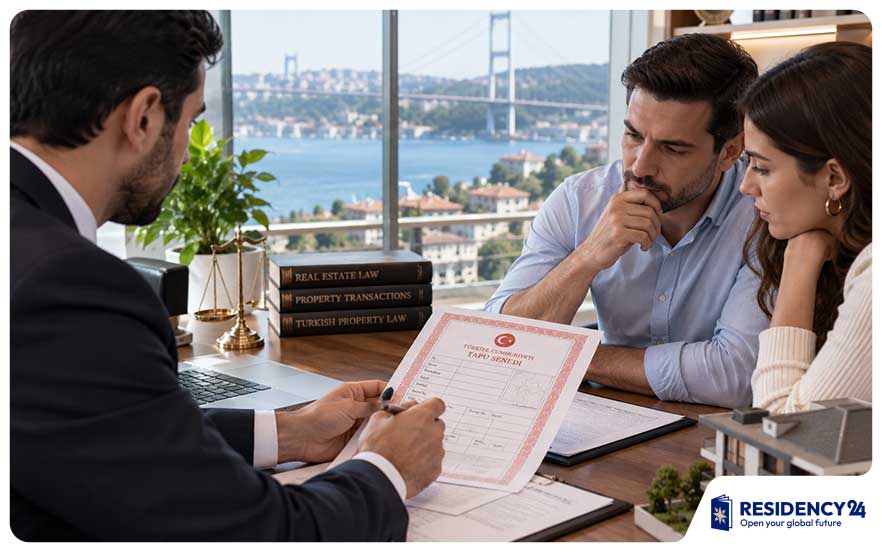
A lawyer is not always legally required for a simple property transfer, but foreign buyers should use an independent lawyer when buying property in Turkey. The reason is simple: the Tapu transfer is the final legal step, and mistakes before that step can be expensive.
GOV.UK strongly recommends obtaining an independent lawyer before committing to a property purchase, deposit, or full payment, and defines an independent lawyer as one with no connection to the seller or the seller’s agent.
A lawyer can review:
Title deed
Registry restrictions
Contract terms
Payment timing
Seller authority
Power of attorney
İskan and zoning issues
Tax and fee obligations
Citizenship or residence suitability
Off-plan project documents
The lawyer should be appointed by the buyer, not provided as the seller’s preferred solution without independent verification.
Tapu Appointment: What Happens?
At the Tapu appointment, the Land Registry Directorate finalizes the transfer. The buyer and seller attend in person, or authorized representatives attend through valid power of attorney. If a party does not speak Turkish, a certified interpreter may be required.
During the appointment:
Identities are checked.
Documents are reviewed.
Fees and taxes must be paid.
The official sale and transfer are confirmed.
Signatures are completed.
Ownership is registered.
The buyer becomes the legal owner.
The updated Tapu is issued or recorded.
The buyer should not release final payment without a secure transfer plan. Payment timing should be coordinated with the lawyer, bank, and registry process.
After Receiving the Tapu
Receiving the Tapu is not the end of the buyer’s practical responsibilities. After transfer, the new owner should update tax, utility, insurance, and management records.
Post-transfer steps usually include:
Keep a secure copy of the Tapu.
Register with the municipality for property tax.
Transfer electricity, water, and gas accounts.
Confirm DASK insurance.
Arrange private home insurance if needed.
Inform building management.
Check unpaid site fees.
Register address if applying for residence.
Keep all bank receipts and official documents.
Prepare rental tax records if renting out the property.
A buyer who plans to rent the property should also prepare a proper rental contract, tax plan, and property management arrangement.
Tapu Checklist for Foreign Buyers
Title checks, valuation and the deed appointment are worth handling with support: Residency24 works across property purchase, residency, company formation and investment planning. Before completing a purchase, use this Tapu checklist:
The Tapu owner matches the seller.
The property details match the physical unit.
The independent section number is correct.
There is no mortgage, lien, seizure, or restriction.
The property is not in a prohibited area.
Foreign ownership is allowed.
The building has the right permit and İskan status.
The title type fits the buyer’s purpose.
The municipal value document is available.
DASK is arranged for buildings.
Payment records are clean.
The sale contract matches the Tapu details.
A certified interpreter is arranged if needed.
A power of attorney is valid and limited, if used.
Citizenship or residence requirements are checked separately.
Final registry check is done before payment release.
This checklist does not replace legal advice, but it helps buyers identify the main risk points.
Conclusion
Tapu in Turkey is the official title deed that proves registered ownership of a property. It is the key document in a Turkish real estate purchase, but buyers should understand that a Tapu copy alone is not enough; the underlying land registry record, title type, encumbrances, habitation certificate, seller identity, and property details must be checked. Foreign buyers can own property in Turkey, but ownership is subject to nationality, location, land-size, military-zone, and district-limit rules. Tapu also matters for residence permits, citizenship by investment, inheritance, mortgages, utilities, and resale. A safe purchase depends on completing the Land Registry transfer correctly and verifying every legal and technical detail before payment.