 Anahita Attarian
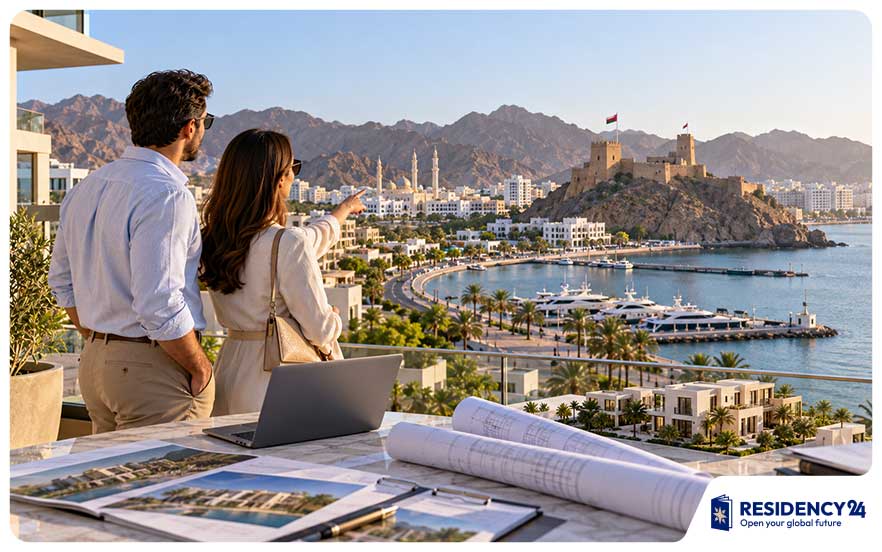
Buying property in Muscat can be a practical option for expats, foreign investors, Gulf buyers, retirees, and families who want a quieter Gulf base than Dubai or Doha. The main rule is that non-Omani buyers must be careful about where they buy, because foreign freehold ownership is mainly available inside licensed Integrated Tourism Complexes, often called ITCs. In Muscat, the most relevant areas for foreign buyers include Al Mouj Muscat, Muscat Hills, Muscat Bay, Jebel Sifah, Yiti/AIDA, and newer approved tourism-complex projects. The decision should be based on legal ownership, title registration, residence eligibility, total purchase costs, service charges, rental demand, resale liquidity, and whether the property fits personal use or investment.
Can Foreigners Buy Property in Muscat?
Yes, foreigners can buy property in Muscat, but mainly inside approved Integrated Tourism Complexes. These are licensed developments where non-Omanis can buy built units or land prepared for building or investment, subject to the rules of the relevant complex and Omani property law.
Oman’s rules for Integrated Tourism Complexes allow Omanis and non-Omanis, whether individuals or legal entities, to own built units or land prepared for building or use inside ITCs for residence or investment. The 2022 amendment also states that in Musandam, non-Omanis may buy built units only through usufruct for a period not exceeding 99 years.
Buying Property in Muscat: Quick Summary
Point | What Buyers Should Know |
|---|---|
Foreign ownership | Mainly allowed in licensed Integrated Tourism Complexes |
Key Muscat ITC areas | Al Mouj, Muscat Hills, Muscat Bay, Jebel Sifah, Yiti/AIDA, newer Al Qurum project |
Ownership type | ITC purchases can support registered ownership for non-Omanis |
Main purchase fee | Gov.om lists 3% of property value as the main contract-related charge for tourist-complex ownership |
Title deed fee | Gov.om lists a title deed fee of OMR 10 for the tourist-complex ownership service |
Property owner residence visa | Residential unit owners in ITCs may obtain a 2-year residence visa |
Owner visa fee | OMR 50 according to Gov.om |
Family joining visa | Available for spouse and first-degree family members if conditions are met |
Best for | Lifestyle buyers, long-term residents, investors, retirees, families, second-home buyers |
Main risk | Buying outside eligible zones, overpaying, weak resale demand, unclear title, high service fees |
Muscat is not a speculative market where every area works the same way. The strongest purchase is usually a legally clear property in a development with real services, tenant demand, and resale depth.
Where Can Foreigners Buy Property in Muscat?
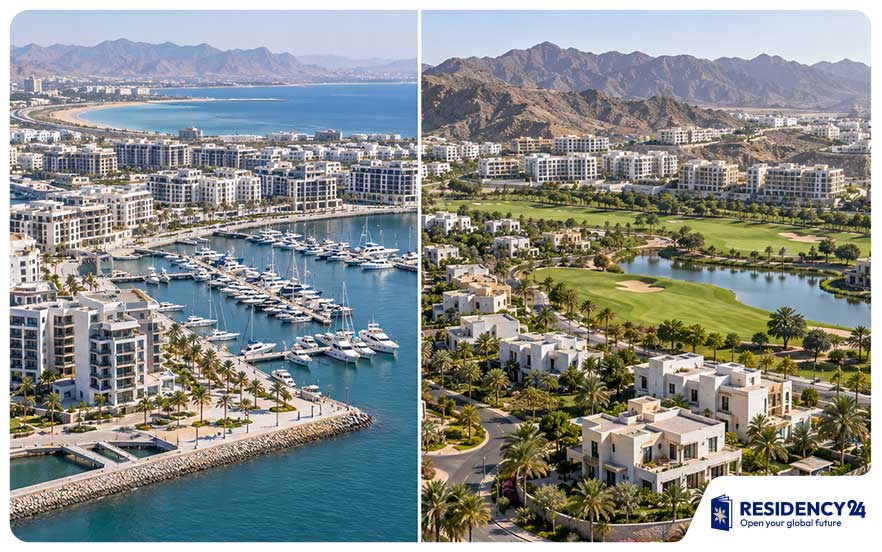
Foreign ownership in Oman is confined to designated zones, and the general conditions to buy property in Oman set the boundary before any shortlist makes sense. Foreign buyers should focus on licensed ITC areas and confirm the exact project status before paying a deposit. Muscat has several established or developing areas that matter for international buyers.
Area | Buyer Profile | Main Strength |
|---|---|---|
Al Mouj Muscat | Premium lifestyle buyers, families, investors | Mature waterfront community, marina, golf, hotels, strong resale profile |
Muscat Hills | Budget-aware foreign buyers, rental investors | Lower entry cost than Al Mouj, airport access, golf-area appeal |
Muscat Bay | Lifestyle buyers, second-home buyers | Coastal setting, mountain-sea environment, resort-style living |
Jebel Sifah | Holiday-home buyers, leisure investors | Resort-style coastal property outside central Muscat |
Yiti / AIDA | Off-plan and appreciation-led buyers | Newer tourism and branded-residence development story |
Al Qurum ITC project | Future premium buyers | Central Muscat location, freehold residential units planned |
The Ministry of Heritage and Tourism has described existing ITC projects including Muscat Bay, Al Mouj, Barr Al Jissah, and Jebel Sifah in Muscat, and also noted the role of ITCs in allowing non-Omani ownership and attracting investors to reside in Oman.
Best Areas to Buy Property in Muscat
The best area in Muscat depends on whether the buyer wants lifestyle, rent, residence, resale, or capital preservation. Al Mouj is usually the most mature foreign-buyer market. Muscat Hills is more accessible. Muscat Bay and Jebel Sifah are more lifestyle-led. Yiti and AIDA are more project-led and depend on delivery, phasing, and future demand.
Al Mouj Muscat
Al Mouj is one of the strongest options for buyers who want a completed community rather than only a future promise. It offers a marina, golf course, hotels, retail, restaurants, and a mature residential environment.
It is usually suitable for:
Families who want a polished community
Premium apartment buyers
Villa buyers
Long-term residents
Buyers who care about resale liquidity
Investors targeting executive tenants
The main limitation is price. Al Mouj is usually more expensive than Muscat Hills, Muscat Bay, or developing areas.
Muscat Hills
Muscat Hills is often more accessible for buyers who want foreign-ownership eligibility but do not want Al Mouj pricing. It can work for apartment buyers, rental investors, and people who want airport-side access.
It is usually suitable for:
First-time foreign buyers in Muscat
Apartment investors
Buyers comparing lower entry points
Tenants working near the airport or business districts
Budget-aware residence buyers
The main risk is project and unit selection. Not every building has the same demand, management quality, or resale appeal.
Muscat Bay
Muscat Bay is more lifestyle-led. It suits buyers who want a quieter, resort-style environment with sea and mountain surroundings. It may appeal more to second-home buyers than people who need daily access to central business districts.
It is usually suitable for:
Lifestyle buyers
Retirees
Second-home buyers
Families wanting a quieter coastal setting
Buyers who value scenery over central access
The main limitation is that liquidity and tenant demand may depend more on lifestyle demand than everyday urban demand.
Jebel Sifah
Jebel Sifah is a coastal resort destination outside central Muscat. It can work for buyers who want leisure use, holiday stays, and a more relaxed environment.
It is usually suitable for:
Weekend-home buyers
Holiday-rental investors
Resort-lifestyle buyers
Buyers who do not need daily city access
The main risk is distance from central Muscat. A property that works for weekends may not work as easily for year-round rental demand.
Yiti and AIDA
Yiti and AIDA are more forward-looking. They may suit buyers who are comfortable with off-plan risk, phased development, and a longer investment horizon.
They are usually suitable for:
Off-plan buyers
Branded-residence buyers
Investors seeking future appreciation
Buyers comfortable with construction and delivery timelines
The main risk is timing. A future-focused project should be checked for developer record, escrow protection, delivery phases, handover date, service charges, and resale options.
How Much Does Property Cost in Muscat?
Muscat property prices vary sharply by area, legal eligibility, project quality, property type, and whether the unit is ready or off-plan. A June 2026 market guide by Waleed Property reported that typical Muscat 2-bedroom apartments were roughly OMR 50,000 to OMR 72,000 depending on area and finish, while foreign-freehold options in areas such as Muscat Hills, Muscat Bay, Sultan Haitham City, and Telal Al Qurm started from about OMR 45,000 for some 1-bedroom units.
Indicative 2026 price ranges:
Property Type | Practical Muscat Range |
|---|---|
Entry studio or 1-bedroom apartment | OMR 40,000–70,000 |
2-bedroom apartment | OMR 50,000–110,000 |
3-bedroom apartment or townhouse | OMR 110,000–180,000+ |
Premium apartment in mature ITC | OMR 150,000–300,000+ |
Villa or large townhouse | OMR 250,000–700,000+ |
Prime waterfront villa | Can exceed OMR 1 million depending on location and size |
Another 2026 market guide put indicative Muscat Hills apartments at around OMR 400–700 per square meter, Muscat Bay around OMR 650–1,100 per square meter, and Al Mouj apartments around OMR 2,200–3,000 per square meter, with Al Mouj waterfront villas reaching higher price bands.
These figures should be treated as planning ranges, not final offers. Exact prices depend on floor, view, size, handover status, payment plan, furniture, developer, and resale negotiation.
Is Muscat Property a Good Investment?
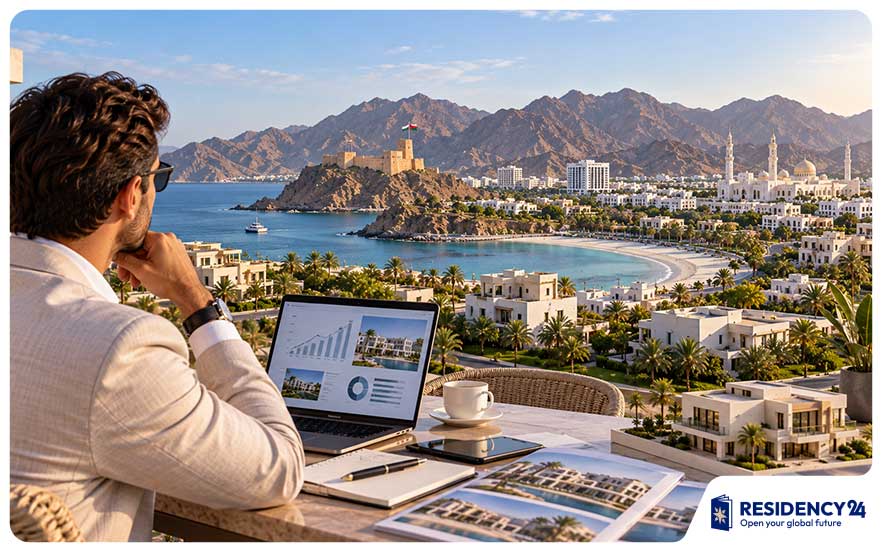
Muscat property can be a good investment when the property is inside an eligible ownership zone, priced realistically, well managed, and supported by tenant or end-user demand. It is weaker when the buyer overpays for an off-plan unit, ignores service charges, or assumes every ITC property will rent easily.
Oman’s property market showed positive momentum in 2026. Times of Oman, citing NCSI data, reported that Oman’s real estate price index rose 15.9% in Q1 2026 compared with Q1 2025, while residential property prices rose 17.6%; Muscat Governorate led residential land-price growth at 43.6%.
Transaction data also showed continued activity. Times of Oman reported that total property transaction value reached OMR 1.43 billion by the end of June 2026, up 5.4% year on year, and that real estate FDI reached OMR 602.5 million by the end of Q1 2026, up 1.2% year on year.
The investment case is strongest in properties that appeal to both end-users and tenants. A property should not be bought only because the development is foreigner-eligible.
Rental Yield in Muscat
A published benchmark helps sanity-check any projection - the Average Rental Yield in Dubai is the closest comparable in the region. Rental yield in Muscat depends on the area, property type, tenant profile, vacancy, service charge, and furnishing standard. Standard residential apartments can be more predictable than large villas, while holiday-style properties can be more seasonal.
Waleed Property’s June 2026 guide described realistic residential rental yield at around 5% to 7% gross, while warning that higher advertised figures often reflect commercial units, short-let assumptions, or developer projections rather than stable residential rent.
A practical rental view:
Property Type | Rental Profile |
|---|---|
1-bedroom apartment | Easier to rent to singles, couples, and professionals |
2-bedroom apartment | Balanced tenant demand, useful for small families |
3-bedroom apartment | Family demand, but higher rent sensitivity |
Villa | Strong for executives and families, but higher maintenance and vacancy risk |
Resort unit | Personal-use value, but rental performance may be seasonal |
Off-plan unit | No income until handover |
For rental investors, net yield matters more than gross yield. Deduct service charges, maintenance, vacancy, agent fees, furniture replacement, rent registration costs, and property management.
Buying Property in Muscat for Residence
Ownership and residence are separate applications; the thresholds for Oman investor residency are assessed on their own terms. Buying property in a qualifying ITC can support residence in Oman. Gov.om states that residential unit owners within Integrated Tourism Complexes can obtain a property owner residence visa valid for two years. The listed documents include the applicant’s passport copy, personal photo, property ownership copy, and a letter indicating the property location; the listed fee is OMR 50.
This is a major reason foreign buyers consider Muscat. Still, a property purchase should not be treated as an automatic residence card. The buyer must meet the service requirements, hold the correct ownership documents, and apply through the relevant authority.
For family members, Gov.om states that an expatriate residential-unit owner holding a property owner residence permit may obtain a residence visa without a sponsor for a foreign spouse and first-degree family members, subject to the listed conditions and documents. The listed visa fee is also OMR 50.
Before buying for residence, check:
Is the property inside an eligible ITC?
Is the unit registered in the buyer’s name?
Does the developer provide the required location letter?
Does the buyer qualify for the property owner visa?
Can spouse and first-degree family members be included?
Is the residence route 2-year property-owner residence or a different investor route?
What happens if the property is sold?
Are renewal conditions clear?
Residence should be checked before signing the sale agreement, not after handover.
Cost of Buying Property in Muscat
The main purchase cost is the property price plus registration, title, contract, legal, agency, financing, and service-charge costs. Gov.om’s tourist-complex ownership service lists a request submission fee of OMR 5, request form fee of OMR 25, title deed fee of OMR 10, contract fee of OMR 2, and a charge of 3% of the property value.
PwC’s 2026 Oman tax summary also states that there are no property taxes in Oman, while a property transfer fee of 3% of land and property value is payable to the Ministry of Housing. It also notes that municipal taxes apply to property rents at 3%.
A practical buying-cost budget:
Cost Item | Typical Planning Figure |
|---|---|
Property price | Agreed sale price |
Transfer / registration fee | 3% of property value |
Title deed and contract fees | Small fixed official fees |
Agency commission | Usually negotiated or built into developer pricing |
Legal review | Varies by lawyer and transaction complexity |
Valuation | Varies if financing or internal assessment is required |
Bank mortgage fees | Applies if financed |
Service charges | Annual or quarterly, project-specific |
Property owner residence visa | OMR 50 if applying through that route |
Family joining visa | OMR 50 per eligible applicant if applying |
A buyer should request a full completion statement before paying any deposit.
Is There Annual Property Tax in Oman?
Oman does not levy a standard annual property tax on ownership, according to PwC’s Oman tax summary. However, there is a 3% property transfer fee on transfer of land and property, and municipal tax applies to property rents at 3%.
This makes Oman attractive compared with markets where annual property tax is a major recurring cost. Still, owners must budget for other recurring costs:
Service charges
Building maintenance
Insurance
Utility bills
Property management
Rental registration fee or municipal rent tax
Repairs
Furniture replacement
Mortgage cost, if financed
No annual property tax does not mean no annual ownership cost.
VAT and Property in Oman
Oman applies VAT at a standard rate of 5%, with exemptions and zero-ratings under the VAT law. PwC notes that the standard VAT rate applies to goods and services supplied in Oman, subject to exemptions and zero-ratings, and that renting residential property is an exempt supply.
For property buyers, VAT treatment should be checked transaction by transaction, especially for new developer sales, serviced apartments, commercial property, mixed-use property, and property inside special zones. The buyer should not assume that every property sale has the same tax treatment.
Before signing, ask:
Is VAT included in the price?
Is the sale residential or commercial?
Is the property new or resale?
Is the seller VAT-registered?
Is the unit a residential home or hotel/serviced product?
Is the project in a special zone or ITC with specific treatment?
VAT is usually less visible than the property price, but it can affect the final budget.
Buying Process in Muscat
The buying process in Muscat is usually straightforward if the property is inside an approved development and documents are clean. The practical sequence should still be controlled carefully.
A typical process:
Define purpose: residence, investment, family use, retirement, or rental income.
Confirm the buyer’s nationality and ownership eligibility.
Choose an approved ITC or eligible development.
Shortlist ready or off-plan units.
Check developer approval and project status.
Review price, payment plan, service charges, and handover date.
Reserve the unit with a written reservation form.
Conduct legal and title checks.
Sign the sale and purchase agreement.
Pay the agreed deposit or purchase instalments.
Apply for transfer through the relevant platform or authority.
Pay transfer and title-related fees.
Register ownership and receive title deed.
Apply for property owner residence visa if needed.
Set up utilities, insurance, maintenance, and property management.
Gov.om’s tourist-complex ownership service lists the service steps as request submission, request processing, and approval, and notes that there must not be legal restrictions on the property.
Documents Needed to Buy Property in Muscat
The exact document list depends on the buyer, developer, bank, and project. A cash buyer purchasing from a developer may have a simpler file than a mortgage buyer or corporate buyer.
Common documents include:
Passport copy
Residence card, if already resident in Oman
Buyer contact details
Reservation form
Sale and purchase agreement
Proof of payment
Bank documents if financed
Power of attorney if represented
Corporate documents if buying through a company
Developer no-objection or location letter where required
Property ownership documents after transfer
Title deed
Service charge account setup documents
For residence applications, Gov.om lists passport copy, personal photo, property ownership copy, and a letter indicating property location for the property-owner visa.
Ready Property vs Off-Plan Property in Muscat
Ready property is usually safer for buyers who want immediate use, clearer rental expectations, and fewer delivery risks. Off-plan property can offer payment plans and lower entry points, but it carries developer, construction, handover, service-charge, and market-timing risk.
Factor | Ready Property | Off-Plan Property |
|---|---|---|
Use | Immediate or near-immediate | After completion |
Rental income | Can start sooner | No rent before handover |
Inspection | Physical inspection possible | Based on plans, mockups, and contracts |
Risk | Hidden defects, resale pricing | Delay, delivery, quality, future demand |
Financing | Easier to evaluate | Depends on developer and bank terms |
Best for | Conservative buyers | Buyers comfortable with project risk |
For foreign buyers, ready property in a mature ITC is usually easier to evaluate. Off-plan property should be checked more strictly.
Mortgage and Financing

Financing conditions for non-residents follow a similar logic across the Gulf; the documentation path is set out in How to Get a Mortgage in Dubai. Some banks in Oman may offer mortgage financing to eligible buyers, but approval depends on income, residence status, employer, nationality, property type, down payment, and bank policy. Foreign buyers should check financing before signing a binding contract.
Mortgage buyers should ask:
Can the bank finance this specific ITC property?
What loan-to-value ratio is available?
Is the buyer required to be an Oman resident?
What income documents are needed?
Are salary transfers required?
What are the arrangement fees?
Is life insurance required?
What happens if the buyer leaves Oman?
Can the property be rented while financed?
Are early settlement charges applied?
A property that is attractive in cash may not be affordable with financing. Always calculate total monthly cost including mortgage, service charge, utilities, insurance, and maintenance.
Service Charges and Maintenance
Service charges are critical in Muscat’s ITC communities. They pay for common-area maintenance, security, landscaping, roads, pools, gyms, beach access, building management, elevators, and shared facilities.
Before buying, ask for:
Current service-charge rate
Payment frequency
Past increases
What the charge covers
Reserve fund rules
Major maintenance plans
Developer or owners’ association role
Penalties for late payment
Rules for renting out the unit
Rules for renovation or furnishing
A lower purchase price can become less attractive if service charges are high. For villas, garden, pool, air conditioning, and exterior maintenance can also add significant cost.
Buying for Rental Income
Muscat rental demand is strongest when the property fits a real tenant profile. Executive tenants may prefer Al Mouj. Airport and business tenants may consider Muscat Hills. Lifestyle tenants may prefer Muscat Bay or coastal communities if pricing is sensible.
Times of Oman reported that Al Mouj remained Oman’s premium residential destination in Q2 2026, with average monthly apartment rents around OMR 664 and average four-bedroom villa rents around OMR 1,700.
For rental income, calculate:
Expected annual rent
Vacancy
Service charges
Maintenance
Property management
Agency fees
Municipal rent tax
Furnishing and replacement
Insurance
Mortgage cost
Net income after expenses
A realistic rental property should work under a long-term lease model. Short-term or holiday-rental projections should be treated as upside, not the base case.
Buying for Personal Use
Many foreign buyers in Muscat are not pure investors. They want a second home, retirement base, family residence, or lower-pressure Gulf lifestyle. In that case, the best property is not always the one with the highest yield.
Personal-use buyers should focus on:
Daily comfort
Access to schools
Access to hospitals
Airport distance
Community services
Walkability
Noise
Privacy
Beach or marina access
Long-term maintenance
Residence visa fit
Family-member eligibility
For personal use, a property that reduces daily friction can be the right choice even if the yield is modest.
Risks of Buying Property in Muscat
The biggest risks are not usually about whether Muscat is livable. The main risks are legal eligibility, overpricing, project delays, service charges, weak rental demand, poor resale liquidity, and misunderstanding residence rules.
Key risks include:
Buying outside an eligible foreign-ownership zone
Assuming every property gives residence
Confusing usufruct with freehold ownership
Overpaying for a foreigner-targeted project
Not checking service charges
Buying off-plan without delivery protection
Ignoring mortgage and exit rules
Underestimating maintenance costs
Relying on gross yield instead of net yield
Not checking title or legal restrictions
Assuming family residence is automatic
Buying for short-term rental without checking rules
The safest approach is to verify the development, title, purchase contract, costs, and residence route before paying a deposit.
Due Diligence Checklist
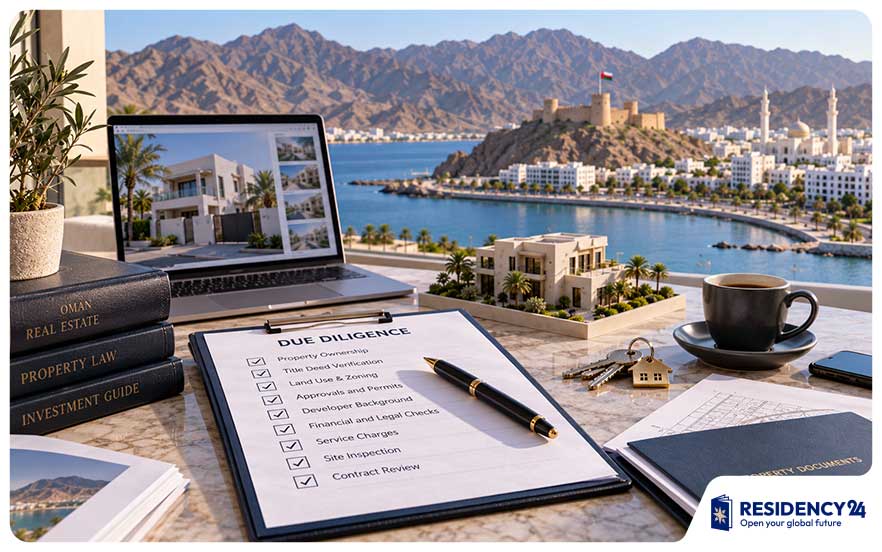
Checking the property and the residence file together is the safer order: Residency24 works across property purchase, residency, company formation and investment planning. Before buying property in Muscat, complete this checklist:
Confirm the project is a licensed ITC or otherwise eligible for the buyer.
Check the exact ownership type.
Confirm whether the property is freehold or usufruct.
Verify the developer and project approvals.
Review the sale and purchase agreement.
Check title and legal restrictions.
Confirm transfer fee and title costs.
Ask for current service charges.
Check utility and maintenance costs.
Review rental rules.
Compare market prices in the same area.
Check resale demand.
Confirm residence visa eligibility.
Confirm family visa eligibility if needed.
Check VAT treatment.
Ask whether the property is ready or off-plan.
Use independent legal review.
Do not rely only on developer or agent promises.
If residence is part of the reason for buying, the residence file should be checked at the same time as the property file.
Who Should Buy Property in Muscat?
Buying property in Muscat can make sense for buyers who want a stable, quieter Gulf base and can hold the property long enough to benefit from lifestyle, rental, or resale value.
It may suit:
Expats planning to stay in Oman
Families seeking a long-term residence base
Retirees
Gulf investors diversifying outside Dubai or Doha
Lifestyle buyers
Remote workers with legal residence
Investors targeting premium tenants
Buyers who prefer lower annual ownership tax exposure
People who value safety and calmer living
It may not suit:
Buyers needing very high liquidity
Short-term speculators
Buyers expecting Dubai-style rental depth
Investors who need daily short-term rental income
People unwilling to manage service charges
Buyers who do not want to verify ownership rules
Buyers who need broad local-market property choice outside ITCs
Muscat is a measured, long-term market. It is not the best place for rushed speculative buying.
Muscat Property vs Dubai Property
The ownership-cost side of that comparison is covered in the Pros and Cons of Buying Property in Dubai, and the rent-or-own question in Renting vs. Buying in the UAE. Muscat is usually calmer, less expensive, and more lifestyle-focused than Dubai. Dubai has a much larger market, deeper rental demand, stronger global liquidity, and more property choice, but also higher purchase prices, service charges, and competition.
Factor | Muscat | Dubai |
|---|---|---|
Market size | Smaller | Much larger |
Lifestyle | Quiet, coastal, family-oriented | Fast, global, commercial |
Foreign ownership zones | More limited | Much broader freehold map |
Rent levels | Lower | Higher |
Resale liquidity | Lower than Dubai | Stronger in major areas |
Annual property tax | No standard annual property tax | No standard annual property tax |
Rental market | Stable but smaller | Deeper and more liquid |
Best for | Long-term lifestyle and measured investment | High-liquidity investment and global-city living |
Muscat is not a replacement for Dubai. It is a different strategy: lower pressure, lower entry in many areas, and a quieter holding profile.
Conclusion
Buying property in Muscat can be a strong option for foreign buyers who understand Oman’s ownership rules and choose the right project. Non-Omani buyers should focus mainly on approved Integrated Tourism Complexes, where foreign ownership is permitted under the ITC framework. The main areas to compare are Al Mouj, Muscat Hills, Muscat Bay, Jebel Sifah, Yiti/AIDA, and new approved tourism-complex projects such as Al Qurum. Muscat property can support lifestyle use, rental income, long-term residence planning, and capital preservation, but it requires careful due diligence. Buyers should check legal eligibility, title status, transfer fees, service charges, VAT treatment, residence visa requirements, family visa rules, rental demand, and resale liquidity before signing. The best Muscat property purchase is not simply the cheapest unit; it is the property that fits the buyer’s legal, financial, and lifestyle plan.