 Anahita Attarian
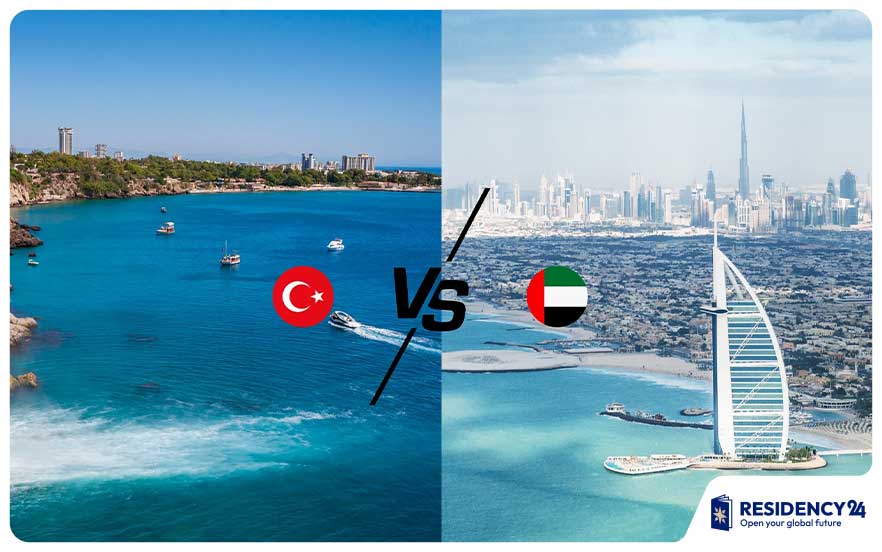
Turkey and the UAE both attract foreign property buyers, but they are not the same type of investment market. The UAE, especially Dubai and Abu Dhabi, is usually stronger for investors who want rental income, legal transparency, dollar-linked currency stability, Golden Visa planning, and a more liquid international resale market. Turkey is more suitable for buyers who want a lower entry price, lifestyle use, potential citizenship through real estate, and exposure to a large domestic housing market, but it carries higher currency, inflation, policy, and liquidity risk. The better choice depends on whether the investor is buying for rent, residence, citizenship, capital growth, capital protection, or personal use.
Is Turkey or the UAE Better for Property Investment?
The UAE is usually better for rental-income investors, buyers who want a cleaner legal framework, and investors who value currency stability and long-term residence through the Golden Visa. Turkey can be better for buyers who want a lower purchase price, Turkish citizenship eligibility, lifestyle use, or exposure to a market where nominal property prices can rise quickly during inflationary periods.
For a conservative foreign investor, the UAE is generally the stronger investment market. For a buyer who specifically wants Turkish citizenship or a Mediterranean lifestyle property at a lower entry point, Turkey may still make sense. The main mistake is comparing a low-priced Turkish apartment with a Dubai property only on purchase price; the real comparison should include currency risk, net yield, exit liquidity, legal clarity, taxes, visa value, and the quality of the specific asset.
Turkey vs UAE Property Investment: Quick Comparison
Factor | Turkey | UAE |
|---|---|---|
Best for | Citizenship, lifestyle, lower entry cost, domestic-market exposure | Rental yield, Golden Visa, liquidity, tax predictability, capital preservation |
Main market | Istanbul, Antalya, Alanya, Bodrum, Izmir, Ankara | Dubai, Abu Dhabi, Sharjah, Ras Al Khaimah |
Currency risk | High, because assets and rents are tied to Turkish lira exposure | Lower for USD-based investors because AED is pegged to USD |
Rental yield | Area-specific and often weaker in real USD terms after inflation and management costs | Stronger in Dubai apartments; citywide DLD/Ejari-based data shows 6.2% gross apartment yield |
Residence benefit | Property can support short-term residence if conditions are met, but not automatic | AED 2 million property can support a 10-year Golden Visa |
Citizenship | Possible from USD 400,000 real estate with three-year no-sale restriction | No citizenship through property |
Transaction tax | Transfer tax is formally 2% buyer + 2% seller, often treated as 4% total | Dubai sale registration fee is 4% of property value |
Foreign ownership | Broad but restricted by nationality, land limits, military/security zones, and district limits | Freehold ownership in designated areas |
Market transparency | Improving but still more fragmented | Stronger in Dubai due to DLD data, escrow, registered transactions, and mature brokerage regulation |
Exit liquidity | Strong in Istanbul and Antalya, weaker in overbuilt foreigner-focused areas | Stronger in prime and mid-market Dubai communities |
Main risk | Currency depreciation, inflation, legal due diligence, overpricing to foreigners | High entry cost, service charges, supply cycle, off-plan risk |
Better for cautious investors | Usually UAE | Usually UAE |
Better for citizenship buyers | Turkey | Not applicable |
The practical answer is that the UAE is usually the better investment market, while Turkey is often the better citizenship-and-lifestyle market.
Current Market Context in 2026
Turkey’s housing market is still moving upward in nominal terms, but real returns are weaker because inflation is high. In July 2026, Türkiye’s Residential Property Price Index rose 25% year on year, but fell 5.1% in real terms after inflation adjustment. That means nominal price growth did not automatically translate into real purchasing-power growth.
Foreign demand in Turkey is also no longer as strong as the peak years. TÜİK-linked July 2026 reporting showed foreign buyers purchased 2,120 homes in July 2026, up 1.9% year on year, but January–July sales to foreigners were still down 7.3% at 11,203 units.
Dubai’s market in 2026 remains more yield-driven and internationally liquid. Bayut’s H1 2026 Dubai sales report showed apartment ROI examples such as 7.15% in Jumeirah Village Circle, 7.10% in Arjan, 8.23% in Dubai Silicon Oasis, and 8.12% in Dubai Sports City, while DLD/Ejari-based citywide data updated in August 2026 showed 6.2% gross apartment yield and 4.9% gross villa yield.
The market context favours UAE property for investors who want measurable rental yield and cleaner exit data. Turkey still has demand, but the investor must separate nominal growth from real return.
Investment Goal: Rental Income
Dubai yields are unusually well documented - Average Rental Yield in Dubai gives the numbers behind the UAE column. For rental income, the UAE is usually stronger. Dubai has clearer rent records, a larger expat tenant base, active short-term and long-term rental demand, and stronger data visibility. Apartments in affordable and mid-market areas can still show attractive gross yields, although net yield will be lower after service charges, maintenance, vacancy, agency fees, and mortgage costs.
Dubai’s DLD/Ejari-based rental-yield data showed 6.2% gross apartment yield citywide and 4.9% gross villa yield, with smaller apartments generally producing higher gross yields than larger units. The same dataset notes that gross yield ignores service charges, vacancy, and transaction costs, so net returns are materially lower.
Turkey can produce rental income, especially in Istanbul, Antalya, Alanya, and coastal areas, but rental performance is less straightforward. Rents may rise in Turkish lira, while a foreign investor may judge returns in USD, EUR, AED, or GBP. If the lira weakens, nominal rent increases may not protect foreign-currency yield.
For rental income, UAE is usually the cleaner choice.
Investment Goal: Capital Appreciation
Turkey can show strong nominal appreciation during inflationary periods, but that does not always mean strong real return. The July 2026 Turkish housing price index is a useful example: prices rose 25% year on year, but real growth was negative at -5.1%.
The UAE, especially Dubai, has had strong price cycles, but it is also exposed to supply risk. Dubai can rise quickly when population growth, liquidity, tourism, business relocation, and investor demand are strong. It can also correct when too much supply enters the market or speculative buying gets ahead of income fundamentals.
For capital appreciation:
Investor Type | Better Fit |
|---|---|
Wants inflation-driven nominal growth | Turkey |
Wants USD-linked price stability | UAE |
Wants high liquidity in international market | UAE |
Wants lower entry price and higher risk | Turkey |
Wants a safer long-term resale market | UAE |
Wants speculative upside in emerging districts | Both, but due diligence matters |
The UAE is usually more attractive for capital preservation. Turkey is more speculative and more exposed to macroeconomic conditions.
Investment Goal: Residency and Visa
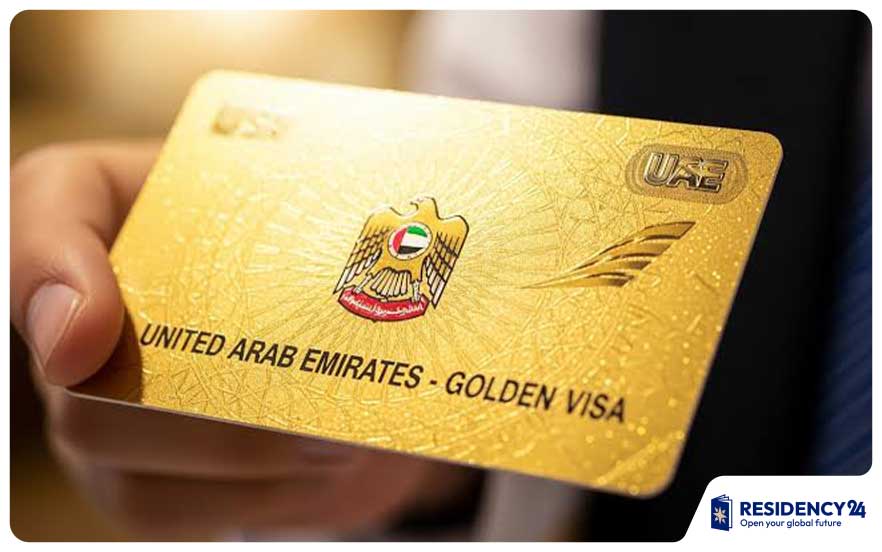
The two systems work quite differently: Does Buying Property in Turkey Give You Residency? on one side, and UAE Golden Visa on the other. The UAE is stronger for property-linked residence planning because the Golden Visa framework is clearer and more valuable for many investors. Dubai Land Department states that a real estate investor owning property with purchase value of at least AED 2 million can apply for a 10-year renewable residence permit, and spouse, children, and parents can be sponsored. In mortgage cases, DLD requires a bank letter showing AED 2 million paid amount or paid amount and balance.
The UAE Ministry of Economy also states that real estate investors can qualify with one or more properties worth at least AED 2 million, and that loans may be accepted if they are from a local bank determined by the competent authority.
Turkey’s property-residence route is more limited. Turkey can grant short-term residence to foreigners who own residential property and use it for that purpose, but the property must meet the residence-permit purpose and the residence conditions must continue to apply. The Presidency of Migration Management states that short-term residence permits can be refused, cancelled, or not renewed if the conditions are not met or no longer apply.
For residence planning, the UAE gives a stronger long-term structure. Residency24 can help investors compare Dubai property purchases when the investment goal is linked to Golden Visa eligibility, mortgage structure, and family sponsorship.
Investment Goal: Citizenship
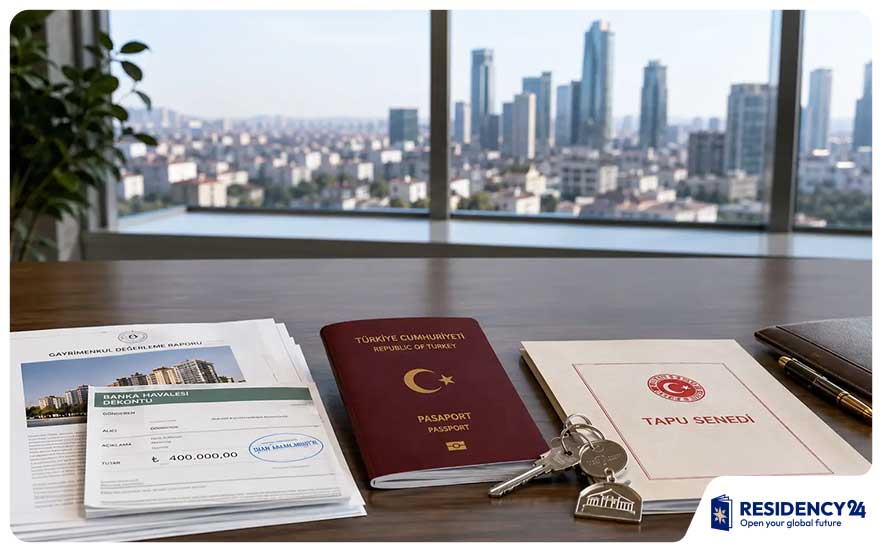
Only one of these two markets offers it - see Turkish citizenship by investment. Turkey is stronger because it offers a real estate citizenship route. Foreigners may qualify for Turkish citizenship through exceptional procedures by purchasing real estate worth at least USD 400,000 and placing a three-year resale restriction on the title deed, subject to official eligibility determination.
The UAE does not offer standard citizenship by property purchase. A UAE property investor can obtain long-term residence through the Golden Visa, but that is not the same as citizenship or a passport.
Goal | Better Market |
|---|---|
Citizenship by property | Turkey |
10-year renewable residence | UAE |
Family residence stability | UAE |
Passport diversification | Turkey |
Tax-residence planning | UAE may be cleaner, but specialist advice is needed |
Long-term living without citizenship | UAE |
If the investor’s main objective is a second passport through property, Turkey is the obvious candidate. If the objective is long-term Gulf residence, the UAE is stronger.
Foreign Ownership Rules

Turkey allows foreign natural persons to acquire real estate and limited rights in rem, but there are limits. Foreigners may acquire up to 30 hectares, cannot buy in prohibited military zones or military security zones, and total foreign acquisition may not exceed 10% of the district area where private property is allowed.
In Dubai, non-UAE citizens can own property in designated freehold areas. Dubai Land Department states that properties and real estate units for non-UAE citizens may be registered in areas specified by the Ruler of Dubai under the real estate registration law.
The difference is practical. In Turkey, the map is broader, but legal checks around location, title, military/security restrictions, valuation, and citizenship eligibility matter. In Dubai, the map is narrower but more clearly structured for foreign buyers.
Transaction Costs
Transaction costs are similar at the headline level, but the structure differs.
In Turkey, property transfer tax is formally 2% for the buyer and 2% for the seller, creating a 4% total transfer tax based on the declared value. GOV.UK’s Turkey property guide also notes that the declared value cannot be lower than the municipal tax value, and that DASK earthquake insurance is obligatory for buildings.
In Dubai, the standard sale registration fee is 4% of the sale contract value, and Dubai Land Department’s fee schedule also lists a title deed certificate fee of AED 250.
A basic transaction-cost comparison:
Cost Item | Turkey | Dubai / UAE |
|---|---|---|
Main transfer fee | 4% total, formally split 2% buyer and 2% seller | 4% DLD sale registration fee in Dubai |
Legal review | Strongly recommended | Recommended, especially for off-plan or mortgage |
Valuation | Important for foreign/citizenship cases | May be required for mortgage or Golden Visa |
Insurance | DASK mandatory for buildings | Property insurance usually required if mortgaged |
Agency fee | Market-specific | Market-specific |
Service charges | Project-specific | Significant in many Dubai communities |
The headline purchase tax does not decide the better market. Service charges, FX risk, net rent, and resale liquidity matter more.
Taxes After Purchase
The UAE is usually more tax-predictable for private property investors. Dubai does not have a standard annual residential property tax, but investors must pay service charges, maintenance, rental registration-related costs, and possible tax or corporate-tax implications if property is held through a company.
Turkey has annual property tax, rental income tax, and potential tax on gains depending on the holding period and tax rules. GOV.UK’s Turkey property guide notes that rental income must be declared if the property is rented, and Turkey’s local property tax system applies based on property type and municipality status.
For a foreign individual buyer, the UAE usually offers lower tax friction. For Turkey, the tax burden is not necessarily high, but it is more administratively involved and lira-based.
Currency Risk
Currency risk is one of the biggest differences. UAE dirham is pegged to the US dollar, which makes the UAE easier to model for USD-linked investors. Property prices, rents, mortgages, and exit values are still market-dependent, but currency conversion risk is lower.
Turkey has more currency volatility. Even if property value and rent rise in Turkish lira, the investor may lose real value in USD, EUR, GBP, or AED terms if the lira weakens. This is why Turkish real estate should be assessed in foreign-currency return, not only Turkish-lira price growth.
Risk | Turkey | UAE |
|---|---|---|
Local-currency depreciation | High | Low for USD-based investors due AED peg |
Inflation effect | High | Lower, though costs and rents still rise |
Rent conversion risk | High | Lower |
Mortgage-currency mismatch | Can be serious | Usually more stable in AED |
Real return visibility | More difficult | Easier |
For investors who measure wealth in USD or AED, the UAE usually provides stronger currency stability.
Market Liquidity
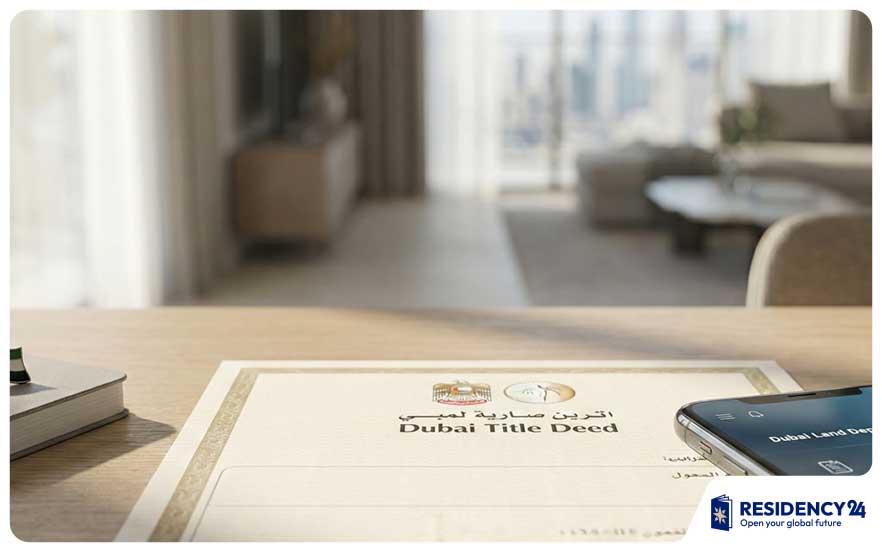
UAE property, especially Dubai, generally has stronger liquidity for foreign investors. Dubai has a large expat buyer base, active broker market, mortgage availability, rental-demand depth, off-plan and ready-home segments, and visible transaction data.
Turkey has liquidity in Istanbul, Antalya, and some coastal areas, but not every foreigner-focused project is easy to resell. Some buyers overpay in projects marketed mainly to international buyers, then find that local resale demand is weaker than expected. Foreign demand also cooled compared with earlier years, with January–July 2026 foreign purchases down 7.3% year on year.
Liquidity ranking by general investor safety:
Market Segment | Liquidity View |
|---|---|
Prime Dubai apartment | Strong |
Affordable/mid-market Dubai apartment | Strong if priced correctly |
Dubai off-plan in weak location | Depends heavily on developer and handover |
Istanbul central apartment | Good if priced for local demand |
Antalya/Alanya foreigner-focused unit | Mixed |
Turkish resort villa | More seasonal and buyer-dependent |
Abu Dhabi prime property | Improving, but usually less liquid than Dubai |
Ras Al Khaimah resort property | Growth potential, but narrower resale market |
The more a property depends only on foreign buyers, the higher the exit risk.
Legal Transparency and Buyer Protection
The UAE, especially Dubai, has stronger real estate infrastructure for foreign investors. Dubai Land Department, RERA, registered title systems, escrow requirements, developer NOCs, registered transactions, rental registration, and Golden Visa service channels create a more transparent market for buyers.
Turkey’s title deed system is formal, but the buyer must be more careful with tapu checks, municipality values, zoning, military/security restrictions, citizenship valuation, building safety, debt on property, iskan, and contract language. Invest in Türkiye states that title deed procedures must be completed through the Land Registry, and foreign buyers must provide documents such as passport, market value document, DASK policy for buildings, and certified interpreter if they do not speak Turkish.
For legal safety, UAE has the advantage for most foreign investors. Turkey is workable, but the due diligence burden is higher.
Off-Plan Property Risk
Both countries have off-plan risk, but the UAE’s off-plan market is larger, more developed, and more regulated. Dubai buyers should still check developer record, escrow registration, payment plan, handover date, service charges, resale restrictions, and whether the project qualifies for Golden Visa if that is part of the plan.
Turkey’s off-plan market can offer lower prices, but it can also create higher delivery, title, construction quality, zoning, and resale risks. A promise of future citizenship eligibility should be checked very carefully because citizenship by real estate requires specific value, title, payment, and no-sale restriction rules. Turkey’s official investment guidance states that the USD 400,000 property must be supported by the required title-deed restriction and official eligibility determination.
For off-plan, UAE is usually safer in established Dubai developers and regulated projects. Turkey requires stricter local legal review.
Property Types That Work Better in Each Market
In the UAE, apartments usually work better for rental yield, while villas may work better for long-term family demand and capital appreciation in the right communities. Dubai’s citywide data shows apartment gross yields above villa yields, and Bayut’s H1 2026 report shows several affordable and mid-market apartment areas above 7% ROI.
In Turkey, property type selection should start with local demand. Central Istanbul apartments, well-located Antalya apartments, and properties with Turkish end-user demand are generally safer than isolated units sold mainly to foreigners.
Investor Need | Better Property Type |
|---|---|
Dubai rental yield | Studio, 1-bedroom, and 2-bedroom apartments in liquid communities |
UAE family use | Townhouses and villas in established communities |
UAE Golden Visa | Property or portfolio worth AED 2 million+ with clean title |
Turkey citizenship | Property worth USD 400,000+ that satisfies citizenship valuation and title rules |
Turkey lifestyle | Coastal apartment or villa with realistic resale demand |
Turkey safer resale | Central Istanbul or Antalya property with local buyer demand |
The best property is not the one with the strongest brochure. It is the one with the deepest buyer and tenant pool.
Best Cities: Turkey vs UAE

Istanbul vs Dubai
Istanbul is Turkey’s deepest property market, with strong domestic demand, large population, and diverse districts. It is better than smaller Turkish markets for long-term resale, but it is also affected by inflation, currency shifts, earthquake concerns, and district-level price gaps.
Dubai is more international, more transparent, and stronger for rental yield. It has better investor data, better Golden Visa integration, and a larger foreign-buyer ecosystem. For most international investors comparing Istanbul and Dubai, Dubai is safer; Istanbul is cheaper and more citizenship-relevant.
Antalya vs Dubai
Antalya is lifestyle-led and attractive for foreign buyers, especially Russians, Europeans, Iranians, and Middle Eastern buyers. It can work for personal use and seasonal rental demand. The risk is that some districts are heavily dependent on foreign buyers and residence-policy changes.
Dubai is stronger for year-round rental demand, business mobility, and resale liquidity. Antalya may offer lower prices and lifestyle appeal, but Dubai usually wins on investment structure.
Abu Dhabi vs Turkey
Abu Dhabi is more conservative than Dubai but has become more attractive for long-term investors. Its Golden Visa property route also uses the AED 2 million threshold, with real estate investor conditions published through Abu Dhabi channels.
Compared with Turkey, Abu Dhabi is better for capital stability and long-term residence. Turkey is better for citizenship and lower entry pricing.
UAE Advantages Over Turkey
The UAE’s main advantage is investment clarity. It offers stronger legal infrastructure, more transparent transaction data, dollar-linked currency stability, higher rental yields in Dubai apartments, and a clearer 10-year Golden Visa route for qualifying property investors.
Main UAE advantages:
Stronger currency stability
Clearer Golden Visa route from AED 2 million property
Better rental-yield visibility
More liquid Dubai resale market
Larger expat tenant base
No standard personal income tax on rental income for individual residents in the same way many countries apply it, though tax advice is still needed
Stronger escrow and property-registration systems
Better international banking and mortgage ecosystem
Stronger property management infrastructure
Easier comparison using DLD and Ejari data
The UAE is usually better for investors who want a property to behave like a managed financial asset.
Turkey Advantages Over the UAE
Turkey’s main advantage is lower entry cost and citizenship potential. A buyer can often purchase larger or more central property in Turkey than in Dubai for the same budget, and the USD 400,000 citizenship route is a unique advantage for passport-focused investors.
Main Turkey advantages:
Lower entry prices in many cities
Citizenship-by-property route from USD 400,000
Large domestic population
Lifestyle appeal in Istanbul, Antalya, Bodrum, Izmir, and Alanya
Potential nominal price growth during inflation
Broader geographic choice
Lower cost of living than Dubai in many areas
Personal-use value for families, retirees, and seasonal residents
Turkey is usually better for buyers who want lifestyle plus citizenship, not purely rental yield.
UAE Risks
The honest ledger for Dubai is in Pros and Cons of Buying Property in Dubai. The UAE is a stronger market for many investors, but it is not risk-free.
Main UAE risks include:
High entry prices in Dubai and Abu Dhabi
Service charges reducing net yield
Off-plan delivery risk
Developer concentration risk
Supply-cycle risk in some communities
Mortgage-rate sensitivity
Price volatility in speculative areas
Overpaying for branded residences
Short-term rental regulation and management risk
Currency stability but no guarantee of property-price stability
The UAE is safer than many regional markets, but a bad property in a weak location can still underperform.
Turkey Risks
They are documented in detail in Risks of Buying Property in Turkey. Turkey’s risk profile is heavier because macroeconomic conditions affect property returns more directly.
Main Turkey risks include:
Turkish lira depreciation
High inflation
Negative real price growth despite nominal increases
Residence-permit uncertainty
Foreigner-focused overpricing
Citizenship valuation risk
Tapu and title issues
Earthquake and building-quality risk
Rental regulation and tenant issues
Lower foreign-buyer liquidity than peak years
Higher due diligence burden
Language and contract risk
Turkey can be profitable, but it is less forgiving for buyers who rely only on agent promises.
Turkey vs UAE for Different Investor Profiles
Investor Profile | Better Choice | Reason |
|---|---|---|
Wants stable rental income | UAE | Dubai yields and tenant demand are stronger |
Wants citizenship | Turkey | Real estate citizenship route exists |
Wants Golden Visa | UAE | AED 2 million property route is clearer |
Wants lower entry price | Turkey | More affordable property options |
Wants USD-linked asset | UAE | AED is pegged to USD |
Wants lifestyle coastal property | Turkey | Antalya, Bodrum, Alanya, Izmir offer lifestyle value |
Wants easiest resale | UAE | Dubai is more liquid for foreign investors |
Wants speculative upside | Turkey | Higher risk, lower entry, inflation-driven nominal movement |
Wants family relocation | UAE | Stronger long-term residence, schools, healthcare, employment |
Wants retirement lifestyle | Depends | Turkey cheaper; UAE more stable and service-rich |
The best choice depends on the investor’s main outcome, not the country’s headline appeal.
Net Yield Comparison
Gross yield is only the starting point. Net yield is what remains after costs.
In Dubai, a property with 7% gross yield may fall to 4.5%–5.5% net after service charges, vacancy, management, maintenance, and agency costs. In Turkey, a property that looks attractive in lira terms may produce weaker foreign-currency net yield if the lira depreciates or if maintenance, tax, and vacancy are underestimated.
A practical yield calculation should include:
Purchase price
Transfer fee
Agency fee
Service charge or building dues
Maintenance
Vacancy
Property management
Rental tax
Currency conversion
Mortgage cost
Furnishing
Insurance
Exit cost
For income investors, the UAE usually provides a cleaner net-yield calculation. Turkey requires an FX-adjusted yield model.
Tax and Exit Planning
The UAE is usually simpler for exit planning because Dubai has clear registration fees, active resale platforms, and strong international buyer demand in key areas. Turkey can still be sold, but exit value depends heavily on local demand, currency environment, title clarity, and whether the property was bought for citizenship with a three-year no-sale restriction.
In Turkey, citizenship properties must carry a three-year no-sale commitment to support citizenship eligibility. This reduces flexibility if the investor wants to exit quickly.
In Dubai, Golden Visa property investors should also avoid treating the property as a short-term flip if the visa depends on continued ownership and eligibility. The property and visa plan should be aligned before purchase.
Due Diligence Checklist
If the shortlist is broader than these two, UAE vs Oman vs Turkey adds a third, and Residency24 works across property purchase, residency, company formation and investment planning. Before buying in either country, check the basics.
For Turkey:
Verify tapu and ownership.
Check zoning and iskan.
Confirm foreign ownership eligibility.
Check military or security-zone restrictions.
Confirm official valuation.
Review earthquake safety.
Check building debt and utility status.
Confirm citizenship eligibility if relevant.
Check residence-permit impact.
Use independent legal review.
Model return in USD or EUR, not only Turkish lira.
For UAE:
Confirm freehold eligibility.
Check DLD or emirate registry data.
Verify developer and escrow for off-plan.
Check title deed or Oqood status.
Review service charges.
Confirm Golden Visa eligibility.
Check mortgage and paid amount if relevant.
Compare DLD transaction prices.
Calculate net rental yield.
Review community supply pipeline.
Use a licensed broker and written agreements.
The wrong asset in a strong country can still be a bad investment.
Which Country Should You Choose?
Choose the UAE if the priority is rental income, long-term residence, legal clarity, USD-linked stability, resale liquidity, and a stronger investor ecosystem. Choose Turkey if the priority is citizenship, lower entry cost, lifestyle use, and willingness to accept higher macroeconomic and currency risk.
A simple decision framework:
Main Goal | Choose |
|---|---|
Rental yield | UAE |
Citizenship | Turkey |
Golden Visa | UAE |
Lower purchase price | Turkey |
Currency stability | UAE |
Lifestyle coast | Turkey |
International liquidity | UAE |
Long-term family relocation | UAE |
High-risk, lower-cost upside | Turkey |
Conservative capital preservation | UAE |
For most foreign investors, the UAE is the better property investment market. Turkey is better when citizenship, lifestyle, or budget are more important than predictable investment performance.
Conclusion
Turkey and the UAE can both work for property investment, but they serve different investor needs. The UAE is generally stronger for rental yield, resale liquidity, Golden Visa planning, legal transparency, currency stability, and capital preservation. Dubai apartment yields remain attractive in several areas, and the AED 2 million property threshold gives investors a clear long-term residence route. Turkey offers lower entry prices and a real citizenship-by-property path from USD 400,000, but investors must manage lira depreciation, inflation, title checks, residence uncertainty, and weaker real returns. Turkey’s 2026 price growth has been positive in nominal terms but negative in real terms, which shows why foreign investors should not rely only on headline price growth. The safest conclusion is practical: choose the UAE for income and stability; choose Turkey for citizenship and lifestyle, but only after stricter due diligence.