 Anahita Attarian
Oman and the UAE are both strong company setup options for expats, but they serve different business goals. The UAE is usually better for international trading, consulting, ecommerce, regional headquarters, high-growth startups, access to banks, investor credibility, and a larger customer market. Oman is usually better for lower setup cost, logistics, manufacturing, port-linked trade, industrial projects, and businesses that want a quieter, lower-pressure Gulf base. The right choice depends on where the company will sell, how much budget is available, whether visas are needed, whether tax incentives matter, and whether the business needs Dubai-level market access or Oman’s lower-cost operating environment.
Is Oman or the UAE Better for Company Setup?
The UAE is generally better for companies that need a larger market, stronger international visibility, more free zone options, better banking depth, easier regional sales, and faster access to clients, investors, and talent. Oman is generally better for businesses that need lower setup cost, port access, manufacturing space, logistics routes, industrial incentives, and a less crowded market.
For most service, consulting, ecommerce, trading, and regional expansion businesses, the UAE is the stronger setup choice. For industrial, logistics, manufacturing, export, and Oman-market businesses, Oman can be more cost-effective. If the company setup is linked to Dubai residence, business banking, property investment, or UAE Golden Visa planning, Residency24 can help investors compare the company structure with the wider relocation and investment plan.
Oman vs UAE Company Setup: Quick Comparison
Factor | Oman | UAE |
|---|---|---|
Best for | Logistics, manufacturing, lower-cost operations, Oman market, industrial projects | Regional business, Dubai market, trading, consulting, ecommerce, startups, international clients |
Setup cost | Usually lower | Usually higher, especially in Dubai and premium free zones |
Market size | Smaller | Larger and more international |
Foreign ownership | 100% foreign ownership possible in many structures and zones | 100% foreign ownership possible in many mainland and free zone structures |
Free zones | Strong for ports, logistics, manufacturing, industrial activity | Large number of sector-specific free zones across Dubai, Abu Dhabi, Sharjah, Ras Al Khaimah and others |
Mainland access | Good for Oman local market | Stronger for UAE local market and government/private contracts |
Corporate tax | 15% standard rate in Oman | 9% on taxable income above AED 375,000 in UAE |
VAT | 5% | 5% |
Banking | Available but smaller ecosystem | Deeper, more international, but still strict KYC |
Visa ecosystem | Investor residence options, but smaller expat market | Broader visa ecosystem, including investor, employment, Green Visa and Golden Visa routes |
Talent pool | Smaller and more sector-specific | Larger international talent pool |
Best city/base | Muscat, Sohar, Salalah, Duqm | Dubai, Abu Dhabi, Sharjah, Ras Al Khaimah |
Best overall for scale | UAE | UAE |
Best overall for low-cost industrial/logistics setup | Oman | Oman |
The simplest answer is this: choose the UAE for market access and scale; choose Oman for cost control and operational substance.
Company Setup Cost: Oman vs UAE
The UAE side of that figure is itemised in Business Setup Cost in Dubai. Oman is often cheaper at the company establishment stage. Oman’s Ministry of Commerce, Industry and Investment Promotion states that the average time to establish a new company is between four and 4.5 days, with four procedures and no minimum capital requirement, and that company establishment cost does not exceed 3% of per capita income, compared with 17% in the UAE and 5% in Saudi Arabia.
The UAE can be more expensive because the final cost depends on the emirate, mainland or free zone choice, activity, office package, visa allocation, establishment card, banking support, and external approvals. In Dubai, the Invest in Dubai platform provides official government licensing and cost estimates for mainland and free zone setup, but the final cost varies by activity and structure.
A practical cost view:
Setup Type | Oman | UAE |
|---|---|---|
Simple consulting company | Often lower-cost | Can be affordable in some free zones, higher in Dubai mainland |
General trading company | Can be lower if Oman-market or port-linked | Stronger market access but higher setup/renewal cost |
Industrial company | Strong value in zones and industrial estates | Strong but often more expensive |
Free zone company | Cost-effective in Sohar, Salalah, Duqm, Al Mazunah, Muscat Airport Free Zone | Wide range from low-cost packages to premium free zones |
Regional HQ | Less common | UAE, especially Dubai and Abu Dhabi, is stronger |
Company with several visas | Usually lower operating pressure | Better visa ecosystem, but higher annual cost |
For small businesses, the UAE may cost more but give more commercial opportunity. Oman may cost less but offer a smaller market.
Foreign Ownership

Full ownership is now the norm on both sides, with caveats - Can Foreigners Own 100% of a Company in the UAE? covers the exceptions. Both Oman and the UAE now allow broad foreign ownership, but the practical details depend on activity, legal form, and licensing authority.
In Oman, the Foreign Capital Investment Law abolished the minimum capital requirement for foreign investors from January 2020, improving market accessibility. Oman’s government has also promoted remote company establishment through the Oman Business Platform and Invest in Oman channels.
In the UAE, foreign investors can own 100% of many mainland and free zone companies. The UAE Ministry of Economy states that full foreign company ownership includes legal forms under the Commercial Companies Law, including limited liability companies, public joint stock companies, private joint stock companies, limited partnership companies, and partnership companies.
The difference is not ownership alone. The real question is whether the chosen activity is permitted, whether the company can operate where it needs to operate, and whether the structure fits banking, visas, tax, and contracts.
Mainland Company Setup
Mainland setup is suitable when the company wants direct access to the local market. In Oman, this means serving Omani customers, bidding for local work, employing locally, leasing premises, and operating under Omani commercial rules. In the UAE, mainland setup is often better for companies that want to trade directly in the UAE market, sign government or private contracts, open physical outlets, or operate outside free zone limits.
The UAE government describes mainland setup as a step-based process involving business activity selection, legal form selection, trade name registration, initial approval, external approvals where needed, memorandum or local service agent arrangements in some cases, office lease documentation, and licence issuance.
Mainland setup is usually better for:
Retail shops
Restaurants
Clinics
Local service companies
Construction and contracting
Real estate brokerage
Local trading
Transport services
Maintenance businesses
Government-facing companies
Businesses with staff working across the country
If the business needs to sell directly inside the local market, mainland is usually cleaner than free zone.
Free Zone Company Setup
The same decision framed for the UAE is in Free Zone vs. Mainland in Dubai, and Omani incorporation is handled under register a company in Oman. Free zones are important in both Oman and the UAE, but they have different strengths.
Oman’s free zones and special economic zones are strongest for industrial, logistics, port-linked, warehousing, re-export, manufacturing, border trade, and large land or facility-based operations. OPAZ states that Oman’s zones can offer tax exemptions for up to 30 years, 100% foreign ownership, full repatriation of capital and profits, and zero import or re-export duties.
The UAE has a broader free zone ecosystem. UAE free zones are used for trading, consulting, media, technology, fintech, ecommerce, logistics, commodities, crypto, education, healthcare, design, aviation, and professional services. The UAE Ministry of Economy states that free zones allow up to 100% foreign ownership and that some activities require additional approvals from relevant government authorities.
Free zone choice should follow the business model:
Business Model | Better Free Zone Market |
|---|---|
Logistics and ports | Oman or UAE, depending on route |
Manufacturing | Oman can be more cost-effective |
Consulting and services | UAE is usually stronger |
Ecommerce | UAE is usually stronger |
Re-export | Both; UAE has larger ecosystem, Oman can be cheaper |
Industrial land | Oman can be attractive |
Regional headquarters | UAE |
Air cargo | UAE or Muscat Airport Free Zone depending on market |
Tech startup | UAE |
Heavy industry | Oman, especially Duqm/Sohar-type routes |
A free zone is useful only if its location, licence, customer access, and compliance rules fit the business.
Local Market Access
The UAE has a much larger and more international business market. Dubai alone gives access to regional clients, global companies, investors, expat consumers, and a stronger private-sector ecosystem. Abu Dhabi adds government, energy, finance, AI, healthcare, and sovereign-linked opportunities.
Oman’s local market is smaller, but it can be less crowded. A business with the right product may face less competition and lower overhead. Oman can be attractive for companies serving ports, logistics, construction, energy, fisheries, manufacturing, tourism, mining, and industrial supply chains.
The main difference:
The UAE gives stronger market size.
Oman gives lower operating pressure.
The UAE is better for client acquisition.
Oman is better for operational cost discipline.
The UAE is better for regional visibility.
Oman is better for companies tied to Oman’s strategic sectors.
A company that needs many customers quickly usually fits the UAE better. A company that needs a stable operational base may prefer Oman.
Selling Outside the Free Zone
Free zone companies must be careful about local-market activity. In the UAE, free zone companies generally operate under a different legal framework than mainland businesses. The UAE government states that to sell goods or services locally, a free zone company must either work through a licensed mainland distributor or establish a mainland branch or company.
Dubai has also introduced a more flexible route for some free zone companies. Dubai DET announced a Free Zone Mainland Operating Permit in 2025, valid for six months at AED 5,000 and renewable for the same fee, allowing eligible free zone companies with a Dubai Unified Licence to conduct specific mainland activities through a structured permit system.
In Oman, free zone companies are usually strongest when they operate inside the zone or export/re-export. If they sell into Oman’s customs territory, local rules, customs, tax, and licensing conditions must be checked.
For both countries, the wrong assumption is dangerous: a free zone licence does not automatically permit unrestricted mainland trading.
Tax Comparison
Tax is one of the clearest differences between Oman and the UAE. Oman has a standard corporate tax rate of 15% on company profits. Oman’s Ministry of Commerce states that companies must register with the Oman Tax Authority for a Tax Identification Number and comply with corporate income tax at 15% on profits, while VAT applies at 5% if revenue exceeds the required threshold.
The UAE has a federal corporate tax regime with 0% on taxable income up to AED 375,000 and 9% on taxable income above AED 375,000. The Ministry of Finance also confirms that free zone juridical persons are within the scope of Corporate Tax, but a qualifying free zone person can benefit from 0% corporate tax on qualifying income.
Tax Area | Oman | UAE |
|---|---|---|
Standard corporate tax | 15% | 9% above AED 375,000 |
Small business relief | Oman has specific small-enterprise treatment in some cases | UAE has small business relief rules, but not for qualifying free zone persons |
VAT rate | 5% | 5% |
Free zone tax incentives | Up to 30 years in some zones, subject to conditions | 0% for qualifying income of qualifying free zone persons |
Withholding tax | 10% on certain payments to non-residents | UAE generally has no broad withholding tax under the corporate tax regime |
Tax simplicity | Moderate | Moderate, but free zone rules are technical |
For tax efficiency, the UAE may look better because of the 9% rate and free zone regime. For industrial investors using zone exemptions, Oman can also be competitive.
VAT Comparison
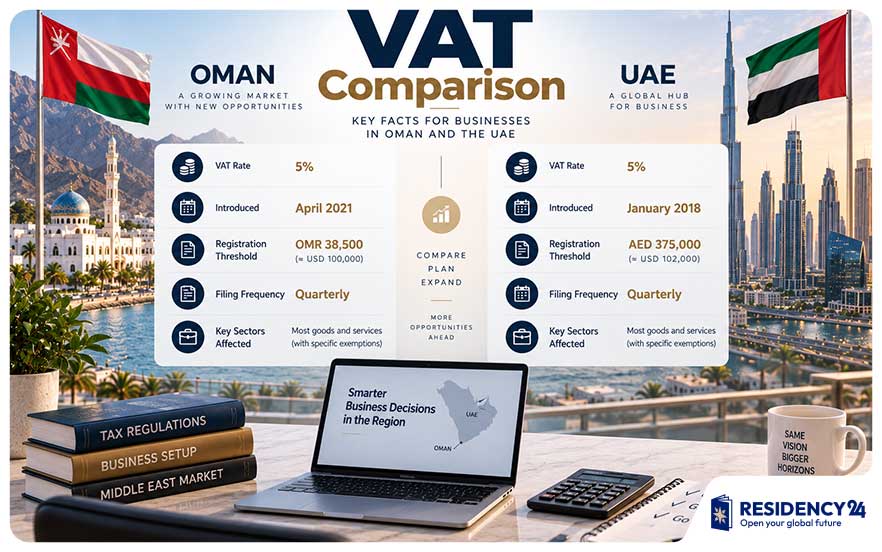
Both Oman and the UAE apply VAT at 5%, but thresholds differ.
In Oman, Gov.om states that VAT registration is mandatory for resident companies and individuals when revenues exceed OMR 38,500, and the registration service fee is listed as 0. Non-resident companies have no revenue limit for VAT registration and must provide a bank guarantee or appoint an official registered representative with the Tax Authority.
In the UAE, the Federal Tax Authority states that a business must register for VAT if taxable supplies and imports exceed AED 375,000, and may register voluntarily if taxable supplies, imports, or taxable expenses exceed AED 187,500.
VAT Point | Oman | UAE |
|---|---|---|
VAT rate | 5% | 5% |
Mandatory threshold | OMR 38,500 for resident businesses | AED 375,000 |
Voluntary threshold | Route-specific; check Tax Authority rules | AED 187,500 |
Non-resident rule | No revenue limit for VAT registration | Non-resident treatment depends on taxable supplies and UAE VAT rules |
Any business with cross-border services, imports, ecommerce, or free zone activity should check VAT before invoicing.
Corporate Tax Registration and Compliance
The UAE and Oman both require tax compliance after company setup. A newly registered company is not finished once the licence is issued.
In the UAE, all juridical persons subject to Corporate Tax must register with the Federal Tax Authority and obtain a Corporate Tax Registration Number. The FTA states that late registration can lead to an administrative penalty of AED 10,000, though a waiver initiative may apply if the first tax return is submitted within the specified time.
In Oman, the company must obtain a Tax Identification Number after incorporation. Oman’s Ministry of Commerce states that the CR certificate proves legal existence, and after incorporation the company must register with the Oman Tax Authority to obtain a TIN.
Compliance after setup may include:
Corporate tax registration
VAT registration when threshold is reached
Bookkeeping
Annual tax return
Audited financial statements where required
Corporate bank account KYC
Ultimate beneficial owner information
Payroll and labour records
Visa and immigration file renewal
Licence renewal
Economic substance or free zone conditions where relevant
A low-cost setup becomes expensive if the company fails compliance.
Banking Comparison
The UAE has a stronger banking ecosystem, but bank account opening is still not automatic. UAE banks are used to free zone companies, international trading companies, consultants, ecommerce businesses, holding companies, and multi-currency transactions. However, KYC is strict, especially for high-risk activities, offshore structures, crypto exposure, cash-heavy businesses, and companies with unclear source of funds.
Oman has a smaller banking ecosystem. It can work well for companies operating locally, industrial projects, logistics businesses, and Oman-based investors, but international banking options are fewer than in Dubai. A company with cross-border clients may find the UAE more convenient for accounts, payments, merchant services, and international transfers.
Banking comparison:
Banking Need | Better Fit |
|---|---|
International transactions | UAE |
Local Oman operations | Oman |
Multi-currency banking | UAE |
Trade finance depth | UAE, especially Dubai and Abu Dhabi |
Industrial project finance | Depends on project and bank |
Simple local company banking | Both |
Startup fundraising account | UAE |
Lower-cost local operations | Oman |
For many foreign founders, banking is one of the strongest reasons to choose the UAE.
Visa and Residence Options
The UAE has a broader and more flexible visa ecosystem. Company owners can often apply for investor or partner visas through mainland or free zone companies, and the UAE also offers Green Visa and Golden Visa routes under separate rules. Dubai and Abu Dhabi have mature service channels for investors, employees, property owners, and family sponsorship.
Oman also offers investor residence options, including long-term residency routes and investor visas, but the ecosystem is smaller and more focused on real investment substance. Oman’s investment licence service requires companies subject to the Foreign Capital Investment Law to register after obtaining commercial registration, with details such as activity type, project implementation timeline, feasibility study, passport copies, and a two-year licence validity.
Visa choice depends on:
Owner residence need
Family sponsorship
Number of employees
Office size or facility
Free zone quota
Investor visa eligibility
Golden Visa or long-term residence goals
Health insurance
Bank account and Emirates ID needs in the UAE
Residence card and investor file in Oman
For founders who want long-term family relocation, the UAE is usually easier to structure.
Labour and Hiring
The UAE has a larger international talent pool, especially in Dubai and Abu Dhabi. It is easier to hire across marketing, technology, finance, consulting, real estate, tourism, ecommerce, logistics, and professional services. The cost can be higher, but the market depth is stronger.
Oman has a smaller labour market and more sector-specific talent. It can work well for logistics, manufacturing, engineering, construction, energy, tourism, and local-service operations. Omanisation requirements and work permit conditions should be checked before hiring.
A hiring comparison:
Hiring Need | Better Fit |
|---|---|
International sales team | UAE |
Digital marketing and ecommerce team | UAE |
Industrial labour and operations | Oman or UAE, depending on project |
Engineering/logistics roles | Both |
Regional management | UAE |
Lower payroll pressure | Oman in many cases |
Large expat talent pool | UAE |
Local market employees | Depends on sector |
A company that needs talent fast usually benefits from the UAE. A company that needs lower-cost operational labour may review Oman.
Free Zones: Oman vs UAE
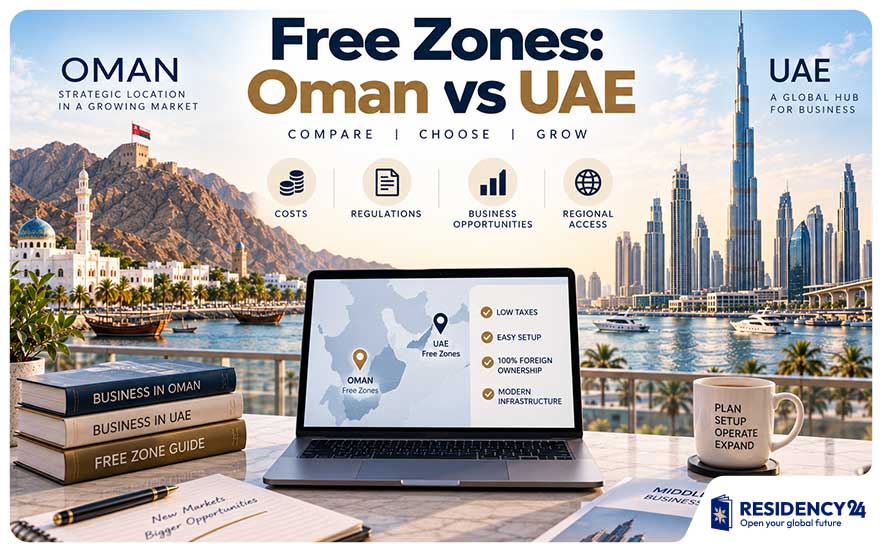
Oman’s free zones are more operational and logistics-led. Sohar, Salalah, Al Mazunah, Muscat Airport Free Zone, and Duqm are designed around ports, airports, border trade, manufacturing, warehousing, industry, and long-term investment. OPAZ states that it oversees the Special Economic Zone at Duqm, Al Mazunah Free Zone, Salalah Free Zone, Sohar Free Zone, and other zones.
The UAE’s free zones are more diversified. They cover media, internet, healthcare, education, commodities, finance, aviation, logistics, trading, creative industries, crypto, design, ecommerce, manufacturing, and professional services.
Free Zone Goal | Oman | UAE |
|---|---|---|
Port-linked manufacturing | Strong | Strong but often more expensive |
Service company | Less developed ecosystem | Strong |
Tech startup | Emerging | Strong |
Commodity trading | Possible | Strong in specific zones |
Logistics | Strong | Strong |
Media and creative business | Limited compared with UAE | Strong |
Low-cost industrial land | Strong | Depends on emirate and zone |
Regional HQ | Less common | Strong |
Export and re-export | Strong | Strong |
Oman free zones are attractive when the business needs physical infrastructure. UAE free zones are stronger when the business needs market access, talent, and global credibility.
Mainland: Oman vs UAE
Mainland setup in Oman makes sense if the company wants to serve Oman’s local economy directly. Mainland setup in the UAE makes sense if the company wants to sell directly in the UAE, work with local customers, employ across the mainland, lease normal commercial premises, or avoid free zone market-access limits.
UAE mainland is stronger for:
Retail
Food and beverage
Real estate
Tourism
Local services
Government contracts
Construction
Professional consulting
Healthcare
Education
Local trading
Oman mainland is stronger for:
Oman-market services
Industrial supply
Local construction
Logistics support
Tourism services
Manufacturing support
Energy and mining support
Fisheries and food processing
Port-related activities
Lower-cost local operations
If the client base is in the UAE, choose UAE mainland or a UAE free zone with a correct mainland access route. If the client base is in Oman, choose Oman.
Setup Speed and Digital Process
Timelines differ more than most people expect - How Long Does It Take to Start a Company in the UAE? gives the UAE benchmark. Both countries have digitalized company setup, but the UAE generally offers more mature digital service channels across emirates and free zones. Oman has made strong progress and now promotes remote establishment and digital KYC.
Oman’s Ministry of Commerce states that the Oman Business Platform supports remote establishment and management of companies, and that AI-powered KYC enables investors to establish companies from outside Oman without physical presence during initial stages.
The UAE government states that investors can establish a mainland business online through the Basher platform in 15 minutes because it is connected with federal and local government entities providing commercial licence services.
The practical difference is that basic registration can be fast in both countries. Full operational readiness still takes longer because of banking, visas, lease, tax, VAT, external approvals, and sector permits.
Documents Required
The document set depends on whether the shareholder is an individual or corporate entity. Corporate shareholders usually require more attestation, translation, board resolutions, beneficial-owner data, and bank support.
Common documents in both countries include:
Passport copies
Residence ID or visa, if available
Proposed trade name
Business activity selection
Shareholder details
Manager or director details
Lease or office agreement
Memorandum of Association
Board resolution for corporate shareholders
Parent company documents for corporate shareholders
Source-of-funds or bank reference, where required
External approvals for regulated activities
Power of attorney if represented
Oman’s investment licence service specifically requires activity type, project implementation timeline, feasibility study, passport proof, and company registration after CR for companies subject to the Foreign Capital Investment Law.
In the UAE, free zone setup often asks for corporate documents, bank reference or audited financial reports for corporate entities, and additional approvals for regulated activities.
Best Business Types for Oman
Oman is not the best choice for every company, but it can be strong for businesses that need location, cost control, industrial space, and access to Arabian Sea, Indian Ocean, GCC, East Africa, and South Asia trade routes.
Oman is suitable for:
Logistics
Warehousing
Manufacturing
Food processing
Fisheries
Mining support
Energy services
Industrial supply
Port-related businesses
Tourism development
Export and re-export
Construction supply
Oman-market distribution
Lower-cost regional operations
Oman is less suitable for businesses that need a very large customer base, startup investors, high-volume ecommerce, a large expat service market, or Dubai-level international visibility.
Best Business Types for the UAE

The UAE is stronger for businesses that depend on market access, international clients, credibility, talent, banking, and high-growth sectors.
The UAE is suitable for:
Consulting
Ecommerce
Digital services
Trading
General trading
Regional headquarters
Real estate services
Tourism
Hospitality
Media and creative businesses
Financial services, where licensed
Technology startups
SaaS
Logistics
Import-export
Education
Healthcare
Professional services
Investor-backed companies
The UAE is not always the cheapest option, but it is often the stronger commercial platform.
Oman vs UAE for Consulting Companies
For consulting companies, the UAE usually wins. A consulting business needs clients, credibility, banking, digital payments, talent, networking, and access to decision-makers. Dubai and Abu Dhabi are stronger for this.
Oman can work for consulting if:
Clients are in Oman.
The founder lives in Oman.
The company serves logistics, industrial, energy, construction, tourism, or government-linked sectors.
Lower annual cost matters more than regional visibility.
The business does not need a large international client base.
For most international consultants, UAE free zone or mainland setup is more practical than Oman.
Oman vs UAE for Trading Companies
The UAE is stronger for general trading, ecommerce, wholesale, regional distribution, and international re-export because the ecosystem is larger. Dubai has ports, airports, customs brokers, banks, logistics providers, warehouses, free zones, and established trade networks.
Oman can be strong for trading if the business depends on:
Sohar Port
Salalah Port
Duqm
Yemen-linked trade through Al Mazunah
Industrial goods
Lower-cost warehousing
Arabian Sea routes
Oman local market
Food, fisheries, or raw material trade
For general trading aimed at the Middle East, Africa, and Asia, UAE gives stronger market reach. For specific logistics routes, Oman can be more cost-effective.
Oman vs UAE for Manufacturing
Oman can be very competitive for manufacturing because of industrial zones, port access, lower operating pressure, and free zone incentives. OPAZ states that zones may provide tax exemptions, 100% foreign ownership, full repatriation, and zero import or re-export duties.
The UAE also has manufacturing zones, especially in Abu Dhabi, Dubai, Sharjah, and Ras Al Khaimah. It can be better if the manufacturer needs a bigger local market, stronger logistics ecosystem, or proximity to regional headquarters and customers.
Choose Oman manufacturing if:
Land or facility cost matters.
Export through ports is central.
The activity fits Duqm, Sohar, Salalah, Madayn, or similar zones.
The business wants lower pressure and long-term industrial positioning.
Choose UAE manufacturing if:
Customers are in the UAE or GCC.
Branding and market access matter.
The company needs stronger banking and logistics services.
The project is linked to UAE industrial incentives.
Oman vs UAE for Startups
The UAE is usually better for startups, especially technology, SaaS, fintech, ecommerce, media, AI, marketplaces, and professional services. Dubai and Abu Dhabi have more accelerators, investors, coworking spaces, events, free zones, startup visas, talent, and commercial customers.
Oman can be suitable for startups that solve Oman-specific problems or operate in sectors like logistics, tourism, fisheries, energy, education, industrial tech, and public-sector digital transformation. But for venture-backed growth, the UAE is usually stronger.
Startup decision:
Startup Need | Better Choice |
|---|---|
Venture capital | UAE |
Global clients | UAE |
Lower cost MVP base | Oman can help |
Regional HQ | UAE |
Oman public or industrial market | Oman |
Talent density | UAE |
Startup events and ecosystem | UAE |
Lower competition | Oman |
Most startups should start in the UAE unless Oman is part of the product-market fit.
Oman vs UAE for Ecommerce
The UAE is usually better for ecommerce because it has stronger logistics, payment gateways, customer density, online shopping behavior, cross-border fulfilment, and digital infrastructure. Dubai in particular is stronger for regional ecommerce brands.
Oman can work for ecommerce if the company targets Oman or uses Oman as a fulfilment or logistics base for specific routes. But for direct-to-consumer scale, the UAE offers a deeper market.
Consider the UAE if the ecommerce business needs:
Payment gateways
Fast courier ecosystem
Influencer and digital marketing market
Warehouse and fulfilment partners
Large expat customer base
GCC expansion
Arabic and English customer support
Marketplace access
Consider Oman if:
The market is Oman-specific.
Logistics costs are better for the route.
Competition is lower.
The brand wants a smaller pilot market.
Warehousing or import path is cheaper.
Company Setup for Residence
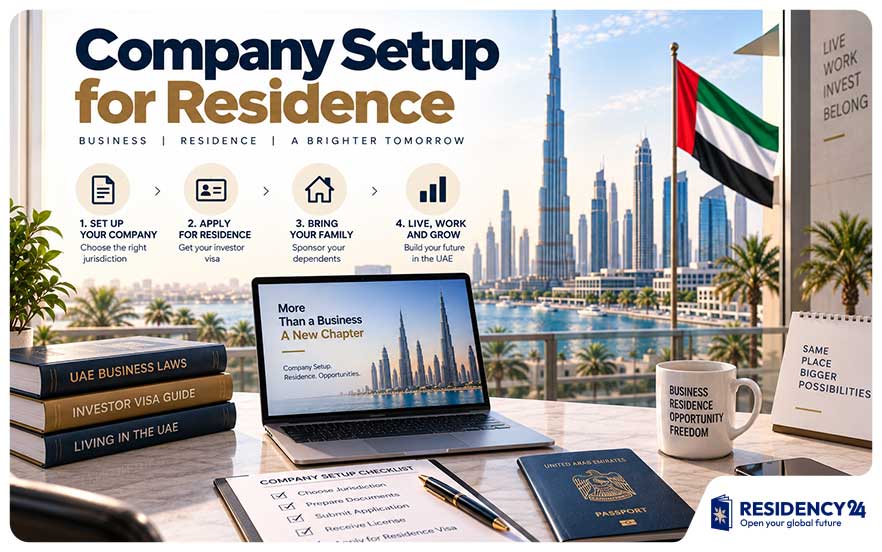
If residence is a major reason for setup, the UAE usually offers more options and a stronger lifestyle ecosystem. Company owners can use investor or partner visa routes through mainland or free zone companies, and other UAE residence options may be available depending on business, salary, property, or professional status.
Oman also offers investor residence routes, but they are usually more closely tied to real investment, company documentation, or approved investor programs. For a founder who simply wants a company plus residence plus banking plus family relocation, the UAE is usually easier.
Residence-based comparison:
Need | Oman | UAE |
|---|---|---|
Owner residence | Available through investor routes | Broadly available through company routes |
Family sponsorship | Available if conditions met | Stronger and more mature ecosystem |
Long-term investor status | Available | Golden Visa and other routes available |
Banking linked to ID | Possible | Stronger ecosystem with Emirates ID and UAE Pass |
Lifestyle for expat family | Quiet, lower pressure | Larger schools, hospitals, communities, services |
Visa flexibility | More limited | Broader |
If the company is mainly a vehicle for relocation, the UAE is usually more practical.
Annual Renewal and Ongoing Costs
The company setup decision should include renewal cost. A cheap first year can become expensive if the renewal includes office lease, visas, establishment card, audit, tax, VAT, accounting, and external approvals.
Oman ongoing costs may include:
Commercial registration renewal
Investment licence renewal, if applicable
Office lease
Municipality or sector permits
Accounting
Corporate tax filing
VAT filing if registered
Labour permits
Investor residence renewal
Free zone or industrial zone facility fees
UAE ongoing costs may include:
Trade licence renewal
Free zone package renewal
Establishment card renewal
Office or flexi-desk renewal
Visa renewal
Emirates ID and medical fees
Corporate tax registration and filing
VAT filing if registered
Audit report in some free zones
External approvals
Bank KYC updates
The UAE can generate higher annual cost, but it may also generate stronger commercial value.
Legal and Regulatory Environment

Both Oman and the UAE have structured legal systems for company registration, but the UAE is more familiar to international investors and banks. Dubai and Abu Dhabi have mature corporate service ecosystems, arbitration options, free zone regulations, and sector-specific authorities.
Oman is improving quickly, especially through digitalization and Vision 2040 reforms. Its environment is more stable and less crowded, but the professional-services ecosystem is smaller.
For legal setup:
UAE is better for international familiarity.
Oman is better for lower-cost operational entry.
UAE has more consultants, lawyers, accountants, and free zone options.
Oman may be simpler for businesses that are genuinely Oman-based.
UAE has stronger brand perception for regional business.
Oman has stronger appeal for industrial and logistics substance.
The legal structure should be chosen with future banking, tax, contracts, and exit in mind.
Risks of Setting Up in Oman
Oman company setup risks include:
Smaller market size
Slower client acquisition
Smaller banking ecosystem
Activity approvals that may take time
Omanisation and labour rules
Lower startup-investor density
Less international visibility
Limited talent pool in some sectors
Business model may not justify local setup
Residence route may not match the founder’s expectations
Free zone location may be far from customers
Oman is not a weak jurisdiction. It is just more suitable for specific business models.
Risks of Setting Up in the UAE
UAE company setup risks include:
Higher setup and renewal cost
Too many free zone choices
Free zone selected without checking mainland access
Corporate tax misunderstanding
Free zone 0% tax assumptions that do not match income type
Banking KYC delays
Expensive office or visa packages
Activity mismatch
Competition in Dubai market
Renewal cost shock
Consultant packages that hide government fees
Mainland/free zone confusion
The UAE is commercially strong, but poor setup design can create unnecessary cost.
Which Is Cheaper?
Oman is usually cheaper for company establishment and some operating models. Oman’s official Ministry statement directly compares establishment cost with regional peers and says Oman’s company establishment cost does not exceed 3% of per capita income, compared with 17% in the UAE.
However, cheaper does not always mean better. A low-cost company in Oman may not help if the clients, banks, suppliers, investors, and staff are in Dubai. A more expensive UAE company may be more profitable if it opens access to a larger market.
Choose cheaper only if the cheaper jurisdiction fits the business model.
Which Is Better for Taxes?
For normal operating companies, the UAE usually has the lower headline corporate tax rate: 9% on taxable income above AED 375,000. Oman’s standard rate is 15% on profits.
However, Oman free zones and special economic zones can offer tax exemptions for qualifying projects, and UAE free zones only preserve 0% treatment if the company is a Qualifying Free Zone Person earning Qualifying Income.
A simple tax view:
Company Type | Better Tax Position |
|---|---|
Small profitable mainland service company | UAE may be better |
Qualifying UAE free zone company | UAE can be very tax-efficient |
Oman industrial/free zone project with exemption | Oman can be competitive |
Company paying foreign suppliers | Needs withholding/VAT review in both |
Company with mainland UAE clients | UAE mainland may be cleaner |
Export manufacturer | Compare Oman zone exemption vs UAE free zone rules |
The answer depends on activity and income, not only the country.
Which Is Better for Banking?
The UAE is usually better for banking. It has more banks, deeper international relationships, more fintech/payment options, stronger multicurrency services, and more experience with international structures. But UAE bank account opening can still be strict and slow if the company has weak documents or no real substance.
Oman is good for local and operational banking but less powerful for international structures.
Choose UAE for banking if:
Clients are global.
Payments are multi-currency.
Merchant accounts matter.
Trade finance matters.
Investors or partners expect a UAE bank.
The company needs international credibility.
Choose Oman for banking if:
Operations are in Oman.
Clients are local or regional.
The company has a physical project.
Payments are simpler.
Lower operating cost matters.
Which Is Better for Visas?
The UAE is usually better for visas because it has a larger and more mature immigration ecosystem for business owners, employees, families, investors, property owners, and high-skilled professionals.
Oman can support investor and employee residence, but it is less flexible for businesses that need fast scaling, family relocation, multiple staff visas, and a broad expat lifestyle ecosystem.
Visa comparison:
Visa Need | Better Choice |
|---|---|
Founder residence | UAE |
Family relocation | UAE |
Many expat employees | UAE, depending on cost and activity |
Industrial workforce | Oman or UAE depending on project |
Long-term investor planning | UAE usually stronger |
Lower-pressure residence base | Oman |
Lifestyle plus business in Dubai | UAE |
A company setup designed around residence usually fits the UAE better.
Decision Framework
Use this decision framework before choosing between Oman and the UAE.
Choose Oman if:
Your customers are in Oman.
You need port, logistics, manufacturing, or industrial facilities.
Setup and operating cost are major constraints.
The business is tied to Oman’s strategic sectors.
You want lower competition.
You do not need Dubai-level visibility.
You can operate with a smaller talent pool.
Free zone or special economic zone incentives match the project.
Choose the UAE if:
You need regional or international clients.
You want Dubai or Abu Dhabi market access.
Banking and credibility matter.
You need ecommerce, consulting, trading, or startup ecosystem.
You need a larger expat talent pool.
You want stronger visa flexibility.
You want a more mature free zone ecosystem.
You plan to sell across the GCC, MENA, Africa, or South Asia.
The wrong choice is usually not about the country. It is about choosing a jurisdiction that does not match the revenue model.
Oman vs UAE Company Setup Checklist
Licence, market and residence goals should be decided together: Residency24 works across company formation, residency, property purchase and investment planning, and register a company in the UAE covers the Emirati route end to end. Before deciding, answer these questions:
Where are the customers?
Will the company sell locally or internationally?
Does the business need mainland access?
Is a free zone enough?
Is the activity regulated?
Is 100% foreign ownership available for the activity?
What is the full first-year cost?
What is the annual renewal cost?
How many visas are needed?
Is office space required?
Can the company open a bank account?
What is the corporate tax exposure?
Will VAT registration be required?
Are free zone tax incentives realistic?
Are staff available locally?
Does the company need investors?
Does the jurisdiction help sales?
Does the setup support residence and family plans?
What happens if the company closes?
A proper setup decision should start with customers, not only licence cost.
Common Mistakes Investors Make
Common mistakes include:
Choosing Oman only because it is cheaper.
Choosing the UAE only because it is more famous.
Opening a free zone company without checking mainland sales rules.
Assuming 100% foreign ownership means no activity restrictions.
Ignoring tax registration after setup.
Assuming UAE free zone means automatic 0% corporate tax.
Assuming Oman free zone means no compliance.
Not budgeting for visas, office, accounting, and renewal.
Registering the wrong activity.
Using a consultant package without line-item costs.
Choosing a free zone far from customers.
Ignoring banking before setup.
Not checking VAT thresholds.
Treating company registration and residence approval as the same thing.
The best setup is not the cheapest. It is the one that lets the company operate legally, bank properly, invoice correctly, hire staff, and renew without surprises.
Conclusion
Oman and the UAE are both valid company setup jurisdictions, but they are not built for the same business strategy. Oman is usually better for lower-cost establishment, logistics, manufacturing, industrial activity, port-linked trade, and companies that want a stable but smaller Gulf market. The UAE is usually better for regional expansion, trading, consulting, ecommerce, startups, international clients, banking depth, visa flexibility, and Dubai or Abu Dhabi market access. Oman’s standard corporate tax rate is 15%, while the UAE applies 9% corporate tax on taxable income above AED 375,000, with 0% possible for qualifying free zone income. Oman can be more cost-effective, but the UAE can produce more commercial opportunity. The right choice depends on the business model, target market, tax position, banking needs, residence goals, and total annual operating cost.