 Anahita Attarian
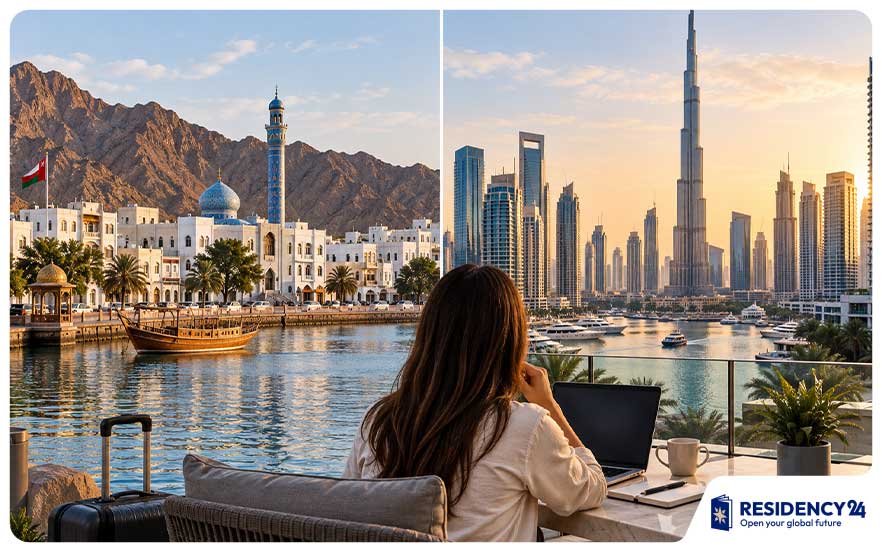
Living in Oman vs Dubai is mainly a choice between a calmer, lower-pressure Gulf lifestyle and a faster, more expensive global-city lifestyle. Oman, especially Muscat, is usually better for families, retirees, nature-focused expats, and professionals who want safety, space, and lower daily intensity. Dubai is usually better for career growth, business access, higher salaries, international networking, public transport, private schools, healthcare choice, and lifestyle variety. Oman is generally cheaper for rent and day-to-day living, but Dubai gives more job opportunities and stronger global connectivity. The better option depends on income, family size, school needs, visa route, career sector, and how much pace you want in daily life.
Is It Better to Live in Oman or Dubai?
Oman is better if you want a quieter life, lower rent, outdoor nature, family stability, and a slower daily rhythm. Dubai is better if you want stronger career opportunities, a larger expat network, more services, better public transport, and a highly international lifestyle.
For most single professionals focused on income and career growth, Dubai is usually the stronger choice. For families or remote workers who value calm, space, safety, and lower housing pressure, Oman can be more comfortable. The decision should not be made only on salary; rent, school fees, transport, tax, healthcare, and lifestyle costs change the real value of the package.
Living in Oman vs Dubai: Quick Comparison
Factor | Oman | Dubai |
|---|---|---|
Best for | Families, retirees, outdoor lifestyle, lower-pressure expats | Career growth, business, networking, lifestyle variety |
Main city for expats | Muscat | Dubai |
Cost of living | Lower overall | Higher overall |
Rent | Usually much cheaper | Much higher, especially in popular areas |
Job market | Smaller, more sector-specific | Larger, more competitive, more international |
Public transport | Limited | Stronger metro, tram, bus, taxi, and ride-hailing options |
Car dependency | High | Depends on area, but still common |
Schools | Fewer choices, lower top-end range | Much wider choice, higher premium fees |
Healthcare | Good in Muscat, fewer options outside | Wider private healthcare network |
Lifestyle | Quiet, conservative, nature-based | Fast, commercial, global, highly serviced |
Tax | PIT starts in 2028 above OMR 42,000 annual income | No personal income tax on individuals |
Family fit | Strong if school and visa package work | Strong but expensive |
Business fit | Suitable for selected sectors | Stronger for startups, trade, services, finance, tech |
Main downside | Smaller job market and less variety | High rent, high schooling cost, faster pace |
Dubai is the better platform. Oman is the easier place to live slowly.
Cost of Living: Oman vs Dubai
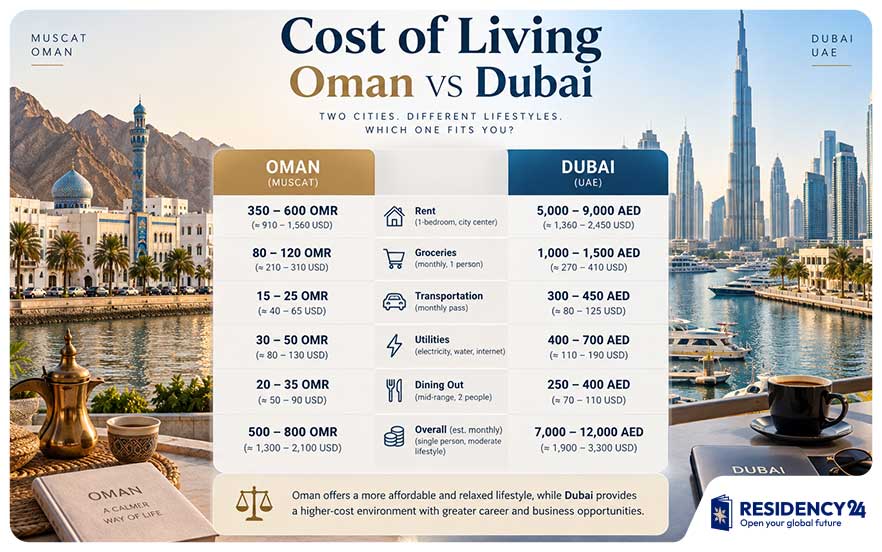
The Dubai side of the ledger is broken down in detail in Cost of Living in Dubai in 2026. Oman is generally cheaper than Dubai, especially for rent and daily family living. Dubai offers more choice, but the price of that choice is high. Expatistan’s August 2026 comparison estimates Dubai to be 51% more expensive than Muscat, while the reverse comparison puts Muscat 34% cheaper than Dubai.
Numbeo’s 2026 Western Asia city ranking shows the same broad pattern: Dubai has a cost of living index of 61.8 and rent index of 56.9, while Muscat has a cost of living index of 44.3 and rent index of 14.8.
Household Type | Oman Monthly Budget | Dubai Monthly Budget |
|---|---|---|
Single person | OMR 500–900 | AED 8,000–14,000 |
Couple | OMR 800–1,600 | AED 14,000–24,000 |
Family without premium school fees | OMR 1,300–2,500 | AED 20,000–35,000 |
Family with international school | OMR 2,000–4,500+ | AED 30,000–55,000+ |
The main cost difference is housing. Dubai rent can take a much larger share of income, while Oman leaves more room for savings if the job package is reasonable.
Rent and Housing
Rent is the biggest difference between living in Oman and Dubai. Muscat has premium areas, but the gap between normal and premium housing is usually less extreme than in Dubai. Dubai has more modern towers, gated communities, branded residences, and serviced apartments, but the cost is much higher.
Muscat 2026 rental data from Renttaag shows average monthly rent around OMR 190 for a studio, OMR 280 for a one-bedroom apartment, and OMR 600 for a three-bedroom apartment.
Dubai rental data is much higher. Bayut’s H1 2026 rental market report lists average rents in International City at AED 41,000 for studios, AED 61,000 for one-bedroom apartments, and AED 82,000 for two-bedroom apartments, while mid-tier villa communities such as DAMAC Hills had average villa rent around AED 263,000.
Housing Type | Muscat | Dubai |
|---|---|---|
Studio | OMR 150–250/month | AED 40,000–75,000/year in many areas |
1-bedroom apartment | OMR 180–350/month | AED 60,000–120,000/year depending on area |
2-bedroom apartment | OMR 280–550/month | AED 80,000–180,000/year depending on area |
3-bedroom apartment | OMR 400–750/month | AED 120,000–300,000/year depending on area |
Family villa | OMR 800–1,800+/month | AED 180,000–400,000+/year |
Dubai gives more housing variety, but Muscat is usually easier on the monthly budget.
Best Housing Areas
On the Dubai side, family stock and commutes vary sharply by community - see Best Neighborhoods in Dubai for Families. In Oman, most expats focus on Muscat. In Dubai, the right area depends heavily on school, office, metro access, budget, and lifestyle.
Lifestyle Need | Better Oman Areas | Better Dubai Areas |
|---|---|---|
Premium family living | Al Mouj, Qurum, Madinat Sultan Qaboos | Dubai Hills, Arabian Ranches, Emirates Living |
Balanced apartment living | Al Khuwair, Ghubrah, Bousher | JVC, Al Barsha, JLT, Business Bay |
More affordable housing | Seeb, Ruwi, parts of Ghubrah | International City, Dubai South, Deira, Muhaisnah |
Beach or marina lifestyle | Al Mouj, Qurum | Dubai Marina, JBR, Palm Jumeirah |
School access | Qurum, MSQ, Azaiba, Bousher | Dubai Hills, Al Barsha, Jumeirah, Mirdif |
Business access | Al Khuwair, CBD, Qurum | DIFC, Business Bay, Downtown, Dubai Internet City |
Dubai’s area decision is more important because a wrong location can mean high rent and a long commute. Oman is more forgiving, but Muscat still requires school and office route planning.
Salaries and Job Market
Dubai has the stronger job market. It has more multinational companies, startups, agencies, free zones, financial institutions, real estate companies, hospitality groups, logistics firms, and regional headquarters. The Dubai Economic Agenda D33 aims to double the size of Dubai’s economy over a decade and position the city among the top global cities for investment, living, and work.
Oman’s job market is smaller and more sector-specific. It can be strong for oil and gas, energy, logistics, ports, manufacturing, tourism, education, healthcare, and government-linked projects. Oman’s Eleventh Five-Year Development Plan for 2026–2030 targets growth in manufacturing, the digital economy, tourism, logistics, mining, education, and health.
Career Goal | Better Choice |
|---|---|
Fast career growth | Dubai |
Multinational company roles | Dubai |
Finance, tech, marketing, consulting | Dubai |
Oil, gas, logistics, industrial roles | Depends on employer; Oman can be strong |
Education and healthcare | Both, but Dubai has more institutions |
Government-linked stability | Oman can be stronger in selected roles |
Entrepreneurship | Dubai |
Lower-pressure professional life | Oman |
Dubai gives more opportunity, but also more competition. Oman can feel more stable, but roles are fewer and more dependent on sector and sponsor.
Tax and Savings

Dubai has a clear advantage for high-income employees because the UAE does not levy personal income tax on individuals. The UAE government states that the UAE does not levy income tax on individuals.
Oman is changing. Oman issued Royal Decree No. 56/2025 on Personal Income Tax, which applies to natural persons whose total annual income exceeds OMR 42,000, and the law enters into force at the beginning of 2028.
Tax Factor | Oman | Dubai |
|---|---|---|
Personal income tax in 2026 | Not yet in force | No personal income tax |
Upcoming PIT | 5% above OMR 42,000 annual income from 2028 | No equivalent personal income tax currently |
VAT | Applies in Oman | Applies in UAE |
High-income employee advantage | Dubai after 2028 | Dubai |
Lower living cost advantage | Oman | Dubai only if income is much higher |
For savings, the question is not only tax. A person earning more in Dubai may still save less if rent, school, car, and lifestyle costs are too high. A person earning less in Oman may save more if housing is cheaper and the package includes school or healthcare.
Visa and Residency
Two different systems: Oman investor residency on one side, and the long-term UAE Golden Visa on the other. Both Oman and Dubai are immigration-controlled environments. Most expats live through employment sponsorship, business ownership, investment, property ownership, or family sponsorship.
In Oman, a work visa is granted at the request and responsibility of an employer, and the applicant must not be below 21. The Royal Oman Police also states that the sponsor must be local and legally competent.
Oman’s family joining visa is available for an expatriate employee’s spouse and children below 21, and the ROP page describes it as valid for two years and multi-entry, with requirements including accommodation and salary conditions.
Dubai has more visa routes for entrepreneurs, investors, skilled workers, remote workers, property buyers, and long-term residents. This makes Dubai more flexible for non-traditional expat profiles, but the cost and documentation burden can be higher.
Visa Profile | Oman | Dubai |
|---|---|---|
Employee | Employer-sponsored | Employer-sponsored |
Family | Possible under conditions | Possible under UAE sponsorship rules |
Investor | Available under investment/residence routes | More varied investor and business routes |
Remote worker | Less prominent | More established visa options |
Property-linked residence | Available under defined conditions | Available under UAE/Dubai property visa rules |
Business owner | Possible | More ecosystem support and free zone options |
Oman is more employer-centered. Dubai is more route-diverse.
Family Life
Oman is usually easier for families who want calm, safety, space, and a more conservative daily environment. Dubai is excellent for families that can afford it, but the cost of housing, school fees, activities, and healthcare can become high.
Oman family advantages include:
Quieter daily rhythm
Less intense traffic than Dubai in many areas
Outdoor nature and weekend trips
More conservative social environment
Lower housing cost
Strong fit for younger children and family routines
Dubai family advantages include:
Wider school choice
More activities for children
Larger healthcare network
More family entertainment
More international communities
Better public transport in selected areas
More job options for both spouses
A family with two school-age children should calculate total school cost before choosing either place. School fees often decide whether the move makes financial sense.
School Fees and Education
Fees are the single biggest swing factor for families - Top International Schools in Dubai 2026 shows the Dubai range. Dubai has more schools and more curriculum choice, but premium school fees are significantly higher. KHDA-regulated private schools in Dubai publish school fee fact sheets, and media reporting for 2026/27 showed tuition at Outstanding-rated schools ranging from AED 29,488 for preschool to AED 111,799 for Year 13.
Muscat has fewer international schools, but the fee ceiling is often lower than Dubai’s top schools. Numbeo’s 2026 Muscat data lists international primary school tuition around OMR 4,051 per child per year, with a reported range of OMR 3,000–6,240.
Education Factor | Oman | Dubai |
|---|---|---|
Number of schools | Fewer | Much larger |
Curriculum variety | Good in Muscat, limited elsewhere | Very wide |
Premium tuition | Lower than Dubai’s top tier | Very high at top schools |
Admissions competition | Moderate to high in good schools | High in popular schools |
Best for | Families wanting simpler school choice | Families needing specific curriculum or top-tier options |
Dubai is better for education variety. Oman is usually easier on school-fee pressure if the family accepts a smaller school market.
Healthcare
Dubai has a larger private healthcare network, more specialist options, more hospitals, and more medical-service variety. Oman has good private healthcare in Muscat, but fewer options outside the capital.
Health insurance is mandatory in Dubai. Dubai’s official health insurance law applies across the emirate, including free zones, and requires the relevant entities to enrol residents and other covered groups in health insurance.
Oman also has a formal health insurance framework. Oman’s Dhamani platform is designed to connect insurance and healthcare institutions and support the health insurance system.
Healthcare Need | Better Choice |
|---|---|
Specialist private care | Dubai |
Routine family healthcare | Both, but Muscat is best in Oman |
Wider hospital network | Dubai |
Lower-pressure clinic access | Oman can be easier |
Complex medical needs | Dubai |
Basic employer coverage | Depends on employer package |
In both places, do not judge healthcare only by whether insurance exists. Network, co-payments, maternity, dental, chronic medication, and exclusions matter.
Transport and Car Dependency
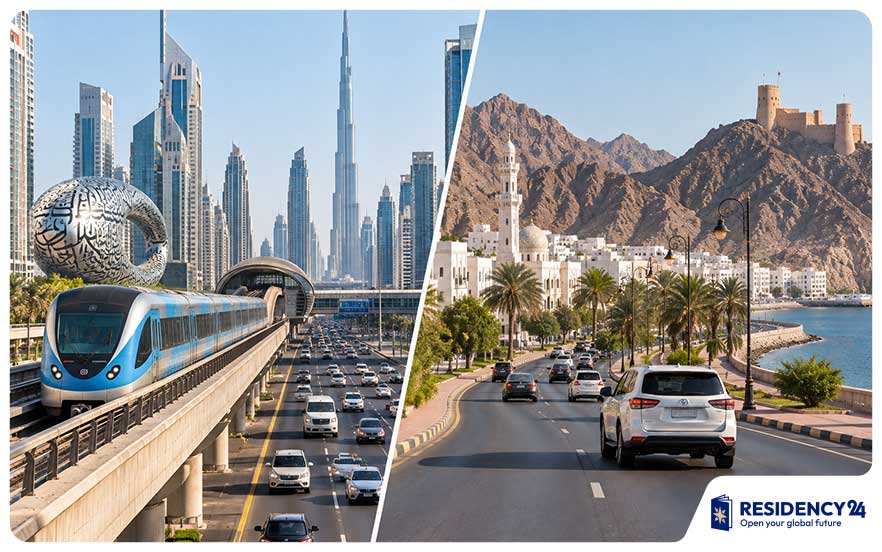
Dubai has much better public transport. RTA’s nol system covers Metro, Tram, public buses, marine transport, paid parking, and other payment uses, and Dubai’s public transport network is built around fare zones.
Oman has public buses, but car ownership is much more necessary. Mwasalat operates Muscat city routes, including connections such as Al Mabelah, Muscat International Airport, and Ruwi, but the network is not as comprehensive as Dubai’s public transport system.
Transport Factor | Oman | Dubai |
|---|---|---|
Car dependency | High | Moderate to high, depending on area |
Metro | No | Yes |
Tram | No | Yes |
Bus network | Limited | Wider |
Taxi/ride-hailing | Available | Widely available |
Family school runs | Usually car-based | Often car-based, but more options |
Best for non-drivers | Dubai | Dubai |
Dubai is more workable without a car if you live near Metro, tram, school, or office. Oman is difficult without a car for most expats.
Lifestyle and Daily Pace
Oman is quieter, slower, and more nature-focused. Dubai is faster, more commercial, and more service-driven. This is one of the biggest differences.
Oman lifestyle is built around:
Beaches
Mountains
Wadis
Camping
Diving
Family gatherings
Quiet restaurants
Conservative social norms
Weekend drives
Lower-pressure routines
Dubai lifestyle is built around:
Malls
Restaurants
Beach clubs
Brunches
Gyms
Events
Business networking
International communities
Hotels
Entertainment
Fast service culture
People who want quiet usually prefer Oman. People who want variety usually prefer Dubai.
Culture and Social Adjustment
Oman is more conservative and socially slower. Dubai is also culturally regulated, but everyday expat life is more international and commercially open. Oman requires more adjustment for people used to fast, urban, nightlife-heavy environments.
Oman suits expats who are comfortable with:
Conservative dress expectations
Quieter nightlife
Slower administration
Relationship-based communication
Family-oriented social life
Outdoor weekends
Respect for local customs
Dubai suits expats who prefer:
International social scenes
Wide restaurant and entertainment choice
Faster services
Business events
Larger expat communities
More visible global lifestyle
Both require respect for local laws and customs. Dubai is more liberal in everyday expat experience, but it is still not a Western legal environment.
Weather and Outdoor Life

Both Oman and Dubai are hot, especially in summer. Oman has more natural variety, including mountains, wadis, desert, beaches, and Dhofar’s seasonal Khareef climate. Dubai has beaches and desert access, but daily outdoor life is more urban and developed.
Oman is better for:
Hiking
Wadis
Mountains
Camping
Diving
Road trips
Natural landscapes
Low-cost outdoor weekends
Dubai is better for:
Urban beaches
Gyms and indoor sports
Organized activities
Hotel pools
Family entertainment venues
Air-conditioned attractions
Professional leisure services
If outdoor nature is central to your lifestyle, Oman is stronger. If controlled comfort and variety matter more, Dubai is stronger.
Business and Entrepreneurship
Setup cost and ownership rules differ: compare register a company in Oman with company registration in Dubai. Dubai is clearly stronger for business setup, networking, regional headquarters, venture activity, trade, finance, consulting, ecommerce, real estate, and professional services. It has more free zones, a larger investor network, deeper talent pools, and a stronger brand as a business hub.
Oman can work for business owners in selected sectors such as logistics, manufacturing, tourism, food, industrial activity, energy, fisheries, and local-market services. Oman’s official economic planning emphasizes diversification through sectors including manufacturing, digital economy, tourism, mining, transport and logistics, education, and health.
Business Type | Better Fit |
|---|---|
Regional consulting | Dubai |
Digital agency or tech startup | Dubai |
Import-export and re-export | Dubai |
Tourism project | Both, depending on model |
Logistics or port-linked business | Both; Oman can be strong in specific zones |
Local lifestyle business | Oman can work |
Venture-backed startup | Dubai |
Manufacturing or industrial project | Oman can be attractive in selected cases |
Dubai is better for scaling. Oman can be better for quieter, sector-specific operations.
Safety and Quality of Life
Both Oman and Dubai are generally safe by international standards. Dubai offers highly developed infrastructure, fast services, and strong urban management. Oman offers calm, low-pressure living and a strong sense of social safety.
Quality of life depends on personality:
Dubai feels efficient, active, and connected.
Oman feels calm, grounded, and spacious.
Dubai gives more convenience.
Oman gives more breathing room.
Dubai gives more opportunity.
Oman gives more stability in daily rhythm.
A person who feels energized by big-city systems may prefer Dubai. A person who feels drained by speed and commercial pressure may prefer Oman.
For Single Expats
Dubai is usually better for single expats who want career growth, networking, dating, events, restaurants, coworking spaces, and social variety. Oman can be good for single expats who prefer saving money, outdoor life, and a quieter routine.
Single Expat Priority | Better Choice |
|---|---|
Career acceleration | Dubai |
Social variety | Dubai |
Saving through lower rent | Oman |
Nature weekends | Oman |
Public transport | Dubai |
Quiet routine | Oman |
Business networking | Dubai |
Lower lifestyle pressure | Oman |
A single person can enjoy Oman, but they need to be comfortable with a smaller social scene.
For Couples
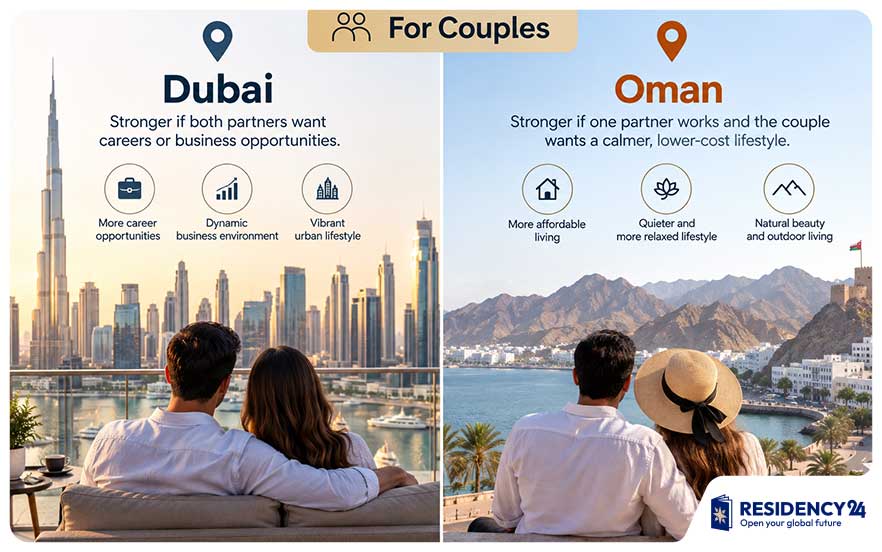
Couples can do well in both places. Dubai is stronger if both partners want careers or business opportunities. Oman is stronger if one partner works and the couple wants a calmer, lower-cost lifestyle.
Couple Priority | Better Choice |
|---|---|
Dual-career opportunities | Dubai |
Lower housing cost | Oman |
Restaurants and events | Dubai |
Nature and road trips | Oman |
Saving on one salary | Oman |
Business access | Dubai |
Quiet lifestyle | Oman |
High-service urban life | Dubai |
Dubai gives more options, but also creates more spending pressure.
For Families
Oman is often more comfortable for families if the job package covers school and healthcare or if school costs are controlled. Dubai is excellent for families with strong income, but costs can rise quickly.
Family Priority | Better Choice |
|---|---|
Lower rent | Oman |
Wider school choice | Dubai |
Lower daily pressure | Oman |
More child activities | Dubai |
International healthcare depth | Dubai |
Outdoor natural weekends | Oman |
Stronger spouse job options | Dubai |
Better public transport | Dubai |
Family savings | Oman if school costs are controlled |
For families, the choice often comes down to school fees and housing. A better salary in Dubai may not be better after rent and education costs.
For Retirees
Oman is usually better for retirees who want calm, safety, nature, and a slower pace. Dubai is better for retirees who want healthcare choice, international flights, entertainment, and a more serviced environment.
Oman may suit retirees who want:
Quiet living
Lower housing cost
Natural landscapes
Conservative social environment
Less commercial pressure
Dubai may suit retirees who want:
Premium healthcare access
International connectivity
Restaurants and activities
Serviced communities
Easier travel
A larger expat network
Retirement should be planned around visa route, health insurance, medication access, housing accessibility, and long-term care needs.
When Oman Is the Better Choice
Choose Oman if daily quality of life matters more than speed, scale, and status.
Oman is better if:
You want a calmer lifestyle.
You prefer nature over malls.
You want lower rent.
You are moving with children and want a quieter environment.
Your job is stable and visa-sponsored.
You are not relying on a broad job market.
You value safety and space.
You are comfortable with car dependency.
You prefer conservative social norms.
You want to reduce lifestyle inflation.
Oman is the better life choice when income is stable and the goal is balance.
When Dubai Is the Better Choice
Choose Dubai if career, business, connectivity, and service variety matter more than lower cost.
Dubai is better if:
You want more job options.
You work in finance, tech, consulting, marketing, real estate, trade, hospitality, or startups.
You want stronger public transport.
You need a specific school curriculum.
You want more hospitals and specialists.
You are building a business.
You want a larger expat community.
You travel frequently.
You value convenience and speed.
You can afford the rent and school fees.
Dubai is the better platform choice when income is high enough to absorb the cost.
Oman vs Dubai Decision Checklist
If the shortlist is wider than these two, UAE vs Oman vs Turkey adds the third option, and Residency24 works across residency, property purchase, company formation and investment planning. Before choosing between Oman and Dubai, answer these questions:
Is the salary difference large enough to cover Dubai rent?
Are school fees covered by the employer?
Does the health insurance cover dependents properly?
Do you need one car or two?
Can your spouse work?
Is your profession more active in Dubai or Oman?
Do you prefer quiet or variety?
Do you need public transport?
Are you trying to save money or grow professionally?
Do you need a specific visa route?
Do you want nature weekends or city entertainment?
Can you handle Dubai’s pace?
Can you handle Oman’s slower rhythm?
What happens if the job ends?
Which country gives a better two-year outcome?
This comparison should be done with numbers, not only lifestyle impressions.
Conclusion
Living in Oman vs Dubai is a trade-off between calm and opportunity. Oman is usually cheaper, quieter, more family-oriented, and better for people who value nature, space, safety, and a slower routine. Dubai is more expensive, but it offers stronger career growth, more business opportunities, better public transport, wider school choice, deeper healthcare options, and a larger international community. For single professionals and entrepreneurs, Dubai often makes more sense if the income is strong enough. For families, Oman can be better if rent and school costs are controlled, while Dubai can be better if the employment package is generous. For retirees and remote workers, Oman may offer a more comfortable daily life, while Dubai provides more services and connectivity. The better choice is the place where salary, visa, housing, schooling, healthcare, and lifestyle all work together.