
A newly established company in the UAE will usually need to register for Corporate Tax with the Federal Tax Authority (FTA) even if it has only recently received its trade licence, has not yet generated revenue or is already registered for VAT. For UAE companies incorporated on or after 1 March 2024, the registration timeline can begin from the company's date of incorporation, establishment or recognition rather than from the date it first makes a profit. Once the registration application is approved, the FTA issues a Corporate Tax Registration Number (TRN) that identifies the company for its Corporate Tax obligations.
When Must a New UAE Company Register for Corporate Tax?
A juridical person that is considered a UAE Resident Person and is incorporated, established or otherwise recognised in the UAE on or after 1 March 2024 must apply for Corporate Tax registration within three months from its date of incorporation, establishment or recognition. The rule applies to UAE companies subject to Corporate Tax, including Free Zone Persons.
For example, if a company is legally incorporated on 10 October, its Corporate Tax registration deadline is determined by the three-month registration rule. The company should therefore not wait until it begins trading, opens a bank account, reaches a particular revenue level or earns taxable profit before considering its registration obligation.
For a new UAE company, Corporate Tax registration and Corporate Tax payment are separate issues. A company may need to register even if it has not yet generated taxable income or expects little or no Corporate Tax to be payable.
The FTA may impose an AED 10,000 administrative penalty where a person required to register fails to submit its Corporate Tax registration application within the prescribed timeframe.
Do Free Zone Companies Also Need Corporate Tax Registration?
Yes. Incorporating a company in a UAE Free Zone does not generally remove the Corporate Tax registration requirement.
A Free Zone company may potentially qualify as a Qualifying Free Zone Person and benefit from the applicable Corporate Tax treatment for qualifying income if all relevant legal conditions are satisfied. That tax treatment does not mean that the company can simply ignore Corporate Tax registration.
The FTA's registration timeline specifically includes Free Zone Persons among UAE resident juridical persons that are required to register.
This distinction is important:
Free Zone status relates to where and under which authority the company is established.
Qualifying Free Zone Person status relates to Corporate Tax treatment and requires specific conditions to be met.
Corporate Tax registration is the administrative process through which the company is registered with the FTA.
These concepts should not be treated as interchangeable.
Do not assume that a 0% Corporate Tax treatment potentially available to qualifying Free Zone income means the company does not need to register, maintain records or file the required Corporate Tax return.
What Is a Corporate Tax TRN?

A Tax Registration Number (TRN) is the registration number issued by the Federal Tax Authority once the company's Corporate Tax registration application has been approved.
The TRN identifies the Taxable Person within the Corporate Tax system and appears in the company's Corporate Tax records and filings. The FTA describes Corporate Tax registration as the process through which persons subject to Corporate Tax apply to obtain a Corporate Tax Registration Number.
The practical sequence is:
Company formation → Corporate Tax registration application → FTA review → Corporate Tax TRN issued
Merely creating an EmaraTax account does not mean the company has completed its Corporate Tax registration. Similarly, submitting the application is not the same as receiving approval.
Once the application is approved and the Corporate Tax TRN is issued, the company can manage its Corporate Tax obligations through its EmaraTax account, including future return-related processes.
Is Corporate Tax Registration the Same as VAT Registration?
No. VAT and Corporate Tax are separate tax regimes.
A company that is already registered for VAT must still complete the Corporate Tax registration process if it falls within the scope of UAE Corporate Tax. The FTA specifically confirms that VAT-registered taxpayers are still required to register for Corporate Tax where applicable.
The difference is especially relevant for new businesses because the registration triggers are not the same.
VAT registration generally depends on the value of taxable supplies and imports and the applicable VAT registration thresholds. Corporate Tax registration for a UAE company is governed by the Corporate Tax rules and the registration timelines established by the FTA.
Requirement | Corporate Tax | VAT |
|---|---|---|
Separate registration required? | Yes | Yes |
Main authority | Federal Tax Authority | Federal Tax Authority |
Managed through EmaraTax | Yes | Yes |
Registration based only on VAT turnover threshold? | No | VAT thresholds apply |
Existing VAT registration replaces CT registration? | No | Not applicable |
If the company is already registered for VAT or Excise Tax, it can use its existing EmaraTax account and add the Corporate Tax registration process instead of creating an entirely separate user account.
What Documents Does a New Company Need for Corporate Tax Registration?
The FTA currently lists several documents that may be required for a Corporate Tax registration application.
For a typical UAE company, these can include:
Certificate of Incorporation, Memorandum of Association or Partnership Agreement, where applicable;
Commercial Registration Certificate or another official document issued by the licensing authority;
valid Trade Licence, including branch licences where applicable;
Emirates ID and passport of owners holding more than 25% ownership;
Emirates ID and passport of the company's authorised signatory;
proof that the signatory is authorised to act for the company.
The exact supporting documents depend on the legal structure and circumstances of the applicant. The FTA's current service requirements state that documents submitted through the Corporate Tax registration service should be in PDF format, with a maximum file size of 15 MB per document.
Before beginning the application, it is useful to make sure the company name, licence number, incorporation details, ownership information and authorised-signatory details are consistent across all documents.
Corporate Tax registration can be delayed when the ownership structure, licence information or authorised-signatory details entered in EmaraTax do not match the supporting documents.
How to Register a New UAE Company for Corporate Tax in EmaraTax
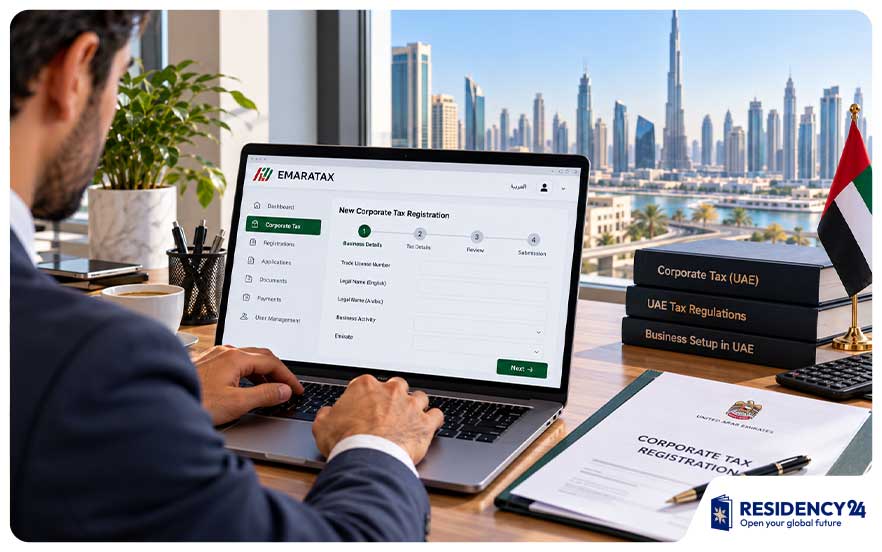
Corporate Tax registration is completed through the EmaraTax platform operated by the Federal Tax Authority.
The FTA's current registration process follows these main steps.
Step 1: Create or access an EmaraTax account
If the company or its authorised user does not already have an EmaraTax account, a user profile must first be created and activated.
Businesses already using EmaraTax for VAT or Excise Tax can generally access their existing account instead of registering a new user profile solely for Corporate Tax.
Step 2: Create the Taxable Person profile
From the EmaraTax dashboard, create a New Taxable Person Profile if the company does not already appear in the account.
Care should be taken to create the profile for the actual legal entity rather than entering information belonging personally to a shareholder or manager.
Step 3: Open the company's Taxable Person account
Select View for the relevant Taxable Person profile.
This opens the company's tax dashboard, where available tax registrations and services can be managed.
Step 4: Start Corporate Tax registration
Under the Corporate Tax section, open the Actions menu and select Register.
The Corporate Tax registration application will then open.
Step 5: Enter the company's legal details
The application requires information about the entity and its legal structure.
This can include details such as:
legal name;
trade name where relevant;
entity type;
incorporation information;
licensing authority;
trade licence details;
business activities.
The information should correspond exactly with the company's official formation and licensing documents.
Step 6: Enter ownership information
The application may require details of owners and shareholders, including relevant ownership percentages.
The FTA's current document requirements specifically refer to identification documents for owners with more than 25% ownership.
Ownership details should reflect the company's current legal structure, not an outdated shareholder arrangement.
Step 7: Enter authorised-signatory details
The person submitting or signing the registration application must have the appropriate authority to represent the company.
Supporting evidence may therefore be required to establish the signatory's authority.
Step 8: Add contact and business information
Complete the requested contact information and other company details.
Use contact details that the company can continue to access because FTA correspondence and notifications relating to the application may be sent through the registered channels.
Step 9: Upload the supporting documents
Attach the required company, ownership and authorised-signatory documents.
Check that:
the documents are current;
licence details are readable;
passport and Emirates ID copies are valid where required;
uploaded documents relate to the correct legal entity.
Step 10: Review and submit the application
Review the entire application before making the declaration and submitting it to the FTA.
A mistake in an incorporation date, licence number, legal name or ownership field can affect the FTA's review and may result in a request for further information.
How Long Does Corporate Tax Registration Take?
The FTA currently estimates that completing the application itself takes approximately 25 minutes, assuming all required information and documents are ready.
The FTA's stated processing time is 20 business days from receipt of a completed application. Additional information requests can affect the actual timeframe.
This is another reason not to leave registration until the final days before the deadline. The legal requirement relates to submitting the registration application within the prescribed timeframe, while approval and issuance of the TRN follow the FTA review process.
What Happens After the Corporate Tax Application Is Submitted?
After submission, the FTA reviews the application and supporting documents.
The application may:
be approved;
require additional information or documents;
be returned for correction;
or, where the requirements are not satisfied, be rejected.
Once the application is approved, the FTA issues the company's Corporate Tax TRN. FTA guidance confirms that the TRN is issued after approval of the Corporate Tax registration application.
The company should then retain its registration information and monitor its EmaraTax account for Corporate Tax obligations and correspondence.
Submitting an application does not by itself confirm that registration has been approved. Check the application's status until the Corporate Tax TRN has actually been issued.
Does a UAE Branch Need a Separate Corporate Tax TRN?

A UAE branch of a UAE domestic company is generally treated as an extension of its parent or head office rather than as a separate juridical person.
The FTA therefore states that UAE branches of domestic juridical persons are not required to register or file separately for Corporate Tax. Their activities are dealt with through the UAE parent or head office.
The position can be different where a foreign company operates through a UAE branch or Permanent Establishment, so the legal structure should be identified before assuming that no separate registration analysis is required.
What Is the Penalty for Late Corporate Tax Registration?
The administrative penalty for failing to register for Corporate Tax by the required deadline is currently AED 10,000.
For a newly incorporated UAE company subject to the three-month rule, this makes the incorporation date an important compliance date that should be recorded as soon as the company is formed.
The FTA is also currently operating a Corporate Tax Late Registration Penalty Waiver Initiative. Under the initiative, eligible persons can have the AED 10,000 late-registration penalty waived if they satisfy the applicable conditions, including submitting their first Corporate Tax return within seven months from the end of their first Tax Period. The initiative also covers certain cases where the penalty has already been imposed or paid.
The waiver initiative should not be treated as an alternative registration deadline. A new company should still register within its legally prescribed timeframe rather than deliberately relying on a later penalty-waiver mechanism.
What Does the Company Need to Do After Receiving Its TRN?
Receiving the Corporate Tax TRN completes the registration stage, but it does not end the company's Corporate Tax responsibilities.
A Taxable Person must generally submit its Corporate Tax return and pay any Corporate Tax due within nine months from the end of the relevant Tax Period. The FTA confirmed this filing timeframe again in September 2026.
A company should therefore establish its compliance process soon after registration, including:
confirming its financial year and Tax Period;
maintaining appropriate accounting records;
keeping supporting documentation;
identifying related-party transactions where relevant;
assessing whether any available relief or Free Zone treatment applies;
preparing for its first Corporate Tax return.
Registration should not be treated as an isolated administrative task. It is the starting point for the company's ongoing Corporate Tax compliance.
Common Corporate Tax Registration Mistakes New Companies Should Avoid
Waiting until the company becomes profitable
Corporate Tax registration is not triggered simply by making a profit. For new UAE resident juridical persons, the registration deadline is tied to the applicable FTA timeline, including the three-month rule for companies incorporated on or after 1 March 2024.
Assuming a Free Zone company does not need to register
Free Zone companies can still have Corporate Tax registration and filing obligations even where qualifying income may benefit from a 0% Corporate Tax rate.
Assuming VAT registration covers Corporate Tax
VAT registration does not replace Corporate Tax registration. A company within the Corporate Tax regime must complete the relevant CT registration process separately.
Creating duplicate Taxable Person profiles
Before creating another profile, check whether the entity already exists in EmaraTax, particularly where it has previously registered for another UAE federal tax.
Uploading expired or inconsistent documents
Trade licence, shareholder and authorised-signatory information should correspond with the information entered in the Corporate Tax application.
Ignoring requests from the FTA
If the FTA requests clarification or additional documentation, the application should be reviewed and responded to promptly. A registration application requiring further information is not the same as an approved registration.
What a New Company Should Check Immediately After Incorporation
Corporate Tax compliance should be included in the company's post-incorporation checklist rather than postponed until the first year-end.
Start by confirming the legal incorporation date and Corporate Tax registration deadline. Then create or review the company's EmaraTax profile, prepare the incorporation and ownership documents, and submit the registration application within the required period.
After the TRN is issued, confirm the company's financial year and future return deadline. Businesses that are also working through company formation, residency and operational setup may coordinate these areas together; Residency24 works with clients on UAE company formation and related establishment matters, while tax filings and tax-specific advice should be handled according to the company's circumstances and applicable FTA requirements.
The most important point is to separate the stages clearly: forming the company does not automatically complete Corporate Tax registration, and obtaining the TRN does not complete the company's future filing obligations.