 Anahita Attarian
UAE corporate tax for free zone companies is often misunderstood. A UAE free zone company is not automatically tax-free under the corporate tax regime. It is generally within the scope of UAE Corporate Tax, must register with the Federal Tax Authority, and must file a Corporate Tax return. The 0% corporate tax benefit is available only when the company qualifies as a Qualifying Free Zone Person and earns Qualifying Income. Income that does not qualify can be taxed at 9%, and if the company fails the free zone conditions, it can lose the 0% regime for at least five years.
Are UAE Free Zone Companies Exempt From Corporate Tax?
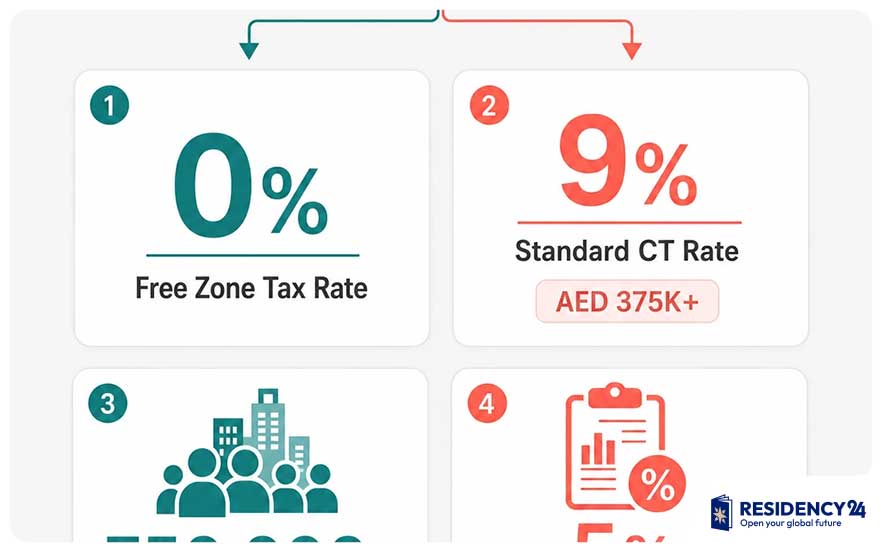
No, UAE free zone companies are not automatically exempt from corporate tax. A juridical person established in a UAE free zone is still within the scope of UAE Corporate Tax as a taxable person, but it may benefit from a 0% corporate tax rate on qualifying income if it meets the conditions to be treated as a Qualifying Free Zone Person.
The standard UAE corporate tax regime applies to financial years starting on or after 1 June 2023, and the general rate is 9% on taxable income above AED 375,000. Free zone companies can preserve the 0% benefit only for qualifying income and only while they continue to meet the required conditions.
UAE Corporate Tax Free Zone: Quick Summary
Point | What It Means |
|---|---|
Free zone companies in scope? | Yes, they are within UAE Corporate Tax |
Automatic 0% tax? | No |
0% rate applies to | Qualifying Income of a Qualifying Free Zone Person |
9% rate applies to | Non-qualifying taxable income or ordinary taxable income |
Corporate Tax registration | Required for taxable persons, including free zone persons |
Filing deadline | Generally within 9 months after the end of the tax period |
De minimis threshold | Non-qualifying revenue must not exceed the lower of 5% of total revenue or AED 5 million |
Failure to meet conditions | Loss of free zone regime for at least 5 years |
Small Business Relief | Not available to Qualifying Free Zone Persons |
Mainland business risk | Can affect 0% treatment depending on activity and income type |
The practical rule is simple: a free zone licence is only the starting point. The tax result depends on activity, income type, customers, substance, records, and compliance.
What Is a Qualifying Free Zone Person?
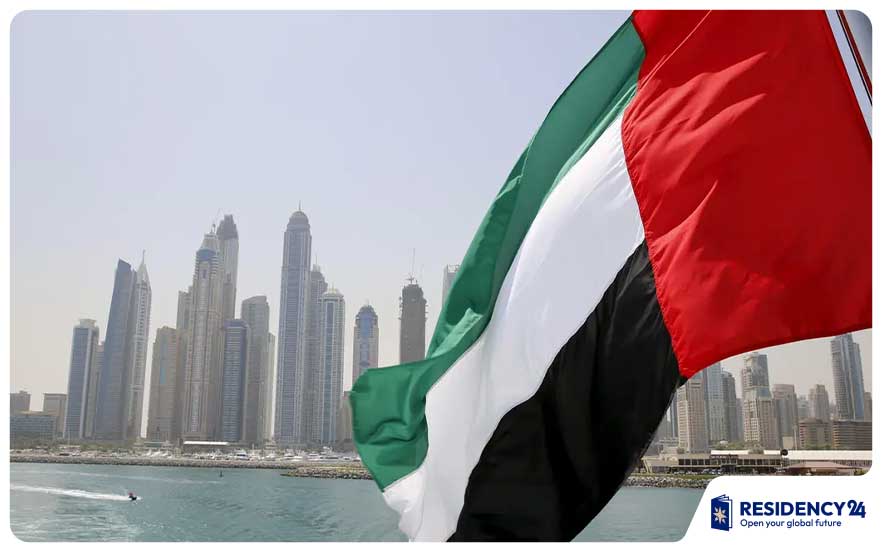
Zone status starts at incorporation - the choice is framed in Free Zone vs. Mainland in Dubai. A Qualifying Free Zone Person is a free zone juridical person that meets the conditions required to benefit from the 0% corporate tax rate on qualifying income. The UAE Ministry of Finance states that a free zone juridical person is within the corporate tax framework, but a Free Zone Person meeting the qualifying conditions can benefit from 0% tax on qualifying income.
To stay within the regime, the free zone company must generally:
Be incorporated, formed, or registered in a UAE free zone.
Maintain adequate substance in the UAE.
Earn qualifying income.
Avoid or limit non-qualifying income within the permitted de minimis threshold.
Comply with transfer pricing rules.
Prepare and maintain proper records and financial statements.
Register and file with the Federal Tax Authority.
Avoid electing to be taxed under the ordinary corporate tax regime if it wants the free zone benefit.
A company can be in a free zone and still fail to be a Qualifying Free Zone Person.
What Is Qualifying Income?
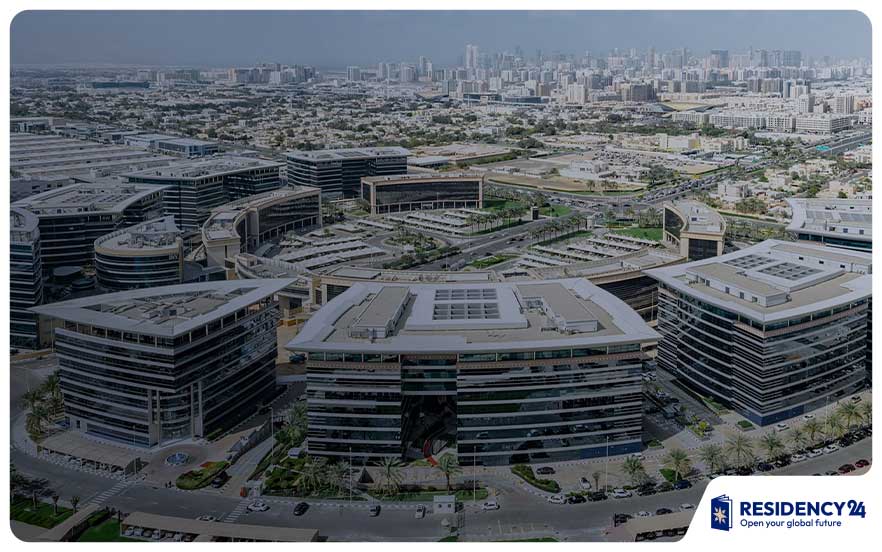
Qualifying Income is the income that can benefit from the 0% corporate tax rate under the UAE free zone corporate tax regime. The Ministry of Finance explains that qualifying income includes income from transactions with other Free Zone Persons and certain domestic or foreign income from qualifying activities listed in the relevant ministerial decisions.
Qualifying income can include income from selected activities such as:
Manufacturing of goods or materials
Processing of goods or materials
Holding of shares and other securities
Ownership, management, and operation of ships
Reinsurance services
Regulated fund management services
Regulated wealth and investment management services
Headquarters services to related parties
Treasury and financing services to related parties
Aircraft financing and leasing
Logistics services
Distribution in or from a designated zone under relevant conditions
Ancillary activities connected to qualifying activities
The 2025 update is important. The Ministry of Finance announced that Ministerial Decision No. 229 of 2025 replaced Ministerial Decision No. 265 of 2023 and clarified the scope of qualifying activities and excluded activities. The update also expanded qualifying commodity trading to include metals, minerals, industrial chemicals, energy and agricultural commodities, associated by-products, and environmental commodities when a quoted price exists.
What Income Is Taxed at 9%?
Income that is not Qualifying Income may be taxed at the ordinary UAE corporate tax rate. The Ministry of Finance states that revenue attributable to a domestic or foreign permanent establishment and some immovable property income that cannot benefit from the free zone regime will be subject to the regular UAE corporate tax regime at 9%.
A free zone company may face 9% tax on:
Non-qualifying mainland income
Income from excluded activities
Income from certain natural-person transactions
Income from certain regulated financial services
Income from some intangible assets
Non-qualifying immovable property income
Income attributable to a UAE mainland permanent establishment
Income attributable to a foreign permanent establishment
Taxable income after losing Qualifying Free Zone Person status
A free zone company should separate qualifying income from non-qualifying income before filing its Corporate Tax return.
What Are Excluded Activities?
Excluded Activities are activities whose income does not qualify for the 0% free zone corporate tax treatment, even if the income is earned by a free zone company. The Ministry of Finance explains that income from certain excluded activities will not be treated as qualifying income, even if earned from a Free Zone Person or while undertaking a qualifying activity.
Excluded activity risk often appears in:
Transactions with natural persons, subject to limited exceptions
Certain regulated financial services
Certain insurance or banking-type activities
Intangible asset income
Certain immovable property income
Mainland-facing activities that do not fit the qualifying framework
The exact result depends on the activity, counterparty, asset type, contract, and whether an exception applies. A company should not rely on the free zone label alone.
De Minimis Rule for UAE Free Zone Corporate Tax
The de minimis rule allows a Qualifying Free Zone Person to earn a limited amount of non-qualifying revenue without losing the free zone corporate tax regime. The Ministry of Finance states that non-qualifying revenue must not exceed the lower of 5% of total revenue or AED 5 million.
Example | Total Revenue | Non-Qualifying Revenue | Result |
|---|---|---|---|
Company A | AED 10 million | AED 300,000 | Within 5% and below AED 5 million |
Company B | AED 10 million | AED 700,000 | Above 5%, risk of losing regime |
Company C | AED 200 million | AED 4 million | Within AED 5 million and 5% |
Company D | AED 200 million | AED 8 million | Above AED 5 million, risk of losing regime |
This rule is useful, but it is not a planning tool for deliberately mixing large mainland or excluded income into a free zone company.
What Happens If the Free Zone Company Fails the Conditions?
If a free zone company fails the de minimis test or does not continue to meet the qualifying conditions, it can lose the free zone corporate tax regime for a minimum period of five years. During that period, it is treated as an ordinary taxable person and taxed at 9% on taxable income above AED 375,000.
This is one of the most important risks for free zone companies. The issue is not only the tax on one transaction. A failed condition can affect multiple tax periods.
Common failure triggers include:
Too much non-qualifying revenue
Conducting excluded activities
Insufficient substance in the UAE
Incorrect mainland activity
Weak transfer pricing documentation
Poor accounting separation
Not maintaining audited financial statements where required
Misclassifying income as qualifying
Not filing correctly
Free zone tax planning should be conservative because the penalty for losing the regime can be significant.
Corporate Tax Registration for Free Zone Companies
Free zone companies must register for Corporate Tax if they are subject to the regime. The Ministry of Finance states that all taxable persons, including free zone persons, are required to register for Corporate Tax and obtain a Corporate Tax Registration Number.
The FTA’s registration service page states that all juridical persons subject to Corporate Tax must register with the Federal Tax Authority and obtain a Corporate Tax Registration Number. It also states that late registration can result in an administrative penalty of AED 10,000.
For free zone companies incorporated on or after 1 March 2024, the FTA says they must apply for Corporate Tax registration within three months from incorporation, establishment, or recognition.
Filing Corporate Tax Returns

Free zone companies must file Corporate Tax returns. The FTA has confirmed that all Corporate Taxable Persons, regardless of income level, have a legal obligation to file tax returns, and that returns must be submitted within a period not exceeding nine months from the end of the relevant tax period.
The same nine-month period generally applies to payment of any Corporate Tax due. The Ministry of Finance also states that taxable persons must file a Corporate Tax return for each tax period within nine months from the end of that period, and the same deadline generally applies to payment.
A free zone company should prepare:
Corporate Tax Registration Number
Financial statements
Revenue split by category
Qualifying income analysis
Non-qualifying income analysis
Transfer pricing documentation, if relevant
Related-party transaction records
Free zone substance evidence
Details of mainland or foreign permanent establishment income
Supporting invoices and contracts
VAT reconciliation, if applicable
The tax return should show why the 0% rate applies, not simply claim it.
Is Small Business Relief Available to Free Zone Companies?
Small Business Relief is not available to Qualifying Free Zone Persons. The Ministry of Finance states that taxable resident persons can claim Small Business Relief when revenue does not exceed AED 3 million for relevant tax periods ending before or on 31 December 2026, but that the relief is not available to Qualifying Free Zone Persons or members of certain multinational enterprise groups.
This creates a practical decision:
Company Type | Potential Relief |
|---|---|
Mainland small business below AED 3 million revenue | May consider Small Business Relief if conditions are met |
Qualifying Free Zone Person | Cannot use Small Business Relief |
Free zone company that chooses ordinary tax treatment | Needs separate review |
MNE group member above relevant group threshold | Small Business Relief unavailable |
A free zone company should not assume that “small company” automatically means simplified tax treatment.
Free Zone Company Doing Business With Mainland UAE
This is where most 0% assumptions break down; mainland licensing is covered under company registration in Dubai. A free zone company can lose tax efficiency if it does mainland business in the wrong way. The UAE free zone corporate tax regime is designed mainly for qualifying activities and qualifying transactions, not unrestricted mainland trading.
Mainland income may be risky when:
The company sells directly to mainland UAE customers.
The activity is not a qualifying activity.
The company has employees or operations outside the free zone.
The company creates a UAE mainland permanent establishment.
The company provides services to natural persons.
The income falls into an excluded activity.
The company exceeds the de minimis threshold.
Mainland-facing operations should be reviewed before revenue starts. A free zone setup can still work, but the contract flow, activity, customer type, and delivery model matter.
Free Zone Company Selling Internationally
A free zone company selling internationally may be better positioned for the 0% regime when the activity is a qualifying activity and the income is not excluded. Many free zones are designed for global trading, logistics, distribution, manufacturing, technology, holding, headquarters, and cross-border service models.
International income should still be tested for:
Qualifying activity status
Substance in the UAE
Related-party transfer pricing
Permanent establishment abroad
Customer type
Contract location
Place of management and control
Whether employees are in the free zone
Whether assets and decision-making are in the UAE
Whether income is attributable to a foreign permanent establishment
Cross-border income is not automatically qualifying. The activity and substance must support the treatment.
Designated Zones and Distribution Businesses
Distribution businesses need special care. The Ministry of Finance explains that distribution in or from a Designated Zone can be a qualifying activity if the relevant conditions are met.
The 2025 update also clarified that distribution of goods or materials in or from a Designated Zone can include transactions with public benefit entities without affecting the de minimis threshold.
Distribution companies should check:
Whether the free zone is a Designated Zone
Whether goods enter, move through, or leave the zone correctly
Whether the customer type is permitted
Whether customs and VAT treatment are documented
Whether storage, logistics, and inventory records support the activity
Whether mainland sales create non-qualifying income
Whether the activity is distribution, trading, or something else
A normal free zone licence is not enough. The zone status and goods flow matter.
Qualifying Commodity Trading
Qualifying commodity trading is one of the areas clarified in 2025. The Ministry of Finance says Ministerial Decision No. 229 of 2025 removed the term “in raw form” and allows trading of metals, minerals, industrial chemicals, energy and agricultural commodities, and associated by-products, where a quoted price exists.
This matters for commodity traders because the corporate tax result may depend on:
Type of commodity
Whether a quoted price exists
Recognised exchange or price reporting agency
Physical trading documentation
Hedging transactions
Related commodity treatment
Whether trading is conducted in or from the free zone
Transfer pricing and related-party rules
Commodity companies should review the 2025 rules carefully before filing.
Treasury and Financing Services
Treasury and financing services to related parties are included among qualifying activities under the free zone regime. The Ministry of Finance’s 2025 update also provided changes related to self-investment for treasury and financing services to related parties or for the taxpayer’s own account.
This can matter for holding companies, group treasury companies, and regional headquarters structures. However, related-party financing is also a transfer pricing-sensitive area.
A treasury company should document:
Loan agreements
Interest rates
Purpose of financing
Related-party relationship
Arm’s length pricing
Currency risk
Cash pooling arrangements
Board approvals
Substance in the UAE
Whether the financing service is actually performed from the free zone
The free zone benefit does not remove the need for economic and pricing evidence.
Holding Companies in UAE Free Zones

Holding shares and other securities can fall within qualifying activities, but the company must still meet the free zone conditions. The Ministry of Finance includes holding shares and other securities in its summary of qualifying activities for the free zone corporate tax regime.
A free zone holding company should check:
Whether it has adequate substance
Whether board decisions happen in the UAE
Whether ownership records are clear
Whether dividend income is treated correctly
Whether capital gains qualify
Whether foreign subsidiaries create permanent establishment issues
Whether related-party services are separately charged
Whether participation exemption applies
Whether financial statements are prepared correctly
A passive holding company should not ignore corporate tax just because income is mostly dividends or capital gains.
Service Companies in UAE Free Zones
Service companies are more exposed to tax classification risk because many services are performed for mainland clients, individuals, related parties, or foreign customers. A free zone consulting, marketing, software, agency, or professional services company should not assume 0% tax applies to all income.
Service-company risks include:
Services to natural persons
Services delivered physically outside the free zone
Mainland UAE client base
Staff working from mainland offices
Wrong licence activity
Weak substance in the free zone
Related-party service fees
No transfer pricing support
Non-qualifying revenue above the de minimis threshold
A service company may still benefit from the regime, but only after checking whether its income fits the qualifying rules.
Real Estate Income in Free Zones
Real estate income has special rules. The Ministry of Finance explains that some immovable property income is excluded from qualifying income, except for transactions with Free Zone Persons in relation to commercial immovable property located in a free zone. It also states that some free zone immovable property income that cannot benefit from the free zone regime is taxed under the regular 9% UAE corporate tax regime.
Real estate companies should check:
Is the property commercial or residential?
Is the property located inside a free zone?
Is the counterparty a Free Zone Person?
Is the income rent, sale proceeds, management fee, or development profit?
Does the company own property directly?
Does the company act as a developer, broker, landlord, or manager?
Is the income excluded or qualifying?
Is the income taxed at 9% separately?
Real estate income should not be classified casually. It is one of the clearer risk areas in the free zone regime.
Permanent Establishment Risk

A free zone company can create a permanent establishment in the UAE mainland or another country if its operations, employees, agents, or fixed places of business are located outside the free zone in a way that meets the legal test. The Ministry of Finance states that profits attributable to a domestic or foreign permanent establishment of a Free Zone Person are subject to the regular UAE corporate tax regime at 9%.
Permanent establishment risk can arise from:
Mainland office
Employees working from mainland premises
Dependent agents concluding contracts
Service delivery through a fixed place outside the free zone
Foreign branch activity
Overseas project office
Operational substance outside the free zone
Management and control outside the free zone
A free zone company should document where its core income-generating activities are performed.
Adequate Substance Requirement
Substance means real staff, premises and decision-making in the zone - see LLC Company Formation in the UAE for how structures compare. A free zone company needs adequate substance in the UAE to qualify for the regime. In practical terms, the business should have enough people, assets, premises, expenditure, management, and activity in the UAE to support the income it claims as qualifying.
Substance evidence may include:
Office lease
Employee records
Payroll
Board minutes
UAE management decisions
Contracts
Invoices
Bank records
Asset records
Local operating expenses
Outsourcing agreements
Free zone licence activity
Customs or logistics records
Evidence of actual activity in or from the free zone
A company that has only a licence, no activity, no records, and no real UAE function may struggle to support 0% treatment.
Transfer Pricing for Free Zone Companies
Transfer pricing rules apply to UAE businesses that have transactions with related parties and connected persons, whether those parties are in the mainland, a free zone, or another country. The FTA’s corporate tax FAQ states that transfer pricing applies to UAE businesses with related-party and connected-person transactions, including those located in UAE mainland, a free zone, or foreign jurisdictions.
Transfer pricing matters for:
Group service fees
Management fees
Royalties
Loans
Cash pooling
Distribution margins
Manufacturing margins
Headquarters services
Shared staff costs
Procurement services
IP licensing
Related-party leases
Free zone companies should document the arm’s length nature of related-party transactions. A 0% regime without transfer pricing support can create audit risk.
Audited Financial Statements and Records

Free zone companies should maintain proper accounting records and financial statements. The FTA and Ministry of Finance expect taxable persons to keep enough records to support tax filings, and the tax return requires taxable income, losses, credits, financial statement principles, and other information.
A practical records file should include:
Audited financial statements, where required
Trial balance
General ledger
Sales invoices
Purchase invoices
Bank statements
Contracts
Related-party agreements
Transfer pricing support
Free zone licence
Office lease
Payroll records
Customs documents
VAT filings
Qualifying income working papers
De minimis calculation
Permanent establishment analysis
The 0% benefit needs evidence. Poor bookkeeping is one of the easiest ways to lose tax certainty.
VAT and Corporate Tax Are Separate
VAT and corporate tax are separate UAE tax systems. A free zone company may have corporate tax obligations even if it has no VAT registration, and VAT treatment does not automatically decide corporate tax treatment.
For example:
A Designated Zone may have specific VAT treatment.
A free zone company may still need Corporate Tax registration.
A VAT-exempt supply can still have corporate tax consequences.
A 0% corporate tax result does not mean no VAT compliance.
Customs treatment does not automatically mean qualifying income.
Free zone companies should review VAT, customs, and corporate tax together, especially for trading, distribution, logistics, ecommerce, and real estate activities.
Free Zone Corporate Tax vs Mainland Corporate Tax

The main difference is that mainland companies are generally taxed under the standard corporate tax regime, while Qualifying Free Zone Persons can access 0% on qualifying income.
Factor | Free Zone Company | Mainland Company |
|---|---|---|
Corporate Tax scope | In scope | In scope |
0% benefit | Possible on qualifying income | Not the normal regime |
Standard rate | 9% on non-qualifying taxable income | 9% on taxable income above AED 375,000 |
Small Business Relief | Not available to Qualifying Free Zone Persons | May be available if conditions are met |
Mainland sales | Can create free zone tax risk | Normal operating model |
Substance | Required for 0% regime | Required generally for tax and business |
Best for | Qualifying activities, international trade, holding, logistics, distribution, group services | Local UAE services, retail, local contracts, mainland operations |
A free zone company is not always better. It is better only when the business model matches the qualifying free zone regime.
Choosing the Right UAE Free Zone for Corporate Tax
Licence cost and activity list matter as much as the tax position - Business Setup Cost in Dubai has the numbers. The corporate tax result is not decided only by the free zone name. It depends on whether the company’s activities, income, customers, substance, and records match the qualifying regime.
Before choosing a free zone, check:
Is the activity a qualifying activity?
Is the zone a Designated Zone if distribution is involved?
Will customers be Free Zone Persons, mainland companies, foreign customers, or individuals?
Will goods move through the free zone?
Will the company need mainland staff or office space?
Will the company provide services to natural persons?
Will the company hold real estate?
Will related-party transactions occur?
Can the company maintain substance in the UAE?
Can the company prepare proper audited accounts?
Will the income mix pass the de minimis test?
Residency24 can help investors compare UAE company setup routes where corporate tax, visa planning, banking, and free zone activity selection need to fit the same business plan.
Common Mistakes Free Zone Companies Make
Many free zone companies lose tax certainty because they assume free zone equals zero tax.
Common mistakes include:
Not registering for Corporate Tax
Not filing a Corporate Tax return
Assuming all income is qualifying income
Ignoring the de minimis threshold
Selling to mainland customers without tax review
Treating services to individuals as automatically qualifying
Not maintaining substance in the UAE
Not preparing transfer pricing support
Mixing qualifying and non-qualifying income in accounting records
Ignoring real estate income rules
Assuming VAT treatment equals corporate tax treatment
Not checking the 2025 qualifying-activity update
Not using official FTA and Ministry of Finance guidance
Believing a free zone sales agent’s “0% tax forever” claim
The free zone corporate tax regime is beneficial, but it is technical. The company must prove its position.
UAE Free Zone Corporate Tax Checklist
Before filing, use this checklist:
Confirm the company is a Free Zone Person.
Confirm whether it is trying to be a Qualifying Free Zone Person.
Confirm adequate substance in the UAE.
Review all revenue streams.
Classify qualifying income.
Classify non-qualifying income.
Identify excluded activities.
Test the de minimis threshold.
Check mainland income.
Check natural-person transactions.
Check real estate income.
Check permanent establishment risk.
Review related-party transactions.
Prepare transfer pricing documents.
Prepare financial statements.
Confirm Corporate Tax registration.
File the Corporate Tax return within 9 months.
Pay any tax due by the deadline.
Keep supporting records.
This checklist should be completed before the tax return is filed, not after the FTA asks questions.
When to Get Tax Advice
Structure, licence and residency decisions interact: Residency24 works across company formation, residency, property purchase and investment planning. Free zone companies should get professional tax advice if the income model is mixed, mainland-facing, related-party-heavy, or real-estate-based.
Get advice if:
The company sells to mainland UAE customers.
The company has several income streams.
The company deals with natural persons.
The company owns or rents out real estate.
The company has related-party transactions.
The company performs headquarters, treasury, or financing services.
The company trades commodities.
The company uses a Designated Zone.
The company has foreign branches or overseas activity.
The company may have a permanent establishment.
The company has no clear substance in the free zone.
The company may exceed the de minimis threshold.
The company has not filed before.
A tax review is cheaper before filing than after losing the 0% regime.
Conclusion
UAE corporate tax for free zone companies is not a blanket exemption. A free zone company is generally within the scope of UAE Corporate Tax and must register, maintain records, and file a Corporate Tax return. The 0% corporate tax rate applies only to Qualifying Income earned by a Qualifying Free Zone Person. Income that is non-qualifying, excluded, linked to certain mainland or permanent-establishment activity, or connected to some immovable property situations can be taxed at 9%. The de minimis rule gives limited flexibility, but non-qualifying revenue must not exceed the lower of 5% of total revenue or AED 5 million. If the company fails the conditions, it can lose the free zone regime for at least five years. The safest approach is to review the company’s activity, customer base, income streams, substance, accounting, transfer pricing, and filing obligations before assuming that a UAE free zone setup is tax-free.