 Anahita Attarian
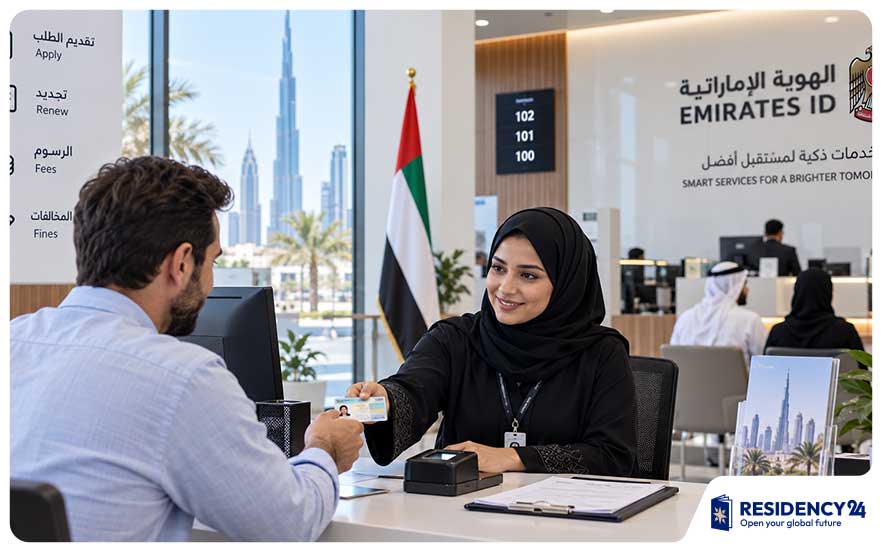
Emirates ID is the official identity card issued by the UAE government to citizens, GCC nationals living in the UAE, and foreign residents. It is mandatory for every UAE citizen and resident, including children and newborns, and it is used across government, banking, telecom, healthcare, travel, residency, and private-sector services. For expats, Emirates ID is usually issued together with the UAE residence process and its validity is normally linked to the residence permit. The card is not just a plastic ID; it contains a unique identity number, readable data, biometric information, and an electronic chip used for identity verification. Anyone moving to the UAE should treat Emirates ID as one of the main documents needed for daily life.
What Is Emirates ID?
Emirates ID is the UAE’s official identity card for citizens and residents. It proves the holder’s identity, links the person to the UAE population register, and is required for many public and private services.
The Federal Authority for Identity, Citizenship, Customs and Port Security states that the ID card includes a unique identification number, readable data, and data stored on an electronic chip, while the UAE government portal states that Emirates ID is mandatory for all UAE citizens and residents, including children and newborn babies.
Emirates ID: Quick Summary
Point | What It Means |
|---|---|
Issuing authority | Federal Authority for Identity, Citizenship, Customs and Port Security |
Required for | UAE citizens, GCC nationals in the UAE, and UAE residents |
Mandatory? | Yes, for citizens and residents, including children and newborns |
Main use | Identity proof for government and private services |
For expats | Usually linked to residence visa issuance or renewal |
Validity for residents | Usually linked to residence validity |
Biometrics | Fingerprint and signature are required for people aged 15 and above where applicable |
New resident fee | AED 100 per year of residence, plus service fees |
Renewal fine | AED 20 per day after the grace period, up to AED 1,000 |
Lost or damaged card replacement | AED 300, plus relevant service fees |
Digital version | Available through ICP digital channels after issuance |
Important duty | Carry the card and show it when legally required |
The practical point is simple: once you become a UAE resident, Emirates ID becomes your core identity document.
Who Needs an Emirates ID?
Every UAE citizen and resident needs an Emirates ID. This includes Emirati citizens, GCC nationals residing in the UAE, foreign residents, sponsored family members, children, and newborn babies.
People who usually need Emirates ID include:
UAE citizens
GCC citizens living in the UAE
Foreign employees
Investors
Property owners with residence
Golden Visa holders
Green Visa holders
Sponsored spouses
Sponsored children
Domestic workers
Students
Newborn babies registered in the UAE
The UAE government’s FAQ states that every citizen and resident must have an Emirates ID, including children and newborn babies.
Why Emirates ID Matters in Daily Life
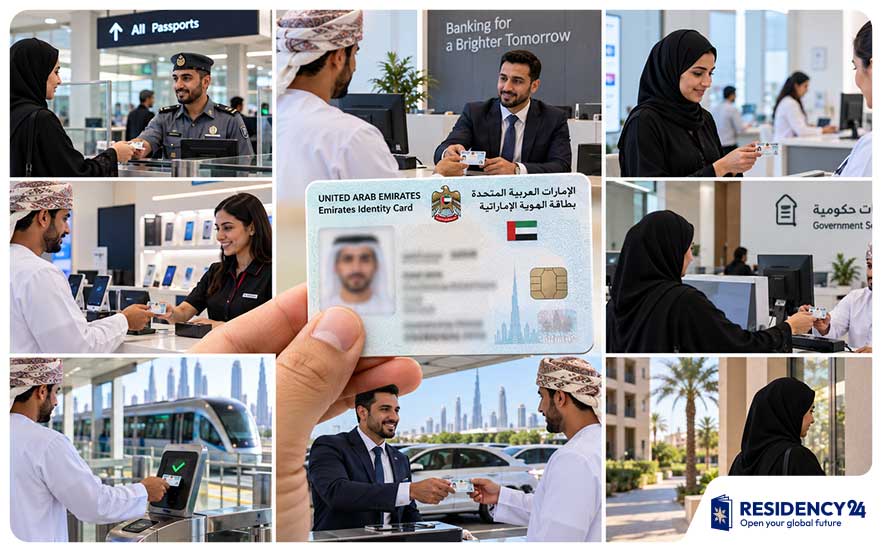
It is the identity layer under most resident services, including the account-opening rules in Bank Account for Non-Residents in the UAE. Emirates ID is used far beyond immigration. In practice, it is required for banking, telecom, healthcare, government services, tenancy procedures, driving-related services, employment processes, school registration, insurance, and UAE Pass verification.
You may need Emirates ID for:
Opening a bank account
Activating a UAE mobile number
Signing tenancy contracts
Registering Ejari or tenancy services
Accessing government portals
Using UAE Pass
Getting health insurance
Visiting hospitals and clinics
Receiving salary
Applying for a driving licence
Registering a vehicle
Accessing immigration services
Sponsoring family members
Renewing residence
Passing through smart gates where accepted
The UAE government portal also lists Emirates ID as usable for accessing government services, travelling to other GCC countries for UAE citizens, and passing through airport immigration gates.
Emirates ID for Expats
The card follows the residence visa, so the route matters - conditions for UAE residency are set out on one page. For expats, Emirates ID is usually part of the residence process. A new resident normally applies for Emirates ID after entering the UAE under the correct visa route and completing the required residence steps.
A typical expat process includes:
Entry permit or visa process.
Medical fitness test, if required.
Residence permit issuance or renewal.
Emirates ID application.
Fingerprint and signature process, if required.
Approval by ICP.
Card printing and delivery.
ICP states that completing the new identity card service for residents is done through the unified application for Emirates ID and residence permit, and the renewal service is linked to issuing or renewing residency permits. For renewals, ICP also notes that the unified residence and identity form applies in all emirates except Dubai.
Residency24 can help investors and property buyers understand how Emirates ID fits into a UAE residence process before they choose a visa route.
Emirates ID for UAE Citizens
For UAE citizens, Emirates ID is a national identity document with a longer validity structure than most resident cards. ICP lists new and renewed national ID card fees of AED 100 for five-year validity for citizens under 21 and AED 200 for ten-year validity for citizens aged 21 and above.
From 14 July 2026, ICP enabled UAE citizens to renew Emirates ID up to one year before expiry, replacing the previous shorter renewal window.
For citizens, Emirates ID can also be used for services such as government access, voting in Federal National Council elections, GCC travel, and smart airport gates where accepted.
Emirates ID for GCC Nationals
GCC nationals living in the UAE may apply for Emirates ID and must provide documents proving their residence or connection in the UAE. ICP’s required-document list for identity card services includes GCC ID for those over 21 or for a parent of those under 21, and it lists supporting documents such as study certificates, employment proof, valid trade or industrial licences, property ownership proof, or kinship documents depending on the case.
For GCC nationals, Emirates ID is often needed for government services, healthcare, property-related services, employment or business proof, and local verification.
Emirates ID for Children and Newborns
Children and newborns also need Emirates ID if they are UAE citizens or residents. For foreign residents with a child born inside the UAE, ICP lists a late fine after four months from the child’s birth if the required identity process is delayed; the fine is AED 20 per day, capped at AED 1,000.
Parents should prepare:
Child passport
Birth certificate
Sponsor documents
Residence visa process documents
Personal photo
Parent Emirates ID
Health insurance, where required
Attested documents if issued outside the UAE
For children, Emirates ID is important for residence, school registration, health insurance, medical services, and family sponsorship records.
Emirates ID Application Process
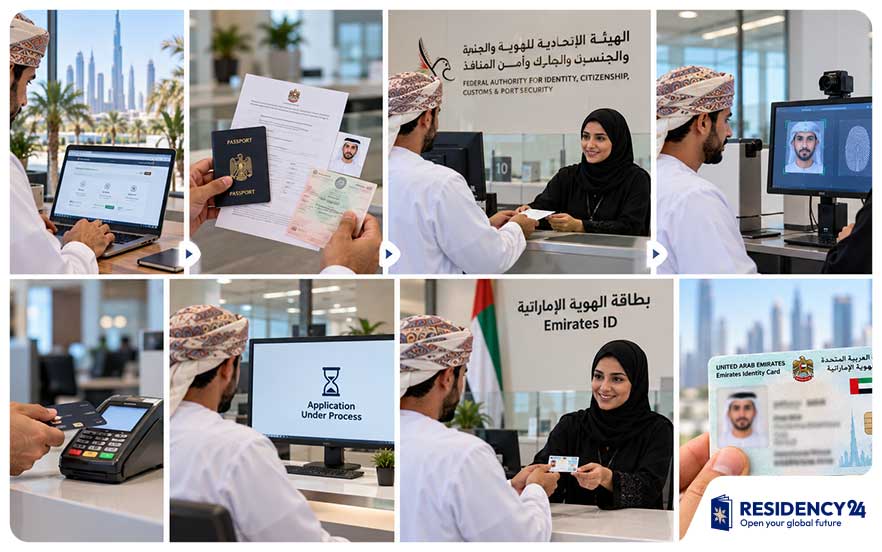
Visa route, card and banking are best sequenced together: Residency24 works across residency, property purchase, company formation and investment planning. The Emirates ID application process depends on whether it is a first issue, renewal, replacement, or data update. For most residents, it is linked to the residence visa process.
A typical first-time application process:
Submit the application through ICP Smart Services, ICP Smart App, a customer happiness centre, or an approved typing channel.
Review the application details.
Attach documents if system integration does not retrieve them.
Pay the required fees.
Complete fingerprint and signature procedures if required.
Wait for approval and card issuance.
Receive the card through authorized courier or collect it through the relevant channel.
ICP lists a five-day completion duration for new identity card issuance and states that smart services are available 24/7.
Documents Required for Emirates ID
The required documents vary by applicant category. For many expat residents, the basic file includes passport, personal photo, residence-related documents, and biometric completion where required.
Common documents include:
Passport
Personal photo
Residence permit or residence application
Sponsor documents for dependents
Employment contract or certificate for employees
Trade licence for investors
Property ownership proof for property owners
Study certificate for students
Attested kinship documents for family members
Previous Emirates ID for renewal or replacement
Damaged card, if applying for replacement due to damage
ICP’s service page lists personal photo and passport as core documents, and adds category-specific documents for students, employees, investors, property owners, relatives, guardians, and other categories.
Emirates ID Biometrics
Biometrics are a key part of Emirates ID. Applicants aged 15 and above may need to complete fingerprint and signature procedures at an ICP service centre, depending on the application and whether biometrics are already registered.
ICP’s renewal service states that individuals who have completed 15 years of age are required to complete fingerprint and signature procedures through authority service centres. It also states that fingerprint capture and signature may be required as part of the digital service steps.
Biometrics help verify identity and reduce identity fraud. For new residents, the fingerprint appointment is one of the main steps before card issuance.
Emirates ID Fees
Digital-first banks lean on the card for onboarding; see Best Digital Banks in the UAE. Emirates ID fees depend on nationality, validity period, service channel, and whether the request is new issuance, renewal, urgent service, replacement, or data update.
Service | Main Fee |
|---|---|
New resident Emirates ID | AED 100 per year of residence |
UAE national under 21, five-year card | AED 100 |
UAE national aged 21 and above, ten-year card | AED 200 |
GCC citizen five-year card | AED 100 |
Smart service fee | AED 100 |
Urgent service fee | AED 150 |
Lost or damaged card replacement | AED 300 |
Data update replacement at service centre | AED 150 |
ICP lists the new resident ID fee as AED 100 per year of residence and the renewal fee for residents also as AED 100 for each year of residence. It lists AED 300 for replacement of a lost or damaged card and AED 150 for urgent service where available.
Fees can vary based on the full service package, delivery, typing, smart-service charges, residence processing, medical test, and Emirates ID duration.
Emirates ID Validity
For residents, Emirates ID validity is usually linked to the residence permit validity. If the resident has a two-year residence visa, the Emirates ID is usually issued in line with that period. If the person has a 10-year Golden Visa, the Emirates ID is normally connected to that long-term residence period.
For UAE citizens, ICP lists five-year validity for citizens under 21 and ten-year validity for citizens aged 21 and above. For residents, ICP lists fees per year of residence, which reflects the connection between residence duration and ID validity.
The important rule is that Emirates ID and residence status should stay aligned. If residence expires, the ID also needs renewal or cancellation depending on the case.
Emirates ID Renewal
Emirates ID renewal is required when the card expires or becomes eligible for renewal. ICP states that Emirates ID can be renewed if it has expired, if less than one year remains before expiry for UAE nationals, or if less than six months remains before expiry for non-UAE nationals.
The renewal process generally includes:
Submit renewal application.
Review retrieved data.
Attach required documents if needed.
Pay fees.
Complete fingerprint and signature if required.
Receive the new card through courier or urgent collection where applicable.
ICP’s FAQ states that UAE nationals may renew during the final year of validity, while GCC nationals and residents may renew upon expiry or during the final six months. It also states that a 30-day grace period is granted after expiry to complete renewal procedures.
Emirates ID Late Renewal Fine
Card renewal is tied to visa renewal, and long-term holders should read UAE Golden Visa 2026 for how the ten-year route changes the cycle. Late Emirates ID renewal can lead to fines. ICP’s FAQ states that the penalty is AED 20 per day, up to a maximum of AED 1,000, and that the fine starts after 30 days from the card’s expiration date.
Late fines may apply when:
The card expires and is not renewed within the grace period.
Personal or civil data changes are not reported within 30 days.
A newborn’s Emirates ID process is delayed beyond the permitted period.
The applicant fails to complete required modifications or procedures in time.
Do not wait until the card is expired if residence renewal, travel, banking, tenancy, or employment processes depend on a valid Emirates ID.
Lost or Damaged Emirates ID
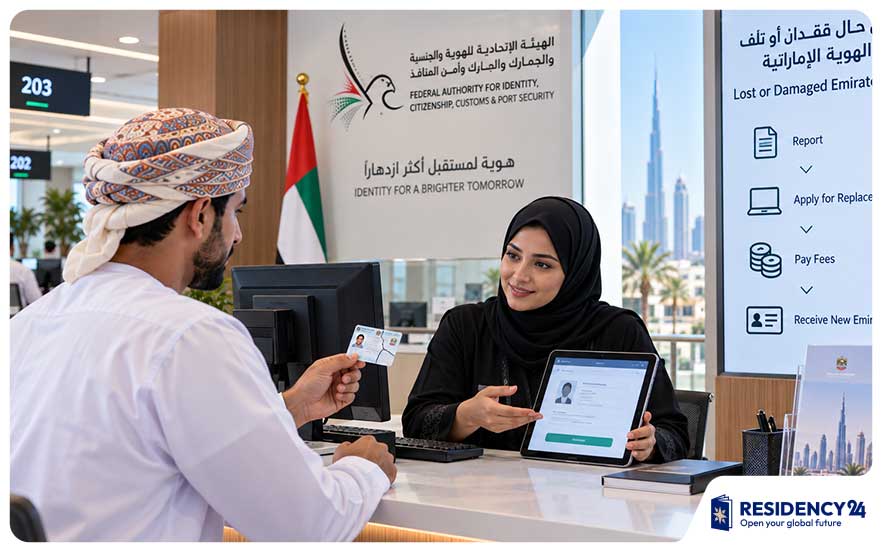
If Emirates ID is lost or damaged, the holder should apply for a replacement. ICP lists AED 300 as the fee for issuing a replacement ID card for lost or damaged cards, plus applicable smart-service or urgent-service fees. The replacement card is issued with the same validity period as the lost or damaged card.
ICP’s card-holder duties also state that the holder should report loss of the ID card to an Emirates ID service point within seven days from the date of loss and apply for replacement if the card is lost or damaged.
If the card is damaged because of a manufacturing defect, ICP’s FAQ says it may be replaced free of charge; if the issue is caused by misuse, the customer must apply for replacement due to damage.
Emirates ID Data Update
Emirates ID data should be kept accurate. ICP states that card holders must report changes in card details to the competent Emirates ID department within one month from the date of change.
Changes that may need updating include:
Name correction
Passport details
Nationality record
Mobile number
Email
Address
Residence status
Sponsor details
Civil status
Other official personal data
ICP also lists a data update service for non-essential data such as phone number, email, and address.
If the visible card information must be changed, replacement or amendment fees may apply depending on the service.
Digital Emirates ID
The digital Emirates ID is useful when the physical card is being issued, replaced, or not immediately available. ICP’s FAQ states that after the ID card is issued, the customer can view the electronic version in the ICP UAE application.
Digital Emirates ID can help with:
Temporary identity proof
Mobile access to ID details
Service verification
Waiting period before physical card delivery
Replacement situations
Some digital government services
Still, the physical card remains important for many real-world processes such as bank verification, some telecom services, in-person government services, and private-sector checks.
Emirates ID and UAE Pass
Emirates ID is closely connected to UAE Pass, the UAE’s national digital identity system. ICP describes UAE Pass as the first approved and unified national digital identity for citizens, residents, and visitors, allowing access to government, semi-government, and private-sector online services and digital signing.
The UAE government portal states that UAE Pass enables smartphone-based authentication and uses biometric face recognition to register users.
For residents, Emirates ID is often needed to verify or strengthen UAE Pass access. This matters because many UAE government and private services now rely on UAE Pass login rather than separate usernames and passwords.
Emirates ID and Banks
Banks in the UAE commonly require Emirates ID for account opening, KYC updates, card renewal, loan applications, salary accounts, credit cards, and ongoing identity verification. If Emirates ID expires, banks may restrict some services until the ID is updated.
Emirates ID may be needed for:
Opening a personal bank account
Opening a business bank account
Updating KYC
Applying for credit cards
Applying for loans
Signing banking documents
Verifying UAE residence
Maintaining salary-account access
For expats, bank-account opening usually becomes easier after Emirates ID is issued because the bank can verify local identity and residence status.
Emirates ID and Mobile Numbers
UAE telecom providers use Emirates ID to register and verify mobile numbers. The UAE government portal notes that “Hesabati” allows users to see mobile and fixed-line phone numbers registered under their Emirates ID number with telecom service providers in the UAE.
This makes Emirates ID important for:
Getting a UAE SIM card
Renewing mobile registration
Checking numbers registered under your name
Preventing misuse of your identity
Maintaining telecom compliance
If you leave the UAE, cancel unused mobile lines. Active phone numbers under your Emirates ID can create billing or identity issues later.
Emirates ID and Healthcare

Emirates ID is used widely in the UAE healthcare system. It helps verify identity, insurance, patient records, eligibility, and government health-service access. The UAE government FAQ states that Emirates ID is also used to access medical services in the UAE.
You may need Emirates ID for:
Hospital registration
Clinic appointments
Insurance verification
Pharmacy records
Medical fitness processes
Government health services
Emergency identification
Vaccination or public health records
Residents should keep Emirates ID available when visiting clinics, hospitals, pharmacies, and insurance service points.
Emirates ID and Travel
Emirates ID can support some travel-related functions. The UAE government portal states that Emirates ID can be used by UAE citizens as a travel document within GCC countries and can be used to pass through immigration gates at UAE airports.
For expat residents, Emirates ID is not a passport replacement. Foreign residents still need their passport, valid UAE residence, and any required destination visa for international travel.
Travel-related uses include:
Airport smart gates where accepted
Identity verification at travel services
Residence verification
GCC travel for UAE citizens
Government travel-related services
Before travel, residents should check passport validity, residence validity, Emirates ID validity, and destination entry rules.
Emirates ID and Residence Visa
For residents, Emirates ID and residence visa processes are closely linked. A new resident usually receives Emirates ID after residence approval, biometrics, and card issuance. Renewing a residence visa generally involves renewing Emirates ID as part of the same administrative cycle.
ICP’s renewal service lists dependency on new identity card issuance, issuing residency permits, and renewing residency permits. It also states that for residents, identity-card renewal is submitted together with the residence application through the unified residence and identity form in all emirates except Dubai.
This matters because an expat cannot treat Emirates ID as separate from immigration status. If residence is cancelled, expired, or changed, Emirates ID must be handled accordingly.
Emirates ID and Golden Visa
Golden Visa holders also need Emirates ID. The ID validity normally follows the long-term residence duration, which means a 10-year Golden Visa holder usually receives an Emirates ID aligned with the Golden Visa period.
Golden Visa holders need Emirates ID for:
Banking
Property services
Family sponsorship
UAE Pass
Health insurance
Employment or business services
Driving licence
Tenancy
School registration
Government services
If the Golden Visa is renewed, cancelled, or category-changed, the Emirates ID record must also remain accurate.
Emirates ID and Company Owners
Company owners, investors, and free-zone shareholders often need Emirates ID for company banking, trade licence services, visa sponsorship, labour files, tax registration, UAE Pass, and government portals.
Business owners may need Emirates ID for:
Corporate bank account opening
Trade licence renewals
Establishment card services
Corporate tax registration
VAT registration
Labour and visa files
Shareholder verification
Free-zone portals
Lease and Ejari services
Notary or legal services
An investor without Emirates ID may face difficulty completing local banking and government-platform processes, even if the company has already been registered.
Can a Company Keep an Employee’s Emirates ID?
No, companies should not keep or seize someone else’s Emirates ID unless there is a court decision or legal basis. ICP’s card-holder duties state that the holder should not leave the ID card at any organization unless there is a decision or judgment by a competent court. The UAE government portal also notes that institutions and companies are not allowed to seize Emirates ID cards of employees, customers, or visitors except based on a competent court decision or judgment.
If an employer, landlord, hotel, or service provider asks to keep the original card, the safer approach is to provide a copy or allow verification without surrendering the original unless the law requires otherwise.
What Information Is on Emirates ID?
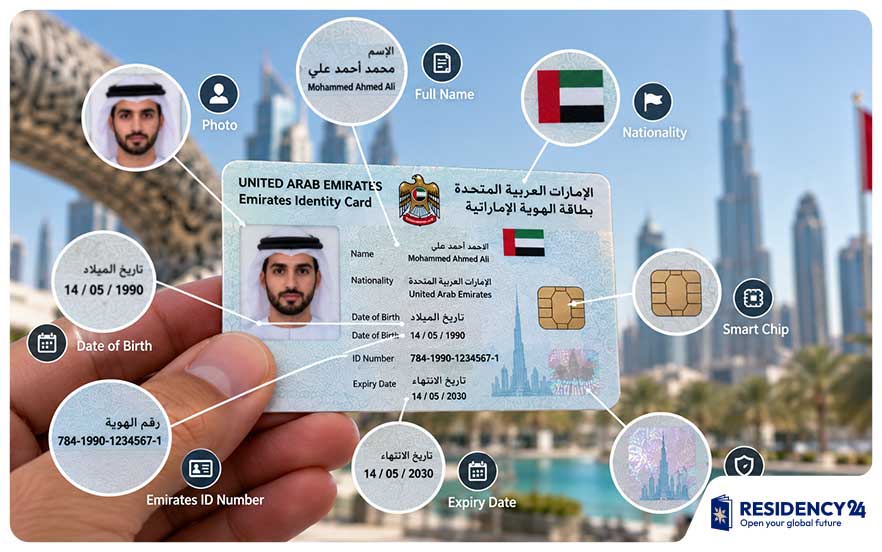
Emirates ID includes visible and chip-based information. ICP states that each card bears a unique identification number, readable data, and data stored on an electronic chip. ICP’s card features page also describes the identity number as a number that stays with the holder forever.
The card can include:
Name
Nationality
Date of birth
Gender
ID number
Signature
Photo
Card number
Expiry date
Electronic chip data
Biometric-linked identity record
Because Emirates ID contains sensitive identity information, it should not be shared casually or sent to unverified parties.
Emirates ID Number
The Emirates ID number is a unique identity number assigned to the holder. ICP describes the ID number as one that remains with the holder permanently.
This number is used in many systems, including:
Government portals
UAE Pass
Banking
Telecom
Health insurance
Visa services
Labour services
Property services
School and university records
Vehicle and driving services
Because the number is permanent, errors in personal data should be corrected quickly.
Emirates ID Status Check
Applicants can track Emirates ID application status through ICP digital channels. ICP’s FAQ states that status can be checked through the applicant’s personal account, through the Smart Services website using the application number starting with 010, or by contacting the call centre.
You may need to check status when:
A new card is under process
Renewal is delayed
Biometric completion is pending
The card has not been delivered
The application was returned for modification
The card was lost or damaged
Courier delivery failed
Data update is pending
Keep the application number, PRAN, mobile number, and passport details available when checking.
Emirates ID Delivery
After approval, Emirates ID is delivered through authorized courier for standard services. ICP’s renewal service states that the new ID card is delivered through authorized courier for standard service and collected from authority centres for urgent service.
Delivery can be delayed if:
Address is incorrect
Mobile number is wrong
Application was returned for modification
Biometrics are incomplete
Payment is incomplete
Residence approval is pending
Courier could not reach the applicant
Always provide an active UAE mobile number and accurate delivery address.
Urgent Emirates ID Service
ICP lists an urgent service fee of AED 150, available only at authority service centres. For renewal, ICP says the urgent card is collected from authority centres rather than delivered through standard courier.
Urgent service can be useful when:
A resident needs the card quickly for banking
A travel or employment process depends on the ID
A replacement is needed after loss or damage
A government service requires physical Emirates ID
A deadline is close
The urgent service may still depend on eligibility, biometric completion, and correct documents.
Common Emirates ID Problems
Most Emirates ID problems are administrative rather than legal. They usually happen because data, documents, residence status, biometrics, or delivery information is incomplete.
Common problems include:
Application returned for modification
Wrong name spelling
Old passport details
Expired passport
Missing photo
Photo not compliant
Biometrics not completed
Residence approval pending
Delivery address error
Mobile number mismatch
Card not delivered
Card lost or damaged
Bank or telecom system not updated
UAE Pass not verifying
ICP states that applications may be cancelled if procedures are not completed or required modifications are not made within the specified period.
Mistakes to Avoid
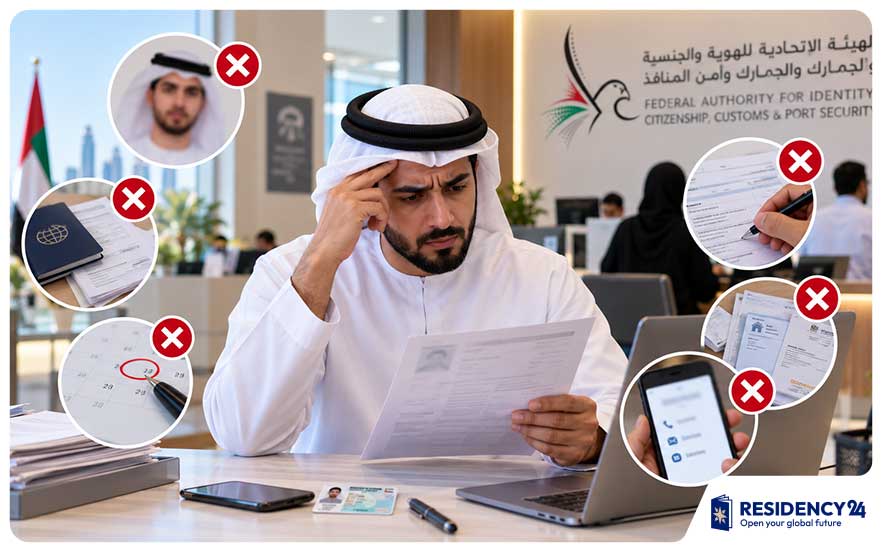
Emirates ID is simple when the file is clean. Most delays come from avoidable mistakes.
Avoid these mistakes:
Waiting until after expiry to renew
Ignoring the 30-day grace period
Not updating changed personal data
Using an old passport copy
Uploading a non-compliant photo
Missing fingerprint appointment
Providing a wrong mobile number
Giving an incomplete delivery address
Letting an employer keep the original card
Sharing the card copy with unverified parties
Not checking application status
Not replacing a lost or damaged card quickly
Forgetting newborn registration timelines
Assuming digital ID replaces all physical-card uses
For residents, Emirates ID should be kept valid, accessible, and updated.
Emirates ID Checklist for New Residents
Before applying for Emirates ID, new residents should prepare:
Valid passport
Entry permit or residence application
Personal photo
Sponsor details
Mobile number
UAE address
Medical fitness result, if required
Fingerprint appointment, if required
Health insurance, where required
Family documents, if applying for dependents
Payment card
Application number for tracking
After approval, check:
Card delivery status
Name spelling
Nationality
Date of birth
Expiry date
UAE Pass activation
Bank and telecom KYC updates
A mistake on Emirates ID can affect many downstream services, so check the card as soon as it arrives.
Emirates ID Renewal Checklist
Before renewing Emirates ID, prepare:
Current Emirates ID
Passport valid for the required period
Updated personal photo
Residence renewal documents
Health insurance, if required
Updated mobile number and address
Fingerprint and signature appointment, if required
Sponsor documents for family members
Trade licence or property proof for investor-related cases
Payment for renewal and service fees
ICP states that the passport must be valid for at least three months for Emirates ID renewal, and that people aged 15 and above must complete fingerprint and signature procedures through service centres where required.
What to Do Before Leaving the UAE Permanently
If you leave the UAE permanently or change residency status, Emirates ID should be handled with the residence cancellation process. The UAE government portal states that if you are leaving the UAE permanently or changing your residency status, you should cancel your residence visa and Emirates ID card through the relevant entities.
Before leaving, check:
Residence cancellation
Emirates ID cancellation
Bank account status
Credit cards and loans
Mobile numbers registered under Emirates ID
Tenancy and utilities
Vehicle registration
Health insurance
Family visa cancellation
Company or investor files
Do not leave active accounts, debts, SIM cards, or unresolved services linked to your Emirates ID.
Conclusion
Emirates ID is the central identity document for UAE citizens and residents. It is mandatory for citizens and residents, including children and newborns, and it is used for government services, banking, telecom, healthcare, travel, residence, UAE Pass, property, employment, and business procedures. For expats, Emirates ID is usually connected to residence visa issuance or renewal, and its validity normally follows the residence period. The standard resident fee is AED 100 per year of residence, while late renewal fines are AED 20 per day after the grace period, capped at AED 1,000. A lost or damaged card should be reported and replaced, with ICP listing AED 300 for replacement. The safest approach is to keep Emirates ID valid, update personal data within the required period, complete biometric steps on time, protect the original card, and avoid sharing copies with unverified parties.