 Anahita Attarian
Health insurance is one of the main requirements for getting or renewing residency in the UAE. It matters for employees, investors, property owners, Golden Visa holders, family members, domestic workers, students, and dependents. The exact rule depends on the emirate, visa type, sponsor, employer, and insurance category, but the practical answer is simple: a UAE residence visa application can be delayed or rejected if the applicant does not have valid health insurance accepted by the relevant authority. Since 2025, mandatory health insurance has also expanded across the UAE for private-sector employees and domestic workers, making insurance a core part of residence issuance and renewal. For anyone planning UAE residency, the safest approach is to arrange insurance before the visa file reaches the final issuance or renewal stage.
Is Health Insurance Required for UAE Residency?
Yes, health insurance is required for UAE residency in most practical residence visa routes. It is already mandatory in Dubai and Abu Dhabi, and from 1 January 2025, employers must also purchase health insurance as a prerequisite for issuing or renewing residency permits for private-sector employees and domestic workers across the UAE.
For federal UAE visa services, ICP lists a valid health insurance policy within the UAE among the conditions for several entry and residence procedures. For property-owner and Golden Visa-related files, health insurance is also part of the application requirements.
Health Insurance for Residency: Quick Summary
Applicant Type | Insurance Requirement | Who Usually Pays |
|---|---|---|
Dubai employee | Mandatory | Employer |
Dubai dependent | Mandatory | Sponsor, unless covered by employer |
Abu Dhabi employee | Mandatory | Employer |
Abu Dhabi dependent | Mandatory | Sponsor or employer, depending on case |
Private-sector worker in other emirates | Mandatory from 1 January 2025 for issuance or renewal | Employer |
Domestic worker | Mandatory under relevant schemes | Domestic worker’s employer or sponsor |
UAE Golden Visa applicant | Required by category or competent authority | Applicant or sponsor |
Property investor | Required for visa or Golden Visa route | Applicant |
Family member | Required for residence issuance or renewal | Sponsor |
Student resident | Required where residence route demands it | Sponsor, university, or applicant |
Visitor converting to residence | May need UAE-valid insurance for entry or completion procedure | Applicant or sponsor |
The cheapest policy is not always the right one. The policy must be valid, accepted in the UAE, connected to the correct visa file, and appropriate for the emirate and applicant category.
Why Health Insurance Matters for Residency
Cover is a condition of the residence file, not an optional extra; the general conditions for UAE residency sit on one page. Health insurance is not only a medical document. It is part of the immigration file. In Dubai, the health insurance system is linked to residence and visa issuance. Dubai’s health insurance implementation resolution states that DHA coordinates with GDRFA to make the issuance and renewal of entry permits, visit visas, and residence permits contingent on satisfying the health insurance prerequisite.
This means insurance can affect:
New residence visa issuance
Residence visa renewal
Emirates ID processing
Golden Visa application
Property investor residence
Family sponsorship
Dependent visa renewal
Domestic worker visa
Employee onboarding
Visa cancellation and transfer
Health insurance fines or compliance flags
A residence file can be technically complete but still blocked if the insurance requirement is not satisfied.
Dubai Health Insurance Requirement for Residency
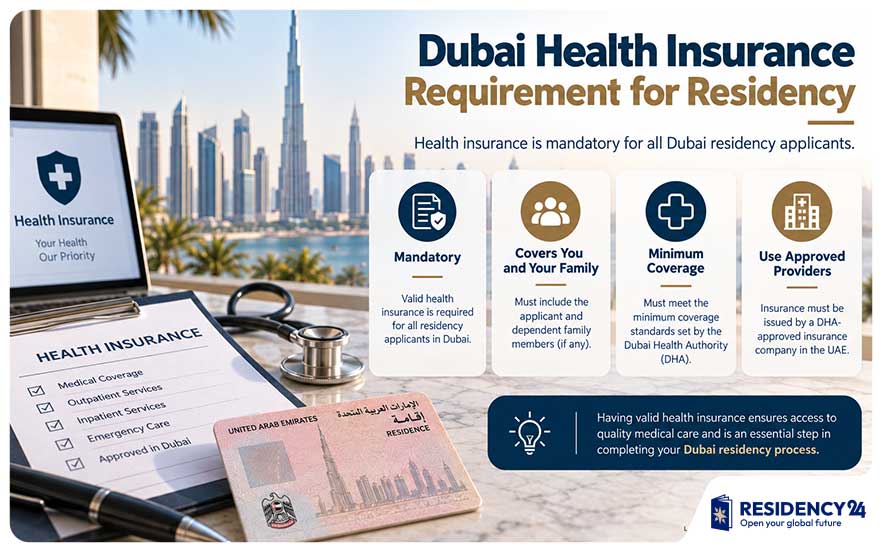
Dubai has one of the clearest mandatory health insurance systems in the UAE. Under Dubai Law No. 11 of 2013, employers must enrol employees in health insurance, bear the cost, and ensure the policy remains valid throughout employment. Sponsors must also enrol sponsored persons who are not covered by an employer, bear the cost, and produce a health insurance policy when issuing or renewing residence or visit permits.
This means:
A Dubai employer must cover employees.
A sponsor must cover family members if they are not covered by an employer.
A sponsor must cover domestic workers and other sponsored dependents.
The policy must remain valid during the residence period.
The beneficiary should not be charged by the employer for employee insurance.
Insurance may be checked during residence issuance or renewal.
Dubai residents should not wait until visa renewal week to arrange insurance. If the policy is expired, mismatched, or not linked correctly, the visa process can be delayed.
Abu Dhabi Health Insurance Requirement for Residency
Abu Dhabi also has a mandatory health insurance system. The Abu Dhabi health insurance manual states that the law and regulations make health insurance mandatory for non-nationals who hold a work or residence visa issued from Abu Dhabi or visit under certain visa types. It also states that employers or sponsors must provide coverage and visa screening for non-nationals under their employment or sponsorship and their dependents.
For Abu Dhabi residents, this affects:
Employment residence visas
Family residence visas
Dependent visas
Visa medical screening
Residency renewal
Sponsor responsibilities
Golden Visa and long-term residence cases where required
Abu Dhabi can be stricter in practice because health insurance, visa screening, employer responsibility, and sponsor responsibility are closely connected.
Health Insurance Across Other Emirates
The UAE expanded mandatory health insurance coverage across the country from 1 January 2025 for private-sector employees and domestic workers. The UAE government portal states that employers are required to purchase health insurance as a prerequisite for applying for the issuance or renewal of residency permits for private-sector employees and domestic workers.
MoHRE’s basic health insurance scheme was introduced with ICP and the Ministry of Health and Prevention, and the package is priced at AED 320 per year. It applies as a practical route for private-sector employees and domestic workers, especially in emirates where this nationwide extension filled earlier coverage gaps.
This matters for residents in:
Sharjah
Ajman
Umm Al Quwain
Ras Al Khaimah
Fujairah
The rule does not mean every resident buys the same policy. It means valid health insurance has become part of the residence issuance and renewal process for affected worker categories.
Basic Health Insurance Package Cost in the UAE
Premiums are a fixed line in the household budget alongside the figures in Cost of Living in Dubai in 2026. Matching a policy to the visa route is worth doing before purchase: Residency24 works across residency, property purchase, company formation and investment planning. The basic UAE health insurance package launched through MoHRE costs AED 320 per year. MoHRE states that the package is for private-sector employees and domestic workers and is available through DubaiCare Network or other approved suppliers. It also notes that the package has no waiting period for workers with chronic illnesses.
A practical cost view:
Policy Type | Typical Use | Cost Logic |
|---|---|---|
Basic UAE package | Private-sector workers and domestic workers under the 2025 scheme | AED 320 per year |
Dubai Essential Benefits Plan | Lower-income employees and dependents in Dubai | Varies by insurer and applicant profile |
Enhanced individual policy | Investors, dependents, higher-income residents | Higher premium |
Family policy | Spouse and children | Depends on age, emirate, cover, network, maternity |
Golden Visa policy | Long-term residence applicants | Depends on age, benefits, emirate, and medical history |
Senior applicant policy | Older investors, parents, retirees | Usually higher premium |
Comprehensive policy | Broader network and higher limits | Higher premium |
The AED 320 package is important, but it should not be treated as the price for every residency case. Investors, family sponsors, older applicants, and people who need wider hospital networks may need more expensive cover.
Who Pays for Health Insurance?
The payer depends on the relationship between the applicant and the visa sponsor. In Dubai, the employer must bear the cost of employee health insurance and cannot charge that cost to the beneficiary. Sponsors must bear the cost for sponsored persons who are not covered by an employer.
A practical breakdown:
Person | Usual Responsible Party |
|---|---|
Employee | Employer |
Domestic worker | Sponsor or domestic worker employer |
Spouse sponsored by resident | Sponsor, unless employer covers them |
Child sponsored by parent | Sponsor |
Parent sponsored by resident | Sponsor |
Investor visa holder | Applicant or company, depending on structure |
Property owner visa holder | Applicant |
Golden Visa holder | Applicant, employer, or sponsor, depending on category |
Student | Sponsor, university arrangement, or applicant |
The rule is not only about who buys the policy. The responsible party must also keep it valid throughout the residence period.
Health Insurance for Employees

For employees, health insurance is usually arranged by the employer. In Dubai, the employer must enrol employees, pay for the policy, and keep it valid throughout employment.
For employees in the wider UAE private sector, from 1 January 2025, the employer must purchase health insurance when issuing or renewing residency permits for private-sector employees under the national basic health insurance scheme.
Employees should check:
Is the policy active before residence renewal?
Does it cover the correct emirate?
Is the network practical near home and workplace?
Are pre-existing or chronic conditions handled correctly?
Are emergency services covered?
Is the policy linked to the visa file?
Is the employer trying to deduct the policy cost incorrectly?
Does the policy remain active after employment cancellation?
A basic employer plan may satisfy residency requirements, but it may not be enough for every medical need.
Health Insurance for Family Residency
Family members need health insurance when they are sponsored for UAE residence. In Dubai, sponsors must enrol sponsored persons who are not covered by an employer and must produce a policy when issuing or renewing the residence permit.
Family residency insurance usually applies to:
Spouse
Children
Parents
Domestic workers
Other eligible dependents
Family sponsors should check:
Policy start date
Visa validity period
Emirate of residence
Hospital network
Maternity cover
Newborn cover
Chronic condition terms
Emergency cover
Annual limit
Co-payment
Pharmacy benefits
Renewal timing
Family insurance is often more expensive than employee basic cover, especially for parents, older dependents, maternity needs, and comprehensive hospital networks.
Health Insurance for Golden Visa
Long-term holders renew on a different cycle - see UAE Golden Visa 2026. Health insurance is required for many UAE Golden Visa routes. ICP lists valid health insurance within the UAE among service requirements for Golden Residency-related entry and residence procedures, and Ministry of Economy guidance states that a real estate Golden Visa investor should have comprehensive health insurance for themselves and family members for the duration of stay or as applied by the competent local authority.
Dubai Land Department’s real estate investor Golden Visa service also lists health insurance among required documents for the 10-year investor residence route.
Golden Visa applicants should check:
Does the policy need to cover the full visa period or only the application stage?
Does the emirate require comprehensive cover?
Are family members included?
Is the policy valid inside the UAE?
Is the insurer accepted by the relevant authority?
Is the applicant living in the UAE full-time or mostly abroad?
Will renewal require updated insurance?
Are parents or older dependents covered?
For Golden Visa holders who spend long periods outside the UAE, insurance still needs to be checked against the issuing emirate’s requirements.
Health Insurance for Property Investor Residency
The investment threshold behind that route is part of buy property in Dubai. Property investors applying for UAE residence or Golden Visa usually need valid health insurance. ICP’s real estate investor entry permit service lists valid UAE health insurance among requirements for completing Golden Residency procedures.
For Dubai property investors, health insurance is listed by DLD as part of the Golden Visa application file.
Residency24 can help Dubai property investors align property purchase, Golden Visa eligibility, health insurance, and family sponsorship requirements before submission.
A property investor should prepare:
Passport
Title deed or property certificate
Valid UAE health insurance
Emirates ID, if available
Current residence permit, if available
Family health insurance if sponsoring dependents
Medical test and Emirates ID steps where required
Bank or property documents if mortgaged
A qualifying property does not remove the insurance requirement.
Health Insurance for Investor or Partner Visa
Which category you fall into changes who pays the premium; the distinctions are in Investor vs Partner vs Freelance Visa UAE. Investor and partner visa holders normally arrange their own health insurance unless the company provides coverage. If the applicant owns a company in Dubai, Abu Dhabi, or another emirate, insurance should be arranged before residence issuance or renewal.
Investor visa insurance should match:
Visa duration
Emirate of issue
Age and medical history
Hospital network preference
Family sponsorship plan
Business travel needs
Chronic condition requirements
Emirates ID and residence renewal timing
A low-cost policy may be enough for visa issuance, but business owners often choose stronger cover because they are responsible for their own medical risk.
Health Insurance for Domestic Workers

Domestic workers are included in mandatory health insurance systems. Dubai’s insurance law places sponsor responsibility on persons sponsored by the sponsor, and MoHRE’s nationwide basic scheme covers domestic workers as part of the 2025 expansion.
Domestic worker sponsors should check:
Insurance is active before visa issuance or renewal.
The policy covers the worker in the UAE.
The card or policy document is available.
Medical test and residence file are coordinated.
Renewal happens before expiry.
The worker understands which clinics and hospitals are in network.
Domestic worker insurance should not be treated as optional or informal. It is part of the visa responsibility.
Health Insurance for Students
Students applying for UAE residence may need health insurance depending on the emirate, sponsor, university, and visa route. Some universities arrange student insurance; others require the student or sponsor to purchase a policy before visa issuance.
Student insurance should include:
Valid UAE coverage
Emergency care
Outpatient clinics
Hospital admission
Pharmacy benefits
Network near campus
Coverage for sports or activities, where relevant
Policy duration matching visa needs
Students under family sponsorship may be covered under a family policy. International students sponsored by universities should follow the university’s visa and insurance process.
Health Insurance for Parents Sponsored in the UAE
Parents are usually more expensive to insure because age and medical history affect premiums. If a resident or Golden Visa holder sponsors parents, insurance should be arranged early because senior-applicant policies can take more time and may require medical declaration.
Parent insurance should be checked for:
Upper age limits
Pre-existing condition coverage
Chronic disease cover
Waiting periods
Hospital network
Emergency cover
Prescription medicine
Co-payment
Annual limit
Renewal restrictions
Claim exclusions
For parent sponsorship, the cheapest policy can become expensive later if it excludes the medical care the parent is most likely to need.
What Should a UAE Residency Health Insurance Policy Cover?
A residency-compliant health insurance policy should be valid in the UAE, accepted by the relevant authority, and matched to the applicant’s visa category. Dubai’s health insurance law states that a policy must include the scope of health benefits, financial ceiling, coverage period, provider network, co-insurance, claims procedures, complaints process, and other required information.
Before buying, check:
Annual coverage limit
Inpatient cover
Outpatient cover
Emergency care
Pharmacy benefits
Diagnostic tests
Specialist visits
Maternity cover
Dental and optical, if needed
Pre-existing condition terms
Chronic condition terms
Co-payment
Deductible
Network hospitals
Geographic coverage
Exclusions
Waiting periods
Renewal rules
A policy can be residency-compliant but still weak for real healthcare use. Residency compliance and medical quality are related, but not the same.
Basic Plan vs Comprehensive Plan
A basic plan is usually designed to satisfy minimum legal or residency requirements at lower cost. A comprehensive plan gives broader coverage, better hospitals, wider networks, lower co-payments, and higher annual limits.
Factor | Basic Plan | Comprehensive Plan |
|---|---|---|
Cost | Lower | Higher |
Residency compliance | Usually enough if accepted | Usually enough if accepted |
Hospital network | Limited | Wider |
Annual limit | Lower | Higher |
Maternity | May be limited | Usually better options |
Chronic conditions | Terms vary | Often better, but still check |
Parents or older applicants | May be limited or expensive | More suitable |
Best for | Basic visa compliance | Real healthcare protection |
If the applicant is young, healthy, and needs only visa compliance, a basic plan may be enough. If the applicant has family, chronic conditions, maternity needs, or wants private hospital access, a comprehensive plan is safer.
Health Insurance and Medical Fitness Test Are Different
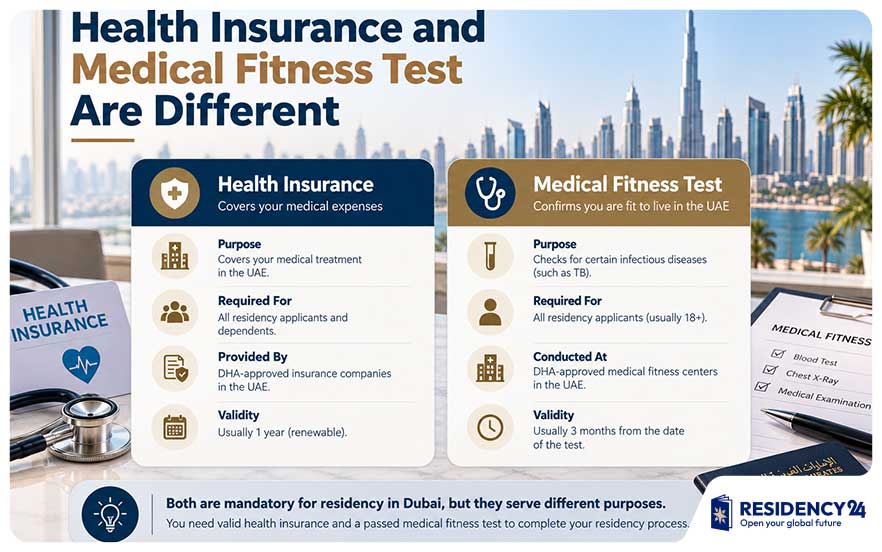
Health insurance and the UAE medical fitness test are not the same. Medical fitness testing is part of the residence process for many adult applicants. Health insurance is the policy that covers medical expenses after the visa is issued or during the insured period.
For residency, an applicant may need both:
Medical fitness test
Emirates ID biometrics
Valid health insurance
Passport validity
Visa or entry permit
Sponsor documents
Abu Dhabi’s visa screening standard states that approved visa screening providers must verify identity documents such as passport, residence visa or Emirates ID for renewal, or entry permit for work, residence, or study. It also notes that valid health insurance is required in some visa screening contexts.
Do not assume passing the medical test means insurance is complete.
Can You Renew Residency Without Health Insurance?
In many cases, no. Dubai’s rules explicitly connect insurance to visa issuance and renewal, and the national 2025 scheme makes insurance a prerequisite for issuing or renewing residency permits for private-sector employees and domestic workers.
A renewal may be delayed if:
Policy has expired.
Policy is not issued inside the UAE.
Policy is not accepted by the relevant emirate.
Insurance data is not linked correctly.
Dependents are not covered.
Employer has not purchased the policy.
Sponsor purchased the wrong policy.
Applicant changed emirate or sponsor.
Emirates ID or visa file does not match the insurance record.
Renew insurance before starting the residence renewal process.
What Happens If Health Insurance Expires?
If health insurance expires, the resident may face visa renewal delays, fines, blocked services, or medical costs paid out of pocket. Dubai’s health insurance law gives DHA enforcement powers and penalties for violations, with fines that can range from AED 500 to AED 150,000 depending on the violation, and repeat violations can increase penalties.
An expired policy can affect:
Visa renewal
Dependent sponsorship
Employer compliance
Domestic worker sponsorship
Hospital access
Claim approval
Bank and HR processes
Golden Visa renewal
Family renewal
The safest rule is to renew the policy before expiry and keep proof of coverage available.
Health Insurance for Residency Cost
The lowest official basic package for affected private-sector workers and domestic workers is AED 320 per year under the MoHRE scheme.
For other residency cases, costs vary widely. The final premium depends on:
Age
Emirate
Visa type
Health history
Chronic conditions
Maternity cover
Hospital network
Annual limit
Co-payment
Family size
Nationality and underwriting profile
Whether the policy is basic or comprehensive
Whether the applicant is an employee, investor, dependent, or parent
Indicative planning view:
Applicant | Cost Pattern |
|---|---|
Private-sector worker under basic scheme | AED 320 per year |
Young dependent | Usually lower than older adult policies |
Spouse | Depends on age, maternity, and network |
Child | Depends on age and benefits |
Investor | Depends on selected policy |
Golden Visa holder | Can vary significantly by age and coverage |
Parent or senior applicant | Usually much higher |
Domestic worker | Basic or approved sponsor-arranged policy |
Do not compare policies by price only. A cheaper plan with poor network access may create higher real costs later.
When Should You Buy Health Insurance for Residency?
Buy or renew health insurance before the residence file reaches the approval stage. For employees, the employer should arrange the policy before residence issuance or renewal. For dependents, the sponsor should arrange it before submitting or renewing the visa. For investors and Golden Visa applicants, the policy should be ready before the authority asks for the document.
A practical timeline:
Confirm visa type.
Confirm emirate of issue.
Check whether employer or sponsor pays.
Select an accepted insurer or approved channel.
Match policy duration to visa needs.
Check applicant name and passport details.
Pay premium.
Receive policy certificate or insurance card.
Submit insurance proof with the residence file.
Keep policy active until renewal or cancellation.
Insurance should not be left until the final day because system linking and approval can take time.
Documents Needed for Health Insurance
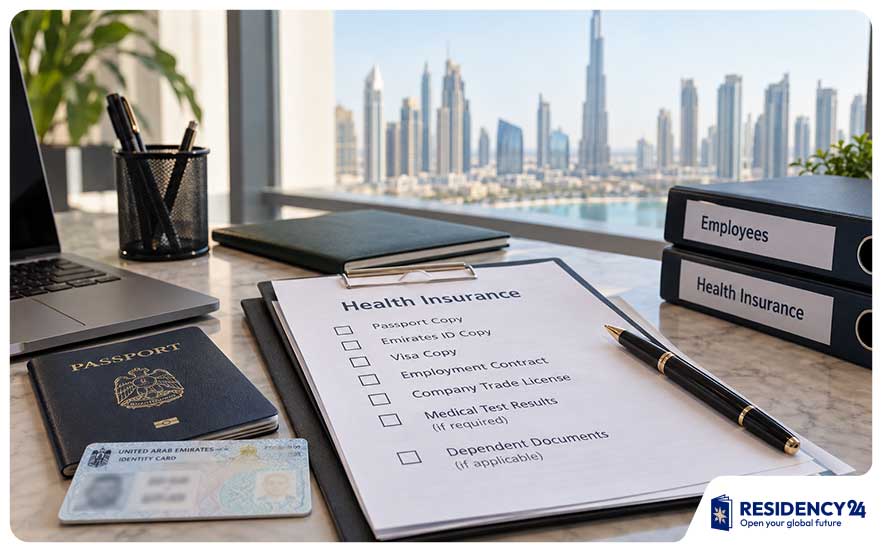
The insurer may request different documents depending on the policy and applicant type.
Common documents include:
Passport copy
UAE visa or entry permit
Emirates ID, if available
UID number, if available
Mobile number
Email address
Salary certificate for some employee-linked plans
Trade license for company plans
Sponsor Emirates ID for dependents
Marriage certificate for spouse
Birth certificate for children
Medical declaration
Previous insurance card, if renewing
Medical reports for chronic or senior cases
For Golden Visa or property investor files, the immigration authority may also request the insurance certificate as part of the residence application.
How to Choose the Right Policy
Choose health insurance based on both visa compliance and real healthcare needs. A policy should not only pass the residency requirement; it should also work when the person needs treatment.
Check:
Is it accepted in the emirate of residence?
Is it valid inside the UAE?
Does it match the visa holder’s details?
Does it cover the full required period?
Are nearby clinics and hospitals in network?
Is emergency treatment covered?
Are pre-existing conditions covered or limited?
Is maternity needed?
Is the annual limit realistic?
Are specialist visits covered?
What are the co-payments?
Are medicines included?
Are claims direct billing or reimbursement?
Can it be renewed easily?
Will it support family visa renewal?
The best policy is the one that satisfies immigration and does not fail during real medical use.
Common Health Insurance Mistakes in UAE Residency
Most insurance problems happen because the applicant treats the policy as a formality.
Common mistakes include:
Buying a policy not accepted for the emirate.
Buying insurance after the visa file is already delayed.
Letting employee insurance lapse.
Not covering dependents.
Assuming employer insurance covers spouse and children.
Choosing a plan with a weak hospital network.
Ignoring pre-existing condition terms.
Not checking maternity cover.
Not checking parent age limits.
Using wrong passport or Emirates ID details.
Not updating insurance after visa renewal.
Assuming travel insurance is enough for residence.
Buying overseas health insurance instead of UAE-valid cover.
Not keeping policy certificate available.
A travel policy is not the same as UAE residency health insurance.
Health Insurance Checklist for UAE Residency
Before applying for or renewing UAE residency, check:
Visa type is clear.
Emirate of issuance is clear.
Employer or sponsor responsibility is clear.
Policy is issued or valid in the UAE.
Applicant name matches passport.
Passport number is correct.
Emirates ID or UID is correct if available.
Insurance duration matches visa needs.
Dependents are separately covered.
Health insurance certificate is available.
Network hospitals are acceptable.
Pre-existing conditions are declared.
Maternity cover is checked if needed.
Parent or senior cover is confirmed.
Renewal date is recorded.
Policy is not confused with travel insurance.
Insurance is uploaded or linked to the visa file.
This checklist reduces the risk of residence delays.
Health Insurance for Residency vs Travel Insurance
Travel insurance is for short stays, trips, emergency travel disruption, and temporary medical cover. Residency health insurance is for people living in the UAE under a residence visa. Immigration authorities generally require UAE-valid health insurance for residency procedures, not a normal travel policy bought abroad.
Factor | Travel Insurance | Residency Health Insurance |
|---|---|---|
Purpose | Short visit or trip | Long-term UAE residence |
Valid for residence visa? | Usually not enough | Yes, if accepted |
Duration | Trip-based | Linked to policy and visa period |
Network | International or reimbursement-based | UAE provider network |
Visa use | Visit visa or travel support | Residence issuance or renewal |
Sponsor/employer link | Usually no | Often linked to employer or sponsor |
Do not use travel insurance for a residence visa unless the authority specifically accepts it for that stage.
Conclusion
Health insurance is a core requirement for UAE residency. It is mandatory in Dubai and Abu Dhabi, and from 1 January 2025 employers must provide health insurance when issuing or renewing residency permits for private-sector employees and domestic workers across the UAE. In Dubai, employers must cover employees, while sponsors must cover dependents and sponsored persons who are not insured through an employer. Abu Dhabi also requires health insurance for non-nationals holding work or residence visas issued in the emirate. For Golden Visa and property investor routes, valid UAE health insurance is part of the application file, and family members usually need their own coverage. The basic national package costs AED 320 per year for eligible private-sector workers and domestic workers, but investors, families, parents, and Golden Visa holders may need higher-cost policies depending on age, benefits, emirate, and medical history. The safest approach is to arrange accepted UAE health insurance before applying for or renewing residency.