 Anahita Attarian
The cost of living in Oman is moderate by Gulf standards, but the final monthly budget depends heavily on rent, school fees, car use, and lifestyle. A single person in Muscat can live on a controlled budget if they rent outside premium districts, cook often, and use a modest car. A family with children in international school needs a much larger budget because education can cost more than rent. In 2026, Oman is not as expensive as Dubai or Doha for many daily expenses, but imported goods, private schooling, compound housing, and private healthcare can raise costs quickly.
How Much Does It Cost to Live in Oman?
A single person in Oman usually needs around OMR 500 to OMR 900 per month for a modest to comfortable lifestyle in Muscat, including rent. A couple may need around OMR 800 to OMR 1,400 per month, while a family of four with private schooling can easily need OMR 1,800 to OMR 3,500+ per month, depending on rent, school choice, car costs, and healthcare.
For Muscat specifically, Wise estimates 2026 monthly living costs at about $841 without rent for one person and $2,869 without rent for a family of four. It also lists average 1-bedroom rent at $637 in the city centre and $419 outside the centre, which is roughly OMR 245 and OMR 161 at a normal USD/OMR conversion.
Cost of Living in Oman: Quick Monthly Budget
Household Type | Modest Budget | Comfortable Budget | Premium Budget |
|---|---|---|---|
Single person | OMR 500–650 | OMR 650–900 | OMR 1,000+ |
Couple | OMR 800–1,100 | OMR 1,100–1,600 | OMR 1,800+ |
Family of 4 without international school | OMR 1,200–1,800 | OMR 1,800–2,600 | OMR 3,000+ |
Family of 4 with international school | OMR 1,800–2,800 | OMR 2,800–4,500 | OMR 5,000+ |
These ranges are realistic planning bands, not fixed rules. A family paying premium villa rent in Al Mouj and sending two children to a top international school will live in a very different cost bracket from a family renting a basic apartment in Seeb or Ghubrah.
Cost of Living in Muscat vs Other Cities in Oman
Muscat is usually the most expensive city in Oman because it has the largest expat market, more international schools, more private healthcare options, more office-based employment, and higher demand for family housing. Smaller cities such as Sohar, Nizwa, Sur, and Salalah can be cheaper for rent, but may offer fewer international school choices and fewer premium housing options.
City | Cost Level | Best For |
|---|---|---|
Muscat | Highest in Oman | Professionals, expat families, corporate workers |
Salalah | Moderate | Lower-pressure lifestyle, tourism-linked work, families |
Sohar | Moderate | Industrial, port, logistics, and manufacturing workers |
Nizwa | Lower to moderate | Local lifestyle, education, public-sector work |
Sur | Lower to moderate | Coastal living, energy-sector access, quieter lifestyle |
Duqm | Variable | Project-based workers, logistics, industrial development |
Muscat gives more services but costs more. Smaller cities may reduce rent and daily spending, but families should check school and healthcare access before moving.
Rent in Oman
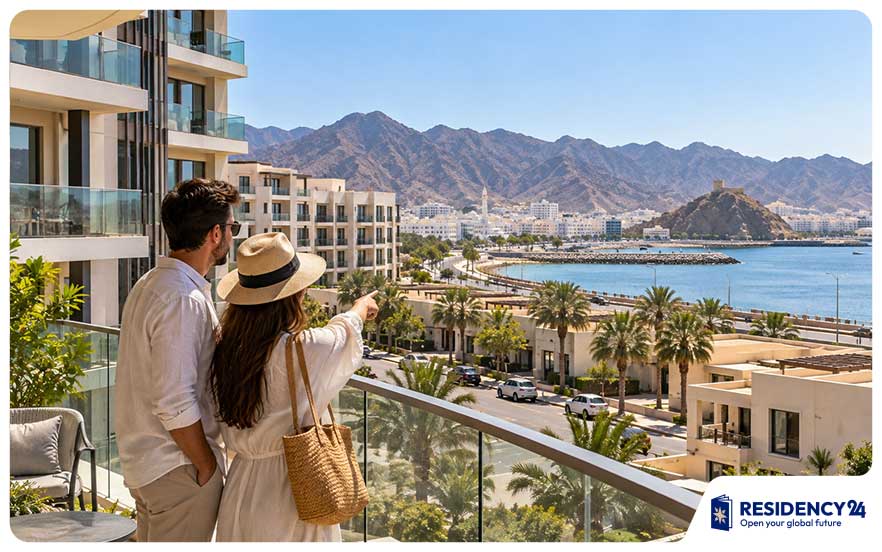
Rent is where the gap with the neighbouring market opens up; the Dubai figures are in Cost of Living in Dubai in 2026. Rent is usually the largest monthly cost in Oman. In Muscat, rent depends on district, property size, building age, furniture, parking, sea access, compound facilities, and proximity to schools or offices.
Renttaag’s August 2026 Muscat rental data gives average monthly rent at around OMR 190 for a studio, OMR 280 for a 1-bedroom apartment, and OMR 600 for a 3-bedroom apartment. It also reports a year-on-year rent change of +3.8% in Muscat.
Property Type in Muscat | Practical Monthly Range |
|---|---|
Studio | OMR 150–250 |
1-bedroom apartment | OMR 180–350 |
2-bedroom apartment | OMR 280–550 |
3-bedroom apartment | OMR 400–750 |
4-bedroom villa | OMR 800–1,800+ |
Premium villa or compound home | OMR 1,500–3,000+ |
Premium communities cost more. A Savills-linked Q2 2026 market report cited by Times of Oman stated that Al Mouj remained Oman’s premium residential destination, with average monthly apartment rents around OMR 664 and four-bedroom villa rents around OMR 1,700.
Best Areas in Muscat by Budget
Area choice can change the cost of living more than almost anything else. Premium neighborhoods are convenient and comfortable, but they can double the rent compared with more practical districts.
Area | Cost Level | Suitable For |
|---|---|---|
Al Mouj | Premium | Executives, high-income families, lifestyle buyers |
Qurum | Upper-mid to premium | Families, diplomats, professionals |
Madinat Sultan Qaboos | Upper-mid to premium | Families, school access, villa living |
Al Khuwair | Mid-range | Professionals, apartment renters, office access |
Ghubrah | Mid-range | Families, commuters, apartment renters |
Bousher | Mid-range | Families, newer apartments, balanced access |
Azaiba | Mid-range to upper-mid | Families, airport access, quieter living |
Seeb | More affordable | Budget-conscious families, airport-side workers |
Ruwi | More affordable | Older apartments, central commercial access |
For most newcomers, the best first step is to rent for 6 to 12 months before buying or signing a long lease. Muscat traffic is manageable compared with some Gulf cities, but school and office commute still matter.
Utilities and Electricity
Utilities in Oman are not always expensive, but summer air conditioning can raise bills sharply. Electricity use is the main variable because hot months require regular cooling.
Wise estimates basic utilities in Muscat for an 85 m² apartment at about $122 per month, including electricity, cooling, water, and garbage, and internet at around $71 per month.
A practical monthly utility estimate:
Household Type | Electricity, Water, Cooling | Internet and Mobile |
|---|---|---|
Single person in apartment | OMR 25–60 | OMR 20–35 |
Couple in apartment | OMR 40–90 | OMR 25–45 |
Family in apartment | OMR 70–150 | OMR 35–70 |
Family in villa | OMR 120–300+ | OMR 40–90 |
Water tariff also matters. APSR’s water and wastewater page lists the primary residential water tariff at OMR 0.660 per cubic meter.
For villas, the bill can rise because of garden irrigation, larger cooling areas, pools, and more bathrooms. A villa that looks affordable on rent may become expensive after summer utility bills.
Groceries and Food Costs

Food costs in Oman are moderate if a household cooks at home and buys standard supermarket items. Imported brands, organic products, specialty items, and regular restaurant meals increase the monthly budget quickly.
A practical grocery budget:
Household Type | Monthly Grocery Budget |
|---|---|
Single person | OMR 90–160 |
Couple | OMR 160–280 |
Family of 4 | OMR 300–550 |
Family using imported/premium brands | OMR 600+ |
Food inflation is one of the main pressures in 2026. Oman’s inflation rate reached 3.2% year on year in July 2026, with food and non-alcoholic beverages rising 7.3% and transport rising 6.5%; vegetable prices increased 19.9% and fruit prices 15.8% year on year.
This means a grocery budget should include a buffer, especially for families who buy imported fruit, meat, dairy, cereals, baby products, and school lunch items.
Eating Out in Oman
Eating out in Oman can be affordable or expensive depending on where you go. Local cafeterias, casual restaurants, Indian restaurants, Turkish restaurants, and Arabic grills are usually reasonable. Hotel restaurants, beach clubs, premium cafés, and international chains cost more.
A practical eating-out budget:
Item | Typical Cost |
|---|---|
Basic cafeteria meal | OMR 1.5–3 |
Casual restaurant meal | OMR 3–6 |
Mid-range meal for two | OMR 12–25 |
Coffee in a café | OMR 1.5–3 |
Premium hotel meal for two | OMR 30–60+ |
Wise lists an inexpensive restaurant meal in Muscat at around $5 and a three-course mid-range meal for two at around $26, which roughly supports the lower-to-mid dining ranges.
The cheapest way to live in Oman is to cook most meals and use restaurants selectively. Daily café and delivery habits can quietly add OMR 100–250 per month for one person.
Transport Costs in Oman
Most residents in Oman rely on cars. Public buses exist in Muscat and Salalah, but they are not enough for every commute, especially for families, school runs, and suburban living.
Mwasalat lists Muscat city routes including Al Mabelah, Muscat International Airport, Ruwi, Wadi Kabir, Al Alam Palace, Burj Sahwa, Al Khuwair, and Azaiba. From August 1, 2026, Mwasalat moved city bus payments in Muscat and Salalah to approved digital payment methods only, including bank cards and mobile payment options.
A practical transport budget:
Transport Type | Monthly Cost |
|---|---|
Occasional bus use | OMR 10–30 |
One modest car, fuel only | OMR 25–60 |
One car with insurance and maintenance | OMR 80–180 |
Car loan or lease added | OMR 150–350+ |
Heavy taxi/app use | OMR 150–400+ |
Fuel is relatively affordable compared with many countries. Oman Oil Marketing Company listed July fuel retail prices at 229 baisas/liter for Mogas 91, 239 baisas/liter for Mogas 95, 399 baisas/liter for Ultimax 98, and 258 baisas/liter for diesel.
For a family, car ownership is often not optional. The real question is whether the household needs one car or two.
School Fees in Oman
International school fees usually move a family budget more than rent does, and the tier structure is explained in Top International Schools in Dubai 2026. School fees are the biggest cost for many expat families in Oman. Public schools are not usually the default option for many foreign families, so international school fees must be planned before accepting a job offer or relocating.
British School Muscat lists 2026/27 annual tuition from OMR 4,400 for FS1 to OMR 10,666 for Years 12–13, with additional new-pupil fees such as a OMR 50 assessment fee, OMR 300 reservation fee, and infrastructure fee of OMR 300 per term for the first nine terms from FS2 upward.
Muscat International School by Amity lists 2026/27 tuition from OMR 3,680 for FS1 to OMR 7,500 for Year 12, with a one-time non-refundable registration fee of OMR 300 for new admissions.
Azzan Bin Qais International School lists 2026/27 tuition from OMR 2,300 for KG1 to OMR 5,200 for Grade 12, plus resource fees and additional charges for uniforms, exams, and learning support where relevant.
School Type | Annual Fee Range per Child |
|---|---|
Indian / lower-cost international school | OMR 800–2,500 |
Mid-range international school | OMR 2,500–5,500 |
British / IB / American premium school | OMR 5,000–11,000+ |
Extras | OMR 300–2,000+ |
Families should budget beyond tuition. Uniforms, transport, books, lunches, exam fees, capital fees, learning support, activities, and deposits can add meaningfully to the first-year cost.
Healthcare and Health Insurance

Healthcare costs in Oman depend on whether the resident uses public services, employer coverage, basic insurance, or premium private insurance. Many expats use private clinics and hospitals, especially for faster appointments and English-speaking service.
Oman’s Dhamani health insurance framework standardizes basic insurance coverage for beneficiaries under the Unified Health Insurance Policy. The Financial Services Authority FAQ describes Dhamani as a mandatory agreement issued by the health regulatory authority to provide minimum basic insurance coverage under the unified policy.
A practical healthcare budget:
Healthcare Item | Cost Planning |
|---|---|
Employer-provided basic insurance | Often included in job package |
Basic annual insurance | Varies by policy and employer arrangement |
Private family insurance | Can be a major annual cost |
GP visit without strong coverage | OMR 10–30+ |
Specialist visit | OMR 25–70+ |
Dental treatment | Usually extra or limited |
Medicines | Low to moderate, depending on prescription |
Before relocating, check the actual insurance network. A policy may exist on paper but still have limited hospital access, exclusions, co-payments, maternity waiting periods, or dental limits.
Mobile, Internet, and Subscriptions
Telecom costs are manageable but not negligible. Home internet, mobile data, streaming, cloud storage, and international calls can add up.
A practical monthly estimate:
Item | Monthly Cost |
|---|---|
Mobile plan | OMR 5–20 |
Higher-data mobile plan | OMR 20–35 |
Home internet | OMR 20–45 |
Streaming and apps | OMR 5–25 |
Combined family telecom budget | OMR 50–120 |
Home internet quality can vary by building and district. Check fiber availability before renting if you work remotely.
Domestic Help and Childcare
Domestic help, nannies, nurseries, and childcare can become major costs for families. The range depends on live-in vs part-time help, legal sponsorship, agency costs, nursery hours, and age of the child.
Planning ranges:
Service | Monthly Cost |
|---|---|
Part-time cleaner | OMR 20–80 |
Regular weekly cleaning | OMR 60–150 |
Full-time domestic worker | Varies by legal sponsorship and package |
Nursery | OMR 120–350+ |
Babysitting | OMR 2–5+ per hour |
Families should budget for legal employment procedures if they sponsor domestic help. Informal arrangements may appear cheaper but can create legal and reliability problems.
Entertainment and Lifestyle Costs
Oman can be affordable if entertainment is based on beaches, hiking, wadis, family gatherings, parks, and low-cost restaurants. It becomes expensive when lifestyle depends on hotels, brunches, beach clubs, premium gyms, imported goods, and frequent weekend trips.
Monthly lifestyle budget:
Lifestyle Type | Monthly Cost |
|---|---|
Low-cost lifestyle | OMR 50–120 |
Moderate lifestyle | OMR 150–350 |
Premium lifestyle | OMR 500+ |
Common lifestyle expenses include:
Gym membership
Cafés
Restaurants
Beach clubs
Hotels
Weekend trips
Kids’ activities
Sports lessons
Shopping
Salon and grooming
Outdoor equipment
Oman’s advantage is that many good activities are low-cost. The country is strong for beaches, mountains, wadis, camping, and road trips.
Cost of Living in Oman for a Single Person

A single person can live in Oman at a relatively controlled cost, especially outside premium areas. The biggest choices are rent, car use, and eating out.
Monthly Cost Item | Modest | Comfortable |
|---|---|---|
Rent | OMR 160–300 | OMR 300–500 |
Utilities and internet | OMR 45–90 | OMR 80–140 |
Groceries | OMR 90–160 | OMR 160–250 |
Eating out | OMR 40–100 | OMR 120–250 |
Transport | OMR 30–100 | OMR 100–250 |
Mobile and subscriptions | OMR 10–35 | OMR 30–70 |
Lifestyle | OMR 50–120 | OMR 150–300 |
Total | OMR 425–905 | OMR 940–1,760 |
A realistic single-person budget in Muscat is usually around OMR 600–900 if rent is controlled and there is no expensive car loan.
Cost of Living in Oman for Couples
A couple can manage costs better than a single person because rent and utilities are shared. The main budget risk is lifestyle spending: restaurants, weekend trips, two cars, and premium housing.
Monthly Cost Item | Modest | Comfortable |
|---|---|---|
Rent | OMR 250–500 | OMR 500–900 |
Utilities and internet | OMR 70–140 | OMR 120–220 |
Groceries | OMR 160–280 | OMR 280–450 |
Eating out | OMR 80–180 | OMR 200–450 |
Transport | OMR 80–200 | OMR 250–500 |
Lifestyle | OMR 100–250 | OMR 300–700 |
Total | OMR 740–1,550 | OMR 1,650–3,220 |
A couple without children can live comfortably in Oman if rent and car costs are reasonable.
Cost of Living in Oman for Families
Families need a more careful budget because rent, schooling, healthcare, transport, and groceries all rise together. One child in a premium international school can change the entire financial picture.
Monthly Cost Item | Moderate Family Budget | Higher Family Budget |
|---|---|---|
Rent | OMR 400–900 | OMR 1,000–2,000+ |
Utilities and internet | OMR 120–250 | OMR 250–450 |
Groceries | OMR 300–550 | OMR 600–900 |
School fees, monthly equivalent | OMR 200–900 per child | OMR 900+ per child |
Transport | OMR 200–500 | OMR 500–900 |
Healthcare and insurance extras | OMR 50–250 | OMR 300+ |
Lifestyle and activities | OMR 150–400 | OMR 600+ |
Total | OMR 1,420–3,750+ | OMR 4,150+ |
Families should always calculate school fees annually and then convert them into a monthly equivalent. Fee payment timing can create cash-flow pressure even if the monthly average looks manageable.
Cost of Living in Oman for Expats
For expats, the cost of living in Oman depends heavily on the employment package. A salary that looks good on paper may feel tight if rent, school fees, insurance, flights, and car costs are not covered.
Important package items include:
Housing allowance
School fee allowance
Health insurance coverage
Annual flights
Car allowance
Relocation support
End-of-service benefits
Visa and medical costs
Dependent sponsorship costs
Utility allowance
A package without school support can be weak for a family, even if the headline salary looks competitive. A package with housing and schooling covered can make Oman much more affordable.
Is Oman Expensive Compared With Dubai?

If the decision is driven by earnings rather than outgoings, Best City in the UAE for Work looks at the same choice from the job-market side. Oman is usually cheaper than Dubai for rent, daily lifestyle, and many family living costs, but the gap depends on school choice and housing type. Muscat has fewer extreme-luxury cost pressures than Dubai, and rent is often lower for comparable space. However, imported goods, private schooling, and premium compound living can still be expensive.
Oman is usually cheaper for:
Rent outside premium areas
Fuel
Outdoor leisure
Lower-pressure lifestyle
Some family housing options
Casual dining
Dubai may offer more choice in:
Public transport
International schools
Private healthcare networks
Job opportunities
Entertainment
Retail and services
Oman is not simply “cheap.” It is more accurate to call it lower-pressure and more controllable than many Gulf destinations.
Hidden Costs in Oman
The most common mistake is budgeting only for rent and groceries. Oman has several hidden or irregular costs that can affect the real monthly average.
Hidden costs include:
School admission and capital fees
School transport
Uniforms and books
Car insurance and registration
Tyres and servicing
Summer electricity bills
Private medical co-payments
Dental treatment
Flights home
Visa and document costs
Furniture deposit or purchase
Rental deposit
Moving costs
Weekend travel
Imported food and personal-care items
For a family, the safest approach is to keep a monthly buffer of at least 10% to 20% above the calculated budget.
How Much Salary Is Enough in Oman?
What that salary has to support depends on the residence route; conditions for Oman investor residency differ from an employment permit. A good salary in Oman depends on family size and what the employer covers. A single person with OMR 800 to OMR 1,200 per month can live reasonably if rent is controlled. A couple may need OMR 1,200 to OMR 2,000 for a comfortable life. A family with children in international school may need OMR 2,500 to OMR 5,000+ depending on rent and school allowance.
Household | Practical Salary Target |
|---|---|
Single person, controlled lifestyle | OMR 800–1,200 |
Single person, comfortable lifestyle | OMR 1,200–1,800 |
Couple | OMR 1,500–2,500 |
Family without school fees | OMR 2,000–3,500 |
Family with international school | OMR 3,500–6,000+ |
The best salary package is not always the highest base salary. Housing, school, healthcare, and annual flights can be more important.
How to Reduce the Cost of Living in Oman
Wider conditions for investing in Oman are on one page, and budget and residence route are best settled together: Residency24 works across residency, property purchase, company formation and investment planning. Oman is easier to manage financially when the big fixed costs are controlled. Small savings help, but rent, school, and car choices decide the budget.
Ways to reduce costs:
Rent outside premium districts.
Choose a smaller apartment before upgrading to a villa.
Live close to school or office to reduce car costs.
Compare school fees before choosing an area.
Cook at home during weekdays.
Buy standard local and regional brands.
Use outdoor activities instead of hotel-based entertainment.
Check air conditioning efficiency before renting.
Avoid unnecessary second-car costs.
Negotiate rent renewal early.
Compare health insurance coverage, not only price.
Track annual costs as monthly equivalents.
The biggest saving usually comes from choosing the right neighborhood, not from cutting small daily expenses.
Conclusion
The cost of living in Oman is manageable compared with some Gulf countries, but it varies sharply by household type. A single person in Muscat can live modestly from around OMR 500 to OMR 650 per month including basic rent, while a more comfortable single-person budget is closer to OMR 650 to OMR 900 or more. Couples usually need OMR 800 to OMR 1,600 depending on rent and car use. Families need a much larger budget, especially if children attend international schools, where annual tuition can range from a few thousand rials to more than OMR 10,000 per child at premium schools. Rent, school fees, car ownership, summer utilities, healthcare, and imported groceries are the main cost drivers. Oman is not a low-cost country, but with controlled housing, realistic school planning, and moderate lifestyle choices, it can be one of the more financially manageable Gulf destinations.