 Anahita Attarian
The cost of living in Abu Dhabi depends mainly on rent, school fees, car ownership, health insurance, and the area where you live. A single person can live more modestly if they rent a studio or shared accommodation and use buses or taxis only when needed. A couple in a one-bedroom apartment usually needs a higher monthly budget, especially in Al Reem Island, Al Khalidiyah, Corniche, Yas Island, or Al Raha. A family with children should budget much more because school fees, larger housing, car costs, insurance, and domestic help can change the monthly figure quickly. In 2026, Abu Dhabi remains expensive, but it can be easier to budget than Dubai if the household chooses the right area and avoids premium islands.
How Much Does It Cost to Live in Abu Dhabi?
A realistic monthly cost of living in Abu Dhabi starts from around AED 6,000 to AED 9,000 for a single person renting modestly, AED 11,000 to AED 18,000 for a couple in a one-bedroom apartment, and AED 25,000 to AED 45,000+ for a family with two school-age children. These are planning ranges, not fixed rules, because rent and school fees can double the budget.
Rent is the largest cost. In H1 2026, dubizzle reported average affordable apartment rents of AED 53,000 in Khalifa City, AED 73,000 in Al Nahyan, and AED 63,000 in Al Ghadeer, while mid-tier areas such as Al Reem Island, Hamdan Street, and Al Khalidiyah were higher.
Cost of Living in Abu Dhabi: Quick Summary
Household Type | Estimated Monthly Budget | What It Usually Covers |
|---|---|---|
Single person, shared housing | AED 4,500–7,000 | Room, utilities share, groceries, mobile, bus/taxi, basic social life |
Single person, studio | AED 6,000–9,500 | Studio rent, utilities, internet, groceries, transport, modest dining |
Single person, 1-bed apartment | AED 8,500–13,500 | 1-bed rent, bills, food, taxis or small car budget |
Couple, 1-bed apartment | AED 11,000–18,000 | Rent, utilities, groceries, transport, dining, insurance extras |
Couple, 2-bed apartment | AED 14,000–23,000 | Bigger rent, higher bills, car or taxi use, more household spending |
Family with one child | AED 20,000–32,000 | 2-bed or 3-bed rent, school/nursery, car, food, insurance |
Family with two school-age children | AED 25,000–45,000+ | Larger home, school fees, transport, car, domestic help, activities |
Premium family lifestyle | AED 45,000–70,000+ | Villa or premium island apartment, top school, two cars, frequent dining |
The biggest cost difference is not food or public transport. It is whether the household rents in an affordable area or a premium community, and whether children attend private school.
Main Monthly Costs in Abu Dhabi

The main monthly costs in Abu Dhabi are rent, utilities, food, transportation, health insurance, school fees, internet, mobile, car expenses, and lifestyle spending. Rent and education are the two items that create the widest gap between a modest budget and a high-income expat lifestyle.
Cost Category | Monthly Planning Range |
|---|---|
Studio rent | AED 3,250–6,000 |
1-bedroom rent | AED 4,700–10,500 |
2-bedroom rent | AED 6,400–13,000 |
Utilities for apartment | AED 400–1,200 |
Internet and mobile | AED 300–800 |
Groceries for one person | AED 900–1,800 |
Groceries for family | AED 3,000–6,000 |
Public transport | AED 95 monthly bus pass or pay-per-trip |
Taxi use | AED 500–2,000 depending on frequency |
Car ownership | AED 1,500–4,000+ |
School fees per child | AED 6,000–80,000+ annually, depending on school |
Dining and entertainment | AED 800–5,000+ |
These ranges should be adjusted by area. A household in Khalifa City will not spend the same as a household in Saadiyat Island or Yas Island.
Rent in Abu Dhabi
Rent is the line that separates the two main UAE markets; the equivalent figures are in Cost of Living in Dubai in 2026. Rent is the largest cost for most residents. Abu Dhabi has a wide rental range: affordable apartments in Khalifa City, Al Nahyan, and Al Ghadeer; mid-tier apartments in Al Reem Island, Hamdan Street, and Al Khalidiyah; and premium homes in Saadiyat Island, The Marina, Yas Island, Al Raha Beach, and Corniche.
In H1 2026, dubizzle reported these affordable apartment averages:
Area | Average Annual Rent | Studio | 1-Bed | 2-Bed |
|---|---|---|---|---|
Khalifa City | AED 53,000 | AED 39,000 | AED 56,000 | AED 87,000 |
Al Nahyan | AED 73,000 | AED 47,000 | AED 66,000 | AED 82,000 |
Al Ghadeer | AED 63,000 | AED 49,000 | AED 63,000 | AED 77,000 |
These figures show why Khalifa City and Al Ghadeer are often easier for budget-conscious residents, while central and island areas cost more. (dubizzle.com)
Mid-Tier Apartment Rents
Mid-tier apartment areas cost more than the affordable segment but offer stronger connectivity, better towers, central access, or waterfront living. Bayut’s H1 2026 rental report listed Al Reem Island at an average annual rent of AED 121,000, Hamdan Street at AED 90,000, and Al Khalidiyah at AED 125,000 in its mid-tier apartment segment.
Area | Average Annual Rent | Studio | 1-Bed | 2-Bed |
|---|---|---|---|---|
Al Reem Island | AED 121,000 | AED 70,000 | AED 94,000 | AED 128,000 |
Hamdan Street | AED 90,000 | AED 56,000 | AED 74,000 | AED 86,000 |
Al Khalidiyah | AED 125,000 | AED 50,000 | AED 84,000 | AED 116,000 |
A single person or couple can live comfortably in these areas, but the rent-to-income ratio should be checked carefully. A 1-bedroom apartment at AED 94,000 per year is about AED 7,833 per month before utilities, internet, parking, and other bills.
Luxury Apartment and Villa Rents
Premium areas can change the cost of living completely. In H1 2026, dubizzle reported average annual apartment rents of AED 192,000 in Saadiyat Island and AED 237,000 in The Marina. It also reported luxury villa averages of AED 332,000 in Yas Island, AED 246,000 in Al Bateen, and AED 226,000 in Sas Al Nakhl Village.
Area / Property Type | Average Annual Rent |
|---|---|
Saadiyat Island apartments | AED 192,000 |
The Marina apartments | AED 237,000 |
Yas Island luxury villas | AED 332,000 |
Al Bateen villas | AED 246,000 |
Sas Al Nakhl Village villas | AED 226,000 |
Al Raha Gardens villas | AED 208,000 |
Khalifa City villas | AED 182,000 |
A family choosing a villa in Yas Island or Saadiyat Island should not compare its budget with a family renting a 2-bedroom apartment in Khalifa City. These are different lifestyles and different income levels.
Best Areas by Budget
For how neighbourhood choice plays out for households, Best Neighborhoods in Dubai for Families follows the same logic one emirate over. The best area in Abu Dhabi depends on whether the priority is affordability, school access, commute, waterfront living, or family space.
Budget Type | Areas to Consider |
|---|---|
Lower rent | Khalifa City, Al Ghadeer, Mussafah, Mohammed Bin Zayed City |
Central apartment living | Hamdan Street, Al Nahyan, Al Khalidiyah |
Modern apartment towers | Al Reem Island, Al Raha Beach, Yas Island |
Premium lifestyle | Saadiyat Island, The Marina, Corniche, Al Bateen |
Family villa living | Khalifa City, Al Reef, Shakhbout City, Al Raha Gardens |
Dubai-Abu Dhabi commuters | Al Ghadeer, Al Samha, parts of Khalifa City |
Airport access | Khalifa City, Yas Island, Al Raha, Al Reef |
Beach and culture | Saadiyat Island |
Entertainment and family leisure | Yas Island |
Rent should be assessed with commute and school location. A cheaper home far from work can become expensive if the household needs two cars or long taxi rides.
Utilities in Abu Dhabi
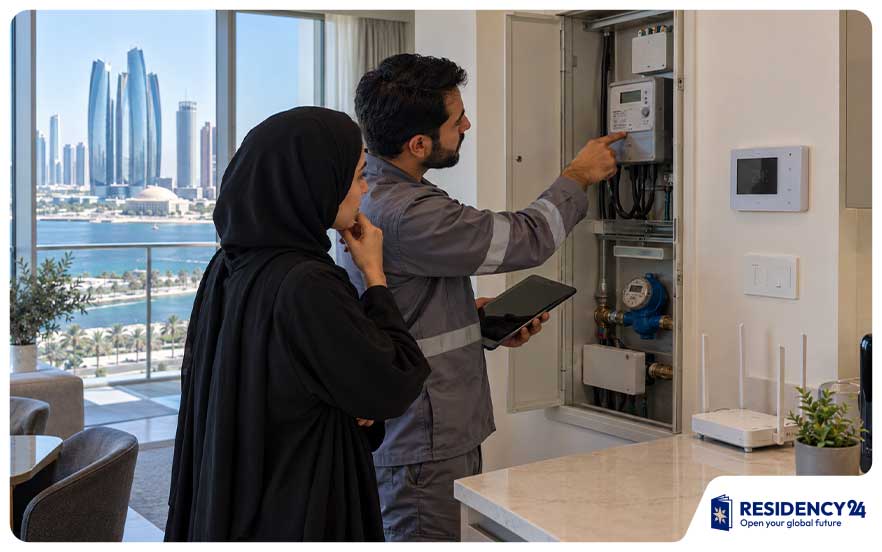
Utilities in Abu Dhabi are provided mainly through ADDC for water and electricity in Abu Dhabi city and surrounding areas. ADDC states that if a tenancy contract is registered with Tawtheeq, the water and electricity account is usually set up automatically, so tenants do not need to submit a separate connection request.
For expat residential customers, ADDC lists electricity at 26.8 fils per kWh within the lower band and 30.5 fils per kWh above the threshold. Water is listed at AED 7.84 per cubic metre in the lower band and AED 10.41 per cubic metre above the threshold.
Utility Item | Expat Residential Tariff |
|---|---|
Electricity, lower band | 26.8 fils / kWh |
Electricity, higher band | 30.5 fils / kWh |
Water, lower band | AED 7.84 / cubic metre |
Water, higher band | AED 10.41 / cubic metre |
For apartments, a practical monthly utilities estimate is often AED 400–1,200, depending on cooling, usage, building type, season, and household size. Villas can cost more because of larger cooling loads, gardens, and water usage.
Internet and Mobile Costs
Internet and mobile costs in Abu Dhabi are usually higher than in many countries. A realistic monthly budget is AED 300–500 for home internet and AED 100–300+ per mobile line, depending on data, contract type, and provider.
A single resident with basic home internet and one mobile plan may spend around AED 400–700 per month. A family with home internet, multiple mobile lines, streaming subscriptions, and higher-speed packages may spend AED 800–1,500+.
This cost is not usually the budget breaker, but it should be included because many apartments do not include internet in the rent unless the listing is a serviced or furnished monthly unit.
Groceries in Abu Dhabi
Groceries in Abu Dhabi are manageable if the household cooks at home and uses supermarkets carefully. Imported products, organic brands, premium meat, specialty diets, and frequent delivery orders increase the budget quickly.
A practical monthly grocery budget:
Household | Monthly Grocery Budget |
|---|---|
Single person, modest cooking | AED 900–1,400 |
Single person, mixed cooking and delivery | AED 1,400–2,200 |
Couple | AED 2,000–3,500 |
Family with one child | AED 3,000–5,000 |
Family with two children | AED 4,000–7,000+ |
A family that cooks rice, chicken, vegetables, eggs, dairy, and basic meals at home can control costs. A family buying mostly imported snacks, ready meals, premium brands, and delivery will spend much more.
Dining Out and Coffee
Dining out in Abu Dhabi ranges from affordable cafeteria meals to premium hotel restaurants. The city has cheaper casual food options, but lifestyle spending rises quickly in malls, hotels, beach clubs, brunches, and licensed restaurants.
Monthly dining budget:
Lifestyle | Monthly Dining Budget |
|---|---|
Mostly home cooking | AED 300–800 |
Single person, casual eating out | AED 800–1,800 |
Couple, mixed restaurants | AED 1,500–3,500 |
Family, weekly casual meals | AED 2,000–5,000 |
Premium lifestyle | AED 5,000–10,000+ |
Dining is the easiest cost to underestimate because small daily expenses add up. Coffee, delivery fees, brunches, lunch at work, and weekend restaurants can equal a second utility bill.
Public Transport in Abu Dhabi
Public transport is affordable by Gulf standards, especially for residents who can use buses regularly. Abu Dhabi Mobility states that the basic public bus fare is AED 2 plus 5 fils per kilometre, and the cost of a single trip is capped at AED 5. It also lists a 7-day pass at AED 30 and a 30-day pass at AED 95. (admobility.gov.ae)
ADRO also lists local bus trips inside the city at AED 2, regional suburb trips at AED 2 plus AED 0.05 per kilometre, and inter-city trips at AED 10 plus AED 0.1 per kilometre.
Public Transport Item | Cost |
|---|---|
Local city bus trip | AED 2 |
Regional trip | AED 2 + AED 0.05 per km |
Single trip cap | AED 5 |
7-day pass | AED 30 |
30-day pass | AED 95 |
Student annual permit | AED 500 |
Public transport is cheap, but route coverage and travel time matter. Many residents still use cars or taxis because Abu Dhabi is spread out.
Taxi Costs in Abu Dhabi
Taxis are widely available and cheaper than owning a car for people who use them occasionally. Abu Dhabi Mobility lists silver taxi daytime flag fall at AED 5, AED 1.82 per kilometre, AED 0.50 per waiting minute, minimum fare of AED 12, and booking fees starting at AED 4 during daytime. Night flag fall is AED 5.50. Airport taxi flag fall is AED 20.
Taxi Cost Item | Cost |
|---|---|
Day flag fall | AED 5 |
Night flag fall | AED 5.50 |
Per kilometre | AED 1.82 |
Waiting per minute | AED 0.50 |
Minimum fare | AED 12 |
Airport flag fall | AED 20 |
A single person who takes taxis only a few times a week may spend AED 500–1,000 per month. Someone commuting by taxi daily can easily spend AED 2,000–4,000 per month, which may make a car more practical.
Car Ownership Cost
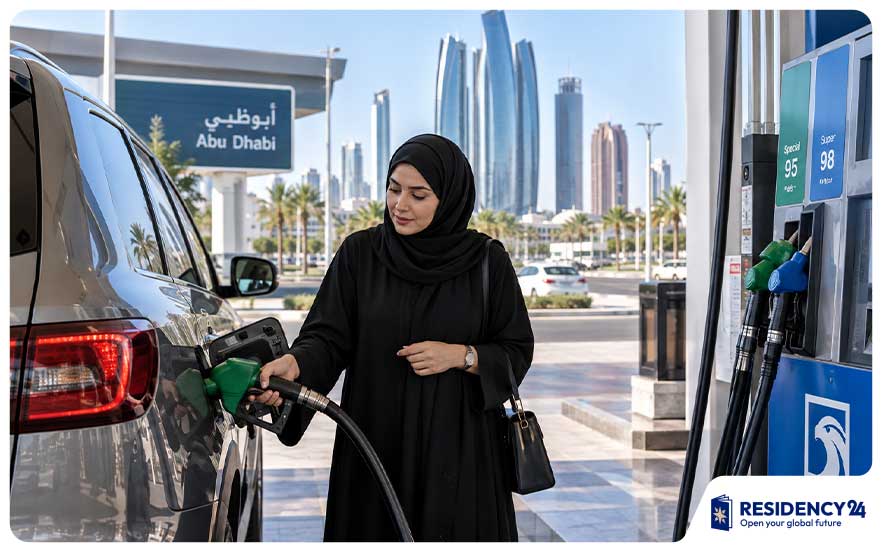
Car ownership is common in Abu Dhabi because many residential areas, schools, offices, and shopping districts are easier to access by car. A basic car budget should include fuel, insurance, registration, servicing, parking, tolls, depreciation, and loan payments if financed.
Practical monthly car cost:
Car Situation | Monthly Budget |
|---|---|
Used economy car, no loan | AED 800–1,800 |
Used or small new car with loan | AED 1,800–3,500 |
Family SUV | AED 3,000–5,500+ |
Two-car household | AED 4,000–8,000+ |
Car ownership becomes almost essential for many families with school runs, weekend activities, and suburban villas. Singles living close to work may be able to use buses, taxis, and ride-hailing instead.
School Fees in Abu Dhabi
School choice usually moves this number more than rent does - see Top International Schools in Dubai 2026 for how the fee tiers work. School fees are one of the biggest costs for families. Abu Dhabi has Indian, British, American, IB, Arabic, and other curriculum schools at very different fee levels. Budget schools may cost under AED 15,000 per year, while premium international schools can exceed AED 70,000 per year per child.
For example, The British International School Abu Dhabi lists 2026–2027 annual fees from AED 54,204 for Nursery to AED 76,952 for Years 12–13, and states that school fees in Abu Dhabi are subject to ADEK approval. It also lists return bus service at AED 8,000 per year.
School Type | Annual Planning Range Per Child |
|---|---|
Lower-cost Indian curriculum | AED 6,000–15,000 |
Mid-range schools | AED 20,000–45,000 |
British / American / IB premium schools | AED 50,000–80,000+ |
School bus | AED 5,000–8,000+ |
Uniforms, books, trips, exams | Extra |
A family with two children in a premium British or American school can spend more on education than on rent.
Nursery and Childcare Costs
Nursery and childcare costs vary by location, hours, curriculum, and whether the child attends full-day or half-day sessions. A working family should budget carefully because nursery fees, nanny costs, transport, meals, and after-school care can overlap.
Practical monthly ranges:
Childcare Type | Monthly Budget |
|---|---|
Part-time nursery | AED 1,500–3,000 |
Full-time nursery | AED 3,000–6,000+ |
Nanny or domestic help | AED 2,500–4,500+ after salary, visa, insurance, and other costs |
After-school activities | AED 500–2,000+ |
For families with young children, childcare can be as important as rent in the total monthly budget.
Health Insurance and Medical Costs
Health insurance is a core requirement in Abu Dhabi. The UAE government portal states that in Abu Dhabi, employers and sponsors are responsible for providing health insurance coverage for employees and their families, including one spouse and three children under 18.
The Department of Health Abu Dhabi has long operated a mandatory health insurance system, and its health insurance manual describes mandatory health insurance for non-nationals who hold work or residence visas issued from Abu Dhabi. (doh.gov.ae)
For employees, the employer may cover basic insurance. For investors, Golden Visa holders, freelancers, dependents, and parents, the sponsor or applicant may need to arrange coverage. Out-of-pocket costs depend on co-payments, network, medicine coverage, dental, optical, maternity, and chronic conditions.
Housing Deposits and One-Time Moving Costs
Monthly living cost is only part of the picture. Moving into Abu Dhabi often requires upfront cash for rent cheques, security deposit, agency commission, utility setup, furniture, internet installation, and moving services.
Typical upfront costs:
Item | Planning Range |
|---|---|
Security deposit | Usually 5% of annual rent, sometimes more for furnished units |
Agency commission | Often 5% of annual rent |
Rent cheques | 1, 2, 4, or more cheques depending on landlord |
ADDC connection/deposit | Varies by account and property |
Furniture | AED 5,000–40,000+ |
Moving cost | AED 1,000–5,000+ |
Internet setup | Depends on provider and package |
Basic household items | AED 2,000–10,000 |
A household renting a AED 100,000 apartment may need much more than one month’s rent ready before moving in.
Cost of Living for a Single Person
A single person can live in Abu Dhabi on a controlled budget if rent is modest and lifestyle spending is limited. The most realistic cost driver is housing.
Single Person Budget: Shared Housing
Item | Monthly Cost |
|---|---|
Room or shared accommodation | AED 2,500–4,500 |
Utilities and internet share | AED 300–700 |
Groceries | AED 900–1,400 |
Transport | AED 200–800 |
Mobile | AED 100–250 |
Dining and entertainment | AED 500–1,500 |
Miscellaneous | AED 500–1,000 |
Total | AED 5,000–10,150 |
Single Person Budget: Studio or 1-Bed
Item | Monthly Cost |
|---|---|
Rent | AED 3,250–8,000 |
Utilities | AED 400–900 |
Internet and mobile | AED 400–700 |
Groceries | AED 1,000–1,800 |
Transport | AED 400–1,500 |
Dining and entertainment | AED 800–2,500 |
Miscellaneous | AED 700–1,500 |
Total | AED 6,950–16,900 |
A single person earning AED 12,000–15,000 can live reasonably if rent is controlled. Below that, shared housing or a lower-rent area may be necessary.
Cost of Living for a Couple

A couple without children can live comfortably in Abu Dhabi if rent is not too high. A one-bedroom apartment is usually enough, but a two-bedroom becomes attractive for remote work or frequent visitors.
Item | Monthly Cost |
|---|---|
1-bed or 2-bed rent | AED 5,000–11,000 |
Utilities | AED 600–1,300 |
Internet and mobile | AED 600–1,000 |
Groceries | AED 2,000–3,500 |
Transport | AED 800–3,000 |
Dining and entertainment | AED 1,500–4,000 |
Miscellaneous | AED 1,000–2,500 |
Total | AED 11,500–26,300 |
A couple can keep costs low in Khalifa City, Al Nahyan, or Hamdan Street. Al Reem Island, Al Raha Beach, Yas Island, and Corniche will push the rent upward.
Cost of Living for a Family
A family budget in Abu Dhabi depends on school fees and housing. A family with no school-age children may manage with a much lower budget. A family with two children in premium schools may need a high salary even if rent is moderate.
Item | Monthly Cost |
|---|---|
2-bed apartment or 3-bed villa | AED 7,000–20,000 |
Utilities | AED 900–2,500 |
Internet and mobile | AED 800–1,500 |
Groceries | AED 3,500–7,000 |
Car or transport | AED 2,000–6,000 |
School or nursery | AED 4,000–14,000+ |
Health and medicine extras | AED 500–2,000 |
Activities and dining | AED 2,000–6,000 |
Domestic help, if used | AED 2,500–4,500+ |
Total | AED 23,200–63,500+ |
For families, salary negotiation should include school allowance, health insurance for dependents, annual flights, housing allowance, and relocation support. A salary that works for a single person may not work for a family.
Cost of Living in Abu Dhabi for Expats
For expats, the main difference between a good and bad budget is employer support. If the employer provides health insurance, school allowance, annual flights, housing support, or car allowance, Abu Dhabi becomes much easier to manage. If the employee must pay everything from salary, the required income is much higher.
Expats should check:
Is rent paid by employer or from salary?
Is health insurance provided for spouse and children?
Is school allowance included?
Is relocation support included?
Are annual flights included?
Is transport or car allowance included?
Is the salary basic or total package?
Are bonuses guaranteed or discretionary?
Is the contract in Abu Dhabi or another emirate?
Will the family live in Abu Dhabi full-time?
Residency24 can help investors and relocating families compare Abu Dhabi residence, property, insurance, and family setup costs before choosing a long-term UAE plan.
Salary Needed to Live in Abu Dhabi
The salary needed depends on household size and lifestyle. A single person can manage on a lower salary than a family because school fees and large housing are absent.
Household | Comfortable Monthly Salary Range |
|---|---|
Single, shared accommodation | AED 8,000–12,000 |
Single, own studio or 1-bed | AED 12,000–18,000 |
Couple, no children | AED 18,000–28,000 |
Family with one child | AED 28,000–45,000 |
Family with two children | AED 35,000–60,000+ |
Premium expat family lifestyle | AED 60,000+ |
These ranges assume the household is paying rent and most costs from salary. If the employer pays school, housing, and insurance separately, the needed cash salary can be lower.
Abu Dhabi vs Dubai Cost of Living
If the move is driven by work rather than lifestyle, Best City in the UAE for Work compares the two on job market rather than price. Abu Dhabi can be cheaper or more expensive than Dubai depending on the area. Dubai has more low-cost outer communities, more nightlife spending, more short-term rental pressure, and a larger private rental market. Abu Dhabi can feel more stable and family-oriented, but premium areas such as Saadiyat Island, Yas Island, Al Bateen, and The Marina are expensive.
Abu Dhabi may be better if:
Work is in Abu Dhabi.
The family wants a quieter lifestyle.
School commute matters.
A villa outside the city centre fits the budget.
The household wants less daily congestion.
Dubai may be better if:
Work or clients are in Dubai.
The person wants more lifestyle options.
The company ecosystem matters.
A wider range of rental communities is needed.
The household wants more international school and entertainment choice.
For pure living cost, neither city is automatically cheaper. The exact community decides the answer.
How to Reduce Cost of Living in Abu Dhabi
The easiest way to reduce costs is to control rent and school choice. Food and mobile bills matter, but they are not the main drivers.
Practical ways to reduce costs:
Rent in Khalifa City, Al Ghadeer, Al Nahyan, Mussafah, or Mohammed Bin Zayed City instead of premium islands.
Choose a home closer to school or work to reduce car and taxi costs.
Use Hafilat bus passes where routes are practical.
Avoid renting a villa if a 2-bedroom apartment is enough.
Negotiate more rent cheques if the landlord offers a lower annual rate.
Check whether utilities, chiller, parking, and maintenance are included.
Choose school carefully before choosing the home area.
Cook at home during weekdays.
Limit delivery apps and hotel dining.
Use employer insurance before buying private upgrades.
Buy a used car instead of financing a high-end vehicle.
Track subscriptions and recurring payments.
The biggest saving is usually choosing the right area before signing the lease.
Hidden Costs New Residents Forget

New residents often calculate rent and groceries but forget the upfront and recurring costs that make the first year expensive.
Common hidden costs include:
Security deposit
Agency commission
Furniture
Utility deposits
Internet installation
Parking
Chiller or cooling charges
Municipality-related charges where applicable
School registration fees
School bus fees
Uniforms and books
Health insurance upgrades
Car registration and insurance
Salik or Darb tolls if commuting
Visa and Emirates ID costs for dependents
Domestic worker visa and insurance
Medical co-payments
Annual flights home
Moving and storage
A first-year budget should be higher than a normal monthly budget.
Cost of Living Checklist Before Moving
Budget and residence route are worth settling together: Residency24 works across residency, property purchase, company formation and investment planning, and the wider conditions for UAE residency sit on one page. Before moving to Abu Dhabi, check:
Expected annual rent
Number of rent cheques
Security deposit
Agency commission
Utility and internet setup
Distance from work
Distance from school
Public transport availability
Parking availability
Health insurance coverage
School fees and bus fees
Car requirement
Salary package details
Housing allowance
School allowance
Annual flight allowance
Visa and Emirates ID costs
Furniture and moving budget
Emergency savings
A household should ideally keep at least three to six months of living expenses available, especially during relocation.
Conclusion
The cost of living in Abu Dhabi is manageable for high-income professionals, investors, and families with strong employer packages, but it can be expensive if rent, school fees, and car costs are not planned carefully. A single person can often live on AED 6,000 to AED 9,000 per month with controlled housing, while a couple usually needs around AED 11,000 to AED 18,000 for a comfortable one-bedroom lifestyle. Families need a much larger budget because school fees, bigger housing, car costs, and insurance can push monthly expenses above AED 25,000 or AED 45,000. Affordable apartment areas such as Khalifa City, Al Nahyan, and Al Ghadeer are much cheaper than premium areas such as Saadiyat Island, The Marina, Yas Island, and Al Bateen. The most important budgeting rule is simple: decide the school and commute first, then choose the area and rent.