
 Anahita Attarian
Opening a bank account in Oman is usually straightforward for residents, but the process depends on whether the applicant is an Omani citizen, expat resident, non-resident, employee, student, investor, property owner, or company owner. Most expats need a valid passport, residence card or visa, local address, mobile number, and proof of income or employment. Non-resident account opening is possible in some cases, but it usually requires stronger KYC checks, proof of address, tax declarations, and a clear reason for opening the account. For companies, the bank account normally comes after company registration, tax registration, and preparation of corporate documents.
Can Foreigners Open a Bank Account in Oman?
Yes, foreigners can open a bank account in Oman if they meet the bank’s eligibility and KYC requirements. For most expats, the easiest route is to open an account after receiving a residence card or valid Oman residence visa.
Bank Muscat lists passport and visa requirements for expat applicants, including a minimum remaining residency period in Oman, while National Bank of Oman states that non-Omani savings-account applicants need resident ID, passport, visa copy, source-of-funds documents, and residence proof.
Open Bank Account in Oman: Quick Summary
Applicant Type | Can Open an Account? | Main Documents Usually Needed |
|---|---|---|
Expat resident | Yes | Passport, resident ID, visa, address proof, salary or income proof |
Omani citizen | Yes | National ID, application form, address/contact details |
Non-resident | Possible but stricter | Passport, proof of address, tax declarations, reason for account |
Employee | Yes | Passport, resident ID, salary certificate or employer letter |
Student | Possible | Passport, resident ID/visa, university or sponsor documents |
Investor | Yes, if documents are clear | Passport, residence/investor visa, source of funds, business/property proof |
Company | Yes, after registration | CR, OCCI, MOA/AOA, shareholder IDs, address proof, income/source-of-funds proof |
New SME | Yes, but due diligence applies | CR, OCCI, physical address, shareholder/director/signatory IDs |
The main rule is simple: banks in Oman need to know who you are, where the money comes from, why you need the account, and whether your visa or business status supports the account.
Documents Required to Open a Personal Bank Account in Oman

The exact document list varies by bank, account type, nationality, salary source, and risk profile. Still, most banks ask for a similar core file.
Common documents include:
Completed account opening form
Valid passport
Residence card or resident ID
Oman visa copy
Local mobile number
Email address
Proof of address
Salary certificate, pay slip, or employer letter
Bank statement, if salary is not yet deposited in Oman
Source-of-funds explanation
Tax declaration forms such as FATCA or CRS, where applicable
Specimen signature
Initial deposit, if required by the bank
National Bank of Oman lists non-Omani KYC documents such as resident ID, passport, visa copy, salary certificate or pay slip for salary income, and residence proof such as property document, tenancy agreement, utility bill, employer letter, or wali/sheikh letter.
Can You Open a Bank Account in Oman Without Residence Card?
The same question in the UAE has a different answer - see Bank Account for Non-Residents in the UAE. It may be possible in limited cases, but it is harder. Most normal expat accounts are easier after the applicant has a residence card or valid residence visa. Some banks may consider an employer letter stating that the visa is under process, but this depends on the bank and the applicant’s file.
HSBC Oman’s personal account form states that non-GCC nationals need an original valid passport and a valid Oman residency visa or an employer letter stating that the visa is under process.
If you have just arrived in Oman for work, the practical order is usually:
Enter Oman on the correct visa.
Complete medical and residence formalities.
Obtain residence card or employer visa confirmation.
Get salary certificate or employer letter.
Prepare address proof.
Open the account.
Ask your employer to transfer salary to that account.
Some employers help new expats open salary accounts before the full residence process is complete, but the bank can still request additional documents.
Resident vs Non-Resident Bank Account in Oman
Resident account opening is usually easier because the applicant has legal status, local ID, local address, and a clearer reason for banking in Oman. Non-resident accounts are more sensitive because the bank must understand the purpose, source of funds, tax residence, and relationship with Oman.
Factor | Resident Account | Non-Resident Account |
|---|---|---|
Main ID | Resident card and passport | Passport |
Address | Oman address usually required | Foreign and/or Oman address proof required |
Visa | Residence visa usually expected | May not have residence visa |
Source of funds | Salary, business, savings, family support | Must be clearly explained and documented |
Tax forms | FATCA/CRS if applicable | Usually more important |
Approval difficulty | Lower | Higher |
Best for | Employees, families, residents, investors | Property buyers, investors, cross-border clients |
Account opening | Branch, mobile, or assisted process depending on bank | Usually branch/relationship-manager led |
Bank Muscat’s KYC page lists proof of address for non-resident customers and notes that proof can include house Mulkiya, tenancy agreement, utility bill, or another bank statement.
Savings Account in Oman
A savings account is usually the easiest account type for individuals. It works for salary deposits, daily spending, ATM withdrawals, debit card use, transfers, and basic savings.
National Bank of Oman states that both Omanis and expatriates can open a savings account. It also lists an initial opening balance of OMR 5 and a minimum average monthly balance of OMR 100 for customers with salaries greater than OMR 500.
A savings account is suitable for:
New expat residents
Employees
Students
Family members
Basic salary deposits
Day-to-day payments
Debit card use
Utility payments
Personal transfers
For most new expats, a savings account is the first practical account to open.
Current Account in Oman

A current account is usually better for people who need cheque book access, more active transactions, multi-currency banking, or business-style personal finance. It may have stricter requirements than a basic savings account.
National Bank of Oman states that its current account can be opened by qualifying individuals, businesses, and organizations, requires a minimum average monthly balance of OMR 200, and requires a valid mailing address. It also says Omanis or expatriates can apply by visiting a branch with national ID or passport, and that the process includes account opening, KYC, and specimen signature forms.
A current account may suit:
Higher-income employees
Business owners
Investors
People needing cheques
People needing multi-currency access
People with more active banking needs
Some banks may require salary assignment, minimum balance, or relationship-manager review for current accounts.
Salary Account in Oman
A salary account is used to receive monthly salary from an Oman employer. Many employers have relationships with specific banks, so employees may be guided toward a particular bank account.
For salaried individuals, banks may request:
Passport
Resident ID
Visa copy
Salary certificate
Employer letter
Salary transfer letter
Employment contract, if needed
Local mobile number
Address proof
If your salary is not deposited with the bank where you apply, the bank may ask for additional employment proof. Bank Muscat’s KYC page specifically lists employment proof when the applicant is employed and salary is not with Bank Muscat.
A salary account is usually the most practical account for expats working in Oman because it supports payroll, debit card use, loan eligibility, credit card assessment, and proof of income.
Islamic Bank Account in Oman
Oman also has Islamic banking options. These accounts follow Sharia-compliant structures rather than conventional interest-based banking. Islamic accounts can be useful for customers who want salary accounts, savings, current accounts, financing, or business banking through an Islamic banking window or Islamic bank.
For example, Meethaq Islamic Banking lists current-account requirements for individuals and businesses, including copies of resident card, passport and valid visa for expatriates, and commercial registration and Oman Chamber documents for business entities.
Islamic accounts may suit:
Customers avoiding conventional interest
Businesses needing Sharia-compliant banking
Salary account holders
Investors
Families
SME owners
The document process is usually similar to conventional banking, but the product structure and profit treatment differ.
Best Banks to Open an Account in Oman
There is no single best bank for every expat. The right bank depends on salary transfer, branch access, mobile app quality, ATM network, international transfers, debit card reliability, credit card needs, corporate banking, and whether the employer already works with the bank.
Common banks expats compare include:
Bank Muscat
National Bank of Oman
Bank Dhofar
Sohar International
Oman Arab Bank
Ahli Bank
HSBC Oman
Islamic banking windows such as Meethaq
International or regional banks with Oman presence
Choose based on practical fit:
Need | What to Prioritize |
|---|---|
Salary account | Employer relationship and salary-transfer speed |
Daily spending | Debit card, ATM access, app stability |
International transfers | FX rates, SWIFT fees, remittance options |
Savings | Minimum balance, interest/profit rate, access rules |
Family account | Branch support and dependent-document handling |
Business account | KYC process, online banking, payroll, POS, trade finance |
Investor account | Relationship manager, source-of-funds review, multi-currency support |
Non-resident account | Bank willingness and documentation clarity |
A bank that is good for salary may not be the best for business. A bank that is good for SMEs may not be the easiest for non-resident personal banking.
Can You Open an Oman Bank Account Online?
Oman is some way behind the app-first banks next door; Best Digital Banks in the UAE shows the contrast. Some personal account steps can be started online or through mobile apps, but full digital onboarding depends on the bank, nationality, ID status, and whether the applicant is already resident in Oman. Many applicants still need branch or relationship-manager interaction, especially for non-residents, companies, and complex investor accounts.
Oman’s Central Bank has supported e-KYC and digital onboarding. Its e-KYC circular describes the objective as promoting digital verification of customer identity through secure digital means while protecting authenticity, safety, confidentiality, and customers from misuse by fraudsters.
In practice, online opening is easiest when:
You have an Oman resident ID
Your mobile number is active
Your KYC data can be verified digitally
The account type is simple
The source of funds is clear
You are not a high-risk or non-resident case
Non-resident, investor, and corporate accounts are usually more document-heavy and may need branch review.
How Long Does It Take to Open a Bank Account in Oman?

A simple personal account can sometimes be opened quickly if documents are complete and the applicant has resident ID. More complex accounts may take several days or longer because of KYC, source-of-funds checks, sanctions screening, tax declarations, employer verification, and internal approval.
A practical timeline:
Account Type | Typical Timeframe |
|---|---|
Simple resident savings account | Same day to a few days |
Salary account with employer support | Usually faster if documents are ready |
Current account | A few days, depending on review |
Non-resident account | Longer and case-by-case |
Investor account | Depends on source-of-funds review |
Corporate account | A few days to several weeks, depending on KYC complexity |
The main delays are usually missing documents, unclear income source, expired visa, no local address, corporate shareholder structure, or mismatch between application and actual activity.
Minimum Balance and Initial Deposit
Minimum balance rules depend on the bank and account type. Some savings accounts have low opening balances, while current accounts and premium accounts may require higher balances.
National Bank of Oman lists OMR 5 as an initial opening balance for certain savings-account customers and OMR 100 as minimum average monthly balance for customers with salary above OMR 500. For current accounts, NBO lists a minimum average monthly balance of OMR 200.
Before opening an account, ask:
What is the opening balance?
What is the monthly minimum balance?
Is there a fall-below-balance fee?
Are debit cards free?
Are cheque books charged?
Are international transfers charged?
What are ATM withdrawal fees?
Are account statements free?
Is there a dormant-account fee?
What is the account closure fee?
A low opening balance does not always mean low total banking cost.
KYC Requirements in Oman
KYC means “Know Your Customer.” It is the process banks use to verify identity, address, income, source of funds, tax status, and account purpose. Oman banks must keep customer information updated and may request documents after the account has already been opened.
National Bank of Oman states that banks are required to keep customer data, information, and documents updated through periodic or event-based reviews to comply with Oman’s regulatory guidelines. It lists documents such as legal ID, passport for non-residents, employment proof, and address proof.
KYC checks may include:
Identity verification
Passport and residence-status check
Employment verification
Address verification
Source-of-funds review
Tax-residency declaration
FATCA/CRS declaration
Sanctions screening
Politically exposed person screening
Beneficial ownership review for companies
Transaction-purpose review
A bank can delay, restrict, or reject the account if KYC is weak or inconsistent.
FATCA and CRS Tax Declarations
Banks in Oman may ask customers to complete tax declarations such as FATCA and CRS forms. These forms help banks identify U.S. tax persons, tax residency, foreign account reporting obligations, and cross-border tax-reporting status.
Bank Muscat’s account-opening information lists FATCA W9 and W8BEN declarations and additional requirements for non-resident customers, including address proof, documents supporting the purpose of opening the account, and CRS completion in the account-opening form.
Customers should answer these forms accurately. A person may be asked about:
Nationality
Tax residency
U.S. citizenship or green card status
Foreign tax identification number
Address
Source of funds
Reason for account
Expected countries for transfers
Do not treat tax declarations as a formality. Wrong answers can cause compliance problems later.
Can Tourists Open a Bank Account in Oman?
Tourists usually find it difficult to open a normal bank account in Oman because most banks prefer resident customers with valid residence status, local address, and clear account purpose. A tourist may be able to explore non-resident banking, but approval is not guaranteed and the bank may ask for stronger documentation.
Tourists may face problems because they often lack:
Residence card
Oman salary
Oman address
Long-term visa
Local employer
Clear ongoing account purpose
Tax-residency documentation
Source-of-funds history acceptable to the bank
If the reason is property purchase, investment, or company registration, it is better to explain that route and prepare supporting documents rather than applying as a casual tourist.
Opening a Bank Account in Oman for Property Buyers

Purchase funds normally have to move through a local account - buy property in Oman covers the transaction side. Property buyers may need an Oman bank account for purchase payments, service charges, rental income, utilities, or residence-linked activity. The file can be easier if the buyer already has residence or a clear property transaction.
Useful documents may include:
Passport
Oman visa or residence card, if available
Sale agreement
Title deed or property reservation documents
Proof of funds
Foreign bank statements
Source-of-funds documents
Local address or property address
Developer letter
Tax declaration forms
A property purchase alone does not guarantee bank-account approval. The bank still has to understand the buyer, funds, transaction route, and tax status.
Opening a Bank Account in Oman for Investors
Investors may open a personal account, company account, or both. The bank will usually ask where the money comes from and what the investment is for.
Investor documents may include:
Passport
Resident ID or investor visa
Commercial Registration, if company owner
Investment license, if applicable
Property ownership documents
Bank statements
Source-of-funds evidence
Tax declarations
Business plan or company profile
Shareholder documents
Proof of address
Investors should be ready for enhanced review if funds come from multiple countries, corporate entities, crypto liquidation, cash-heavy business, or high-risk jurisdictions.
Opening a Corporate Bank Account in Oman
The bank will want the licence first, so start with register a company in Oman. A corporate bank account is required for companies that want to receive payments, pay suppliers, process salaries, use POS, make international transfers, and maintain accounting records. It usually comes after company registration.
The Ministry of Commerce states that after obtaining a Commercial Registration certificate and Tax Identification Number, company representatives can approach any bank in Oman to open an account in the company’s name. It also notes that banks may require CR, memorandum of association, shareholder identity documents, AML checks, and verification of ultimate beneficial owners.
A corporate bank account is usually needed for:
LLCs
SMEs
Free-zone companies
Foreign branches
Trading companies
Consulting companies
Retail businesses
Restaurants
Industrial companies
Property holding companies
For a new expat-owned company, corporate account opening can be more complex than the company registration itself.
Documents for Corporate Bank Account in Oman
Corporate account documents vary by bank and legal form. Bank Muscat’s Najahi current account page lists required documents such as Commercial Registration certificate, Oman Chamber of Commerce and Industry membership certificate, copies of IDs or passports for shareholders, directors and authorized signatories, and proof of company physical address.
National Bank of Oman’s corporate KYC page lists documents such as Commercial Registration, OCCI, constitutive contract/MOA/AOA, passport or ID copy, utility bill or tenancy contract, and proof of income such as account statement or audited financial statement.
A practical corporate file may include:
Commercial Registration certificate
OCCI membership certificate
Memorandum of Association
Articles of Association
Constitutive contract
Tax Identification Number
VAT number, if applicable
Shareholder passport and ID copies
Director passport and ID copies
Authorized signatory documents
Board resolution
Company stamp
Lease or physical address proof
Utility bill
Source-of-funds statement
Business plan
Expected transaction profile
Existing bank statements
Audited financial statements, if available
UBO declaration
Sanctions undertaking, if requested
Banks can request more documents depending on company activity, nationality, shareholder structure, and transaction profile.
Opening a Bank Account for an Oman Free Zone Company
Free-zone companies can open bank accounts in Oman, but banks will still apply full corporate KYC. A free-zone license is not enough by itself.
A free-zone company may need:
Free-zone license
Commercial Registration
OCCI or zone equivalent
Lease or facility agreement
Shareholder documents
Authorized signatory documents
Company activity explanation
Import-export plan
Expected countries of trade
Supplier and customer details
Tax number
UBO documents
Proof of initial capital or source of funds
Free-zone companies that trade internationally may receive more questions about countries, suppliers, goods, shipment documents, sanctions, and customs. This is normal banking due diligence.
Bank Account for Freelancers and Self-Employed Expats
Freelancers and self-employed expats may find bank account opening more difficult if they cannot prove legal income source. A bank needs to understand whether the person is employed, self-employed, company owner, investor, or dependent.
Useful documents may include:
Residence card
Passport
Valid visa
Freelance or business license, if applicable
Commercial Registration, if company owner
Client contracts
Invoices
Bank statements
Tax records from home country
Source-of-funds explanation
Address proof
Expected monthly transaction estimate
The account should match the legal status. Personal accounts should not be used to hide business activity if the bank requires a business account.
Bank Account for Students and Dependents

Students and dependents may be able to open accounts, but the bank will look at age, sponsorship, visa, and source of funds. For minors, parent or guardian involvement is usually required.
Documents may include:
Passport
Resident ID or visa
Student certificate
Sponsor documents
Parent or guardian ID
Proof of address
Source-of-funds explanation
Birth certificate for minors
University letter, where relevant
Student and dependent accounts are usually suitable for allowance, basic spending, debit card use, and savings. Credit and lending products may be restricted.
Can You Open a Joint Account in Oman?
Joint accounts may be available depending on the bank and the relationship between account holders. Couples, family members, or business partners may ask for joint account options, but documents are needed for each account holder.
A joint account may require:
Passports of all account holders
Resident IDs or visas
Address proof
Relationship proof, if relevant
Signature instructions
Operating mandate
Source-of-funds explanation
Tax declarations for each account holder
Before opening a joint account, clarify who can withdraw, who can close the account, what happens if one account holder leaves Oman, and how tax residency is reported.
International Transfers from Oman
Corridor pricing matters once salaries start moving - Send Money to United Arab Emirates covers the mechanics in the region. Most Oman banks support international transfers, but fees, exchange rates, correspondent bank charges, processing time, and compliance review vary.
Before choosing a bank, compare:
SWIFT transfer fee
Exchange rate margin
Online transfer limits
Transfer countries supported
Required beneficiary details
Correspondent bank deductions
Same-currency account availability
Transfer processing time
App reliability
Support for recurring transfers
Documentation for large transfers
Large international transfers may be delayed if the bank asks for invoice, sale agreement, salary proof, investment proof, or source-of-funds documents. This is not unusual in regulated banking.
Debit Cards, Credit Cards and Cheque Books
Most personal accounts can come with a debit card. Credit cards and cheque books usually require additional checks. Current accounts are more likely to support cheque books than basic savings accounts.
Banks may check:
Salary amount
Salary transfer history
Employer quality
Existing debt
Credit history
Account balance
Residence validity
Age
KYC status
Bank Muscat’s credit card requirements for expatriates include resident card, passport and valid visa copy, and salary transfer letter or bank deposit.
New expats should not assume that opening a salary account immediately qualifies them for a credit card or loan. Most banks want salary history and internal assessment.
Opening a Bank Account Before Moving to Oman
Opening a full bank account before moving to Oman can be difficult unless the person already has a strong connection to Oman, such as employment, investment, property purchase, or company registration. Some banks may allow an application to begin remotely, but completion may require identity verification, residence documents, or branch review.
Before moving, prepare:
Passport
Visa or offer letter
Employment contract
Salary certificate, if available
Foreign bank statements
Proof of address abroad
Oman address, if already rented
Tax residency details
FATCA/CRS information
Property or company documents, if relevant
For employees, the most realistic path is to ask the employer which bank they use for salary transfer and what documents the bank accepts before the residence card is issued.
Common Reasons Bank Account Opening Is Delayed or Rejected
Most delays are caused by weak documentation or unclear source of funds. Banks in Oman are conservative when the account purpose is not clear.
Common issues include:
No resident ID
Visa under process without employer confirmation
Expired passport
Short remaining residence validity
No local address
No proof of income
Salary certificate mismatch
Source of funds unclear
Large cash deposits expected
High-risk nationality or country exposure
Corporate shareholder documents incomplete
UBO not clear
Company activity not matching expected transactions
Tax declarations incomplete
Sanctions or PEP review required
Business has no physical address
The best way to reduce delay is to prepare a complete file and explain the account purpose clearly.
How to Choose the Right Bank in Oman
Do not choose a bank only because it is popular. Choose it based on how you will actually use the account.
Compare:
Salary transfer speed
Mobile app quality
ATM network
Branch location
Customer service language
International transfer fees
FX rates
Debit card reliability
Credit card eligibility
Cheque book availability
Minimum balance
Dormant account rules
Business banking support
POS and payment gateway options
Corporate internet banking
Relationship manager availability
Islamic vs conventional product preference
For a simple salary account, convenience matters most. For a business account, banking support, compliance clarity, and online corporate tools matter more.
Corporate Banking and Wages Protection
Companies in Oman that hire staff must also think about payroll. Bank Muscat’s WPS page states that private-sector employers in Oman are required to register in the Wages Protection System and disburse wages and salaries through the specified WPS file structure.
For business owners, the bank account should support:
Salary transfers
WPS file processing
Corporate internet banking
Bulk payments
Supplier payments
International transfers
POS or merchant acquiring
Debit cards
Trade finance, if needed
Statements for accounting and tax
A company bank account should be selected based on operations, not just opening speed.
Dormant Account Rules
If an account is not used for a long time, it can become dormant or inactive. National Bank of Oman states that if no transactions occur for one year, a savings account turns dormant and the customer must visit a branch for reactivation.
To avoid dormant-account problems:
Make at least occasional transactions.
Keep mobile and email updated.
Keep residence ID and passport documents updated.
Respond to KYC update requests.
Do not leave the account unused for long periods.
Close unused accounts properly before leaving Oman.
Dormant accounts can create problems later when you need salary, rent, school, utilities, or business payments processed quickly.
Bank Account Closing in Oman
If you leave Oman permanently, close or regularize accounts properly. Do not simply abandon them.
Before closing:
Clear loans and credit cards.
Cancel standing instructions.
Cancel unused cheque books.
Return debit or credit cards if required.
Download final statements.
Transfer remaining funds.
Update employer payroll.
Close business accounts only after tax and company closure steps.
Keep proof of closure.
Bank Muscat’s account information notes that account closure requires a closure form, ID for Omanis or resident ID for residents, and return of debit cards or unused cheque books where applicable.
Leaving accounts open with debts, fees, or outdated KYC can create future banking issues.
Step-by-Step Process to Open a Personal Bank Account in Oman
A typical personal account process looks like this:
Choose the bank.
Choose savings, current, salary, Islamic, or multi-currency account.
Prepare passport and resident ID.
Prepare visa copy if needed.
Prepare proof of address.
Prepare salary certificate, pay slip, or employer letter.
Complete FATCA/CRS declarations.
Complete account opening and KYC forms.
Submit application through branch, app, or assisted channel.
Pay opening balance if required.
Wait for approval.
Receive account number or IBAN.
Collect or activate debit card.
Register mobile and internet banking.
Ask employer to transfer salary, if applicable.
For most residents, the account becomes useful only after mobile banking, debit card, salary deposit, and beneficiary setup are active.
Step-by-Step Process to Open a Corporate Bank Account in Oman
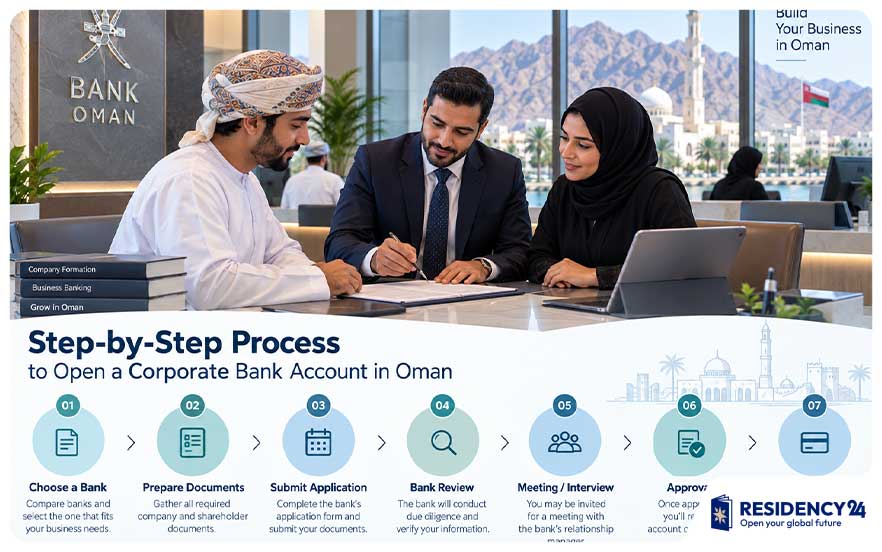
A typical corporate account process looks like this:
Register the company.
Obtain Commercial Registration.
Obtain Oman Chamber membership where required.
Obtain Tax Identification Number.
Prepare MOA/AOA and shareholder documents.
Prepare lease or physical address proof.
Prepare board resolution or authorization.
Identify authorized signatories.
Prepare UBO documents.
Prepare expected transaction profile.
Submit account-opening form.
Complete corporate KYC.
Provide source-of-funds and income documents.
Wait for compliance review.
Activate corporate internet banking.
Set up payroll, POS, or trade services if needed.
The Ministry of Commerce notes that after CR and TIN, company representatives can approach any Oman bank to open an account, and that the process usually takes a few days because of banking compliance requirements such as AML checks and UBO verification.
Practical Checklist Before Applying
Sequencing residency, licence and banking in the right order removes most delays: Residency24 works across residency, company formation, property purchase and investment planning. Before opening a bank account in Oman, use this checklist:
Passport is valid.
Residence card or visa is available.
Oman mobile number is active.
Local address proof is ready.
Salary certificate or employer letter is ready.
Source of funds is clear.
Foreign bank statements are available if needed.
Tax residency information is accurate.
FATCA/CRS forms are completed honestly.
Company documents are complete, if corporate account.
Physical address is documented for business account.
UBO and signatory documents are clear.
Minimum balance and fees are understood.
Online banking and debit card process is confirmed.
International transfer costs are checked.
A complete file is usually faster than trying to explain missing documents later.
Common Mistakes to Avoid
Common mistakes include:
Applying before residence documents are ready
Using an old passport copy
Not bringing original documents
Giving inconsistent address details
Not preparing salary proof
Ignoring source-of-funds questions
Treating FATCA/CRS forms casually
Opening a personal account for business activity
Choosing a bank without checking transfer fees
Not asking about minimum balance
Forgetting to update KYC after passport or visa renewal
Letting the account become dormant
Not closing accounts properly before leaving Oman
Registering a company before planning corporate banking
Banking in Oman is manageable, but document consistency matters.
Conclusion
Opening a bank account in Oman is usually easy for expat residents who have a valid passport, residence card, visa, local address, and proof of salary or income. Non-resident account opening is possible in some cases, but it is more document-heavy and depends on the bank’s risk assessment, account purpose, tax declarations, address proof, and source-of-funds evidence. For individuals, the most common account types are savings, current, salary, fixed deposit, Islamic, and multi-currency accounts. For companies, a corporate bank account normally requires Commercial Registration, Oman Chamber documents, MOA/AOA, shareholder and signatory IDs, physical address proof, source-of-funds documents, and KYC review. The safest approach is to choose the bank based on salary transfer, app quality, branch access, fees, international transfers, business tools, and compliance clarity, not only popularity.
Frequently Asked Questions
Can expats open a bank account in Oman?
Yes, expats can open bank accounts in Oman if they meet the bank’s eligibility and KYC requirements. Most banks ask for passport, resident ID, visa copy, address proof, and salary or income proof.
Can I open a bank account in Oman without a residence card?
It may be possible in limited cases, especially if an employer confirms that the visa is under process, but most normal expat accounts are easier after residence card or valid residence visa is issued.
Can non-residents open a bank account in Oman?
Some banks may consider non-resident accounts, but approval is stricter. Non-residents usually need passport, proof of address, tax declarations, source-of-funds documents, and a clear reason for opening the account.
What documents are needed for a corporate bank account in Oman?
A corporate account usually requires Commercial Registration, OCCI membership, MOA/AOA or constitutive contract, shareholder and signatory ID copies, physical address proof, and source-of-funds or financial documents.
How long does it take to open a bank account in Oman?
A simple resident personal account may open the same day or within a few days if documents are complete. Non-resident, investor, and corporate accounts can take longer because of KYC and compliance review.