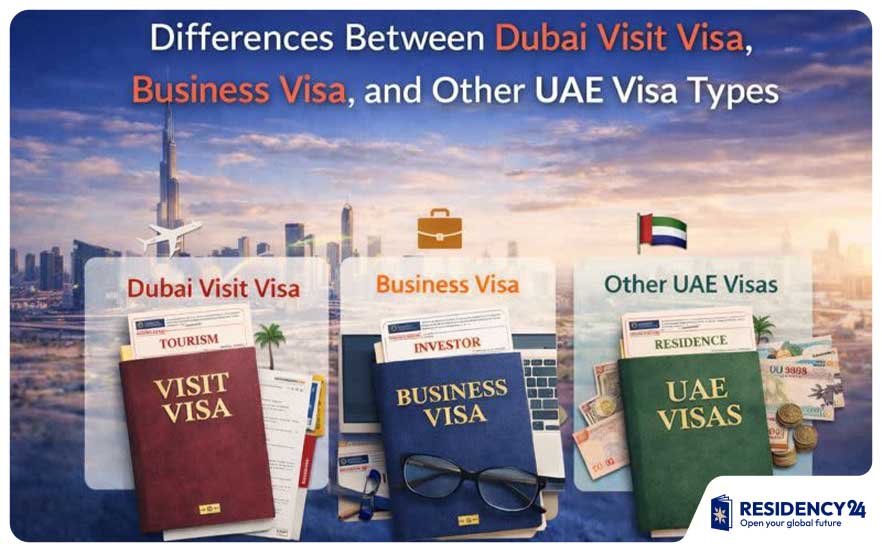
The UAE offers several residence visa routes for people who want to live and work in the country through investment, business ownership, partnership, or independent professional activity. The investor visa, partner visa, and freelance visa are often compared because they all can support self-sponsored or business-linked residency, but they are not the same. An investor visa is usually linked to capital ownership or business investment, a partner visa is linked to ownership shares in a UAE company, and a freelance visa is linked to an approved freelance permit or professional activity. Choosing the right option depends on whether the applicant wants to own a company, join an existing business, work independently, sponsor family members, open a bank account, or build a long-term base in the UAE.
What Is the Difference Between an Investor Visa, Partner Visa, and Freelance Visa in the UAE?
An investor visa is for someone who invests in a UAE business, property, or qualifying investment structure. A partner visa is for someone who owns shares in a UAE company with one or more partners. A freelance visa is for an independent professional who works under a freelance permit rather than a full company license.
The main difference is the legal basis of residency. Investor and partner visas are tied to ownership or investment. A freelance visa is tied to approved independent work. In the UAE’s Green Visa structure, investors and partners can apply through commercial activity participation, while freelancers and self-employed professionals have a separate route based on permits, education, and income requirements.
Investor Visa UAE

A UAE investor visa is a residence visa for someone who has made a qualifying investment in the country. This may include business ownership, company formation, public investment, or property investment, depending on the specific visa route.
For business owners, the investor visa usually starts with a company license. The applicant must show that they own or control a qualifying business interest. In many cases, this means providing a trade license, establishment card, memorandum of association, share certificate, and proof that the company is active.
Investor visas can suit people who want to:
Set up a new company in the UAE
Own a business without taking a salaried employee role
Use the UAE as a base for regional operations
Sponsor family members, subject to income and housing rules
Build long-term banking, tax, and commercial presence
An investor visa is not only about getting residency. It also creates a legal structure around business activity. That makes it more relevant for founders, owners, and people who need a commercial license to operate.
Partner Visa UAE

A UAE partner visa is for a foreign national who owns shares in a UAE-registered company with other shareholders. It is common in mainland companies, free zone companies, and multi-shareholder structures.
The partner visa confirms that the applicant is not merely employed by the company. They have ownership in it. The size of the shareholding, company activity, capital documentation, and licensing authority can affect the application process.
This visa may be suitable when:
Two or more people own a company together
A shareholder wants UAE residency through the business
A foreign partner joins an existing UAE company
A company has multiple founders who each need residency
The applicant wants business-linked residency rather than freelance status
The partner visa is close to the investor visa in practice, but the distinction matters. An investor may own the business alone or hold a qualifying investment. A partner holds a share in a company with other owners. For applicants comparing setup options, Residency24 can help with Dubai company formation, residency, and investment-related structuring.
Freelance Visa UAE

A UAE freelance visa is for independent professionals who want to work legally without setting up a full company. It is normally connected to a freelance permit issued by a free zone or relevant authority.
The freelance route is popular with consultants, designers, developers, media professionals, educators, marketers, trainers, writers, photographers, and other service-based professionals. The exact activities depend on the free zone or authority issuing the permit.
A freelance visa is usually a good fit for people who:
Work alone rather than through a larger company
Offer professional services under their own name
Do not need a full trade license with multiple activities
Want lower operating complexity than a company setup
Need UAE residency but not a corporate structure
For the Green Visa freelance route, official UAE information states that freelancers and self-employed people need a freelance or self-employment permit from the Ministry of Human Resources and Emiratisation, proof of a bachelor’s degree or specialized diploma, and evidence of annual income of at least AED 360,000 from self-employment for the previous two years or proof of financial solvency.
Investor Visa vs Partner Visa
The investor visa and partner visa are often treated as similar because both are linked to business ownership. The practical difference is the ownership structure.
An investor visa is broader. It may apply to a person who invests in a company, establishes a business, or qualifies through another investment category. A partner visa specifically applies when the applicant is a shareholder or partner in a licensed UAE business.
Factor
Investor Visa
Partner Visa
Main basis
Investment or business ownership
Shareholding in a company
Best for
Solo owners, investors, founders
Co-founders and company shareholders
Business license needed
Usually yes for business route
Yes
Freelance work allowed
Not by default
Not by default
Company activity required
Yes, if business-linked
Yes
Family sponsorship
Usually possible if requirements are met
Usually possible if requirements are met
A solo founder may use an investor visa. Two co-founders may use partner visas. A shareholder joining an existing company may also need a partner visa rather than a standard employment visa.
Investor Visa vs Freelance Visa
The investor visa is better for someone who wants to own or operate a business. The freelance visa is better for someone who wants to provide services independently without building a company structure.
An investor visa can support broader commercial activity. It may allow hiring staff, leasing office space, applying for business banking, and expanding the company. A freelance visa is narrower. It is usually limited to the permitted freelance activity and the individual professional.
Choose an investor visa if the plan includes:
Building a company
Hiring employees
Having multiple business activities
Working with corporate clients under a company name
Creating a scalable UAE business presence
Choose a freelance visa if the plan is:
One-person professional work
Lower setup complexity
Service-based independent activity
No need for employees
No need for a full company license
The investor route usually costs more and involves more administration. The freelance route is simpler but less flexible for business expansion.
Partner Visa vs Freelance Visa
A partner visa is ownership-based. A freelance visa is activity-based. This is the most important distinction.
A partner visa gives residency because the applicant owns shares in a UAE company. A freelance visa gives residency because the applicant has permission to work independently in a specific professional category.
A partner visa may be better if the applicant:
Owns part of a business
Wants to operate under a company license
Needs to invoice through a company
Plans to share ownership with other people
Wants to build a long-term business structure
A freelance visa may be better if the applicant:
Works alone
Does not want company partners
Provides services personally
Wants fewer company compliance obligations
Does not need a full commercial license
A freelance visa is not a shortcut for running a company. If the business model requires employees, multiple shareholders, office expansion, or wider trading activity, a company setup with an investor or partner visa is usually more appropriate.
Eligibility Requirements
Eligibility depends on the visa category and issuing authority. Applicants should not assume that one approval rule applies across all emirates, free zones, or business activities.
For investor and partner routes, common requirements may include:
Valid passport
UAE company trade license
Establishment card
Memorandum of association or shareholder documents
Proof of shareholding or investment
Passport-size photo
Entry permit or status adjustment
Medical fitness test
Emirates ID application
Health insurance
Proof of address or tenancy contract, where required
For freelance routes, common requirements may include:
Valid passport
Freelance permit or approval
Professional qualification
Portfolio or experience proof, depending on activity
Income evidence, where required
Medical fitness test
Emirates ID application
Health insurance
Proof of financial solvency, where required
The UAE has also tightened review procedures for freelance and Green Residency applications to prevent misuse, while reporting has indicated that the freelance visa route has not been suspended. This makes accurate documentation more important than relying on informal assumptions.
Cost Comparison
The cost of an investor, partner, or freelance visa depends on the emirate, issuing authority, visa duration, license type, medical test, Emirates ID, insurance, office requirement, and whether dependents are included.
Investor and partner visas usually involve higher total costs because they may require a trade license, company registration, establishment card, immigration file, office or flexi-desk package, and annual license renewal. Freelance visas are often less expensive because the applicant may only need a freelance permit, visa processing, medical test, Emirates ID, and insurance.
A practical cost comparison should include:
Initial license or permit fee
Visa application fee
Medical fitness test
Emirates ID
Health insurance
Establishment card, if applicable
Office, flexi-desk, or workspace requirement
Renewal fees
Dependent visa costs
Accounting, tax, or compliance support
The cheapest option is not always the best option. A freelance visa may save money at the beginning, but it can restrict growth. A company-linked visa may cost more, but it can support banking, hiring, contracts, and expansion.
Which Visa Is Best for Business Owners?
For business owners, the investor visa or partner visa is usually more suitable than a freelance visa. A company-linked visa provides a clearer legal structure for commercial activity, client contracts, business banking, invoicing, and future expansion.
The choice between investor and partner depends on ownership. If one person owns the company, the investor route may fit. If several people own the business, the partner route may be more accurate.
A freelance visa can work for a solo consultant or service provider, but it may not support all business models. For example, a person building an agency, trading company, consultancy firm, e-commerce operation, or multi-person service business may need a company license rather than a freelance permit.
Which Visa Is Best for Independent Professionals?
The freelance visa is often the best option for independent professionals who do not need a full company. It gives a legal route to live in the UAE and offer approved services under a freelance structure.
This can work well for:
Designers
Software developers
Marketing consultants
Media professionals
Writers and editors
Trainers
Coaches
Photographers
Education professionals
Independent consultants
The main limitation is activity scope. A freelancer should make sure the permit covers the services they actually provide. Working outside the approved activity can create compliance problems.
Can These Visas Lead to Long-Term Residency?
Yes, but the route depends on eligibility. Some investors, partners, entrepreneurs, and skilled professionals may qualify for longer-term residence options such as the Green Visa or Golden Visa if they meet the official thresholds.
The Green Visa is especially relevant because it provides five-year residency for selected skilled employees, freelancers, self-employed people, investors, and partners. UAE Government information describes the Green Visa as a five-year residence visa that allows eligible holders to sponsor themselves without needing a UAE national or employer as sponsor.
The Golden Visa is more selective and usually requires stronger investment, professional, academic, or exceptional talent evidence. Applicants should not confuse a standard investor, partner, or freelance visa with automatic Golden Visa eligibility.
Family Sponsorship
Investor, partner, and freelance visa holders may be able to sponsor family members if they meet the relevant income, housing, insurance, and documentation requirements. The exact requirements depend on visa type, emirate, and family member category.
Family sponsorship usually requires:
Valid residence visa
Minimum income or financial proof
Tenancy contract or accommodation proof
Marriage certificate for spouse
Birth certificates for children
Attested and translated documents, where needed
Health insurance
Medical fitness tests for eligible adults
Applicants planning to relocate with family should consider the total cost, not only the main applicant’s visa. School fees, housing, insurance, and dependent visas can change the real budget significantly.
Banking and Tax Considerations
A UAE residence visa can make banking easier, but it does not guarantee account approval. Banks may still ask for source of funds, business activity details, contracts, invoices, tax residency information, and company documents.
For investor and partner visa holders, banks usually review the company license, shareholder structure, business model, expected transactions, and client countries. For freelancers, banks may ask for permit details, income history, contracts, and proof of professional activity.
Tax should also be considered. UAE residency does not automatically solve tax obligations in another country. Applicants with cross-border income, foreign companies, or previous tax residence should get qualified tax advice before relocating.
Common Mistakes to Avoid
Many applicants choose a visa based only on cost or speed. That can lead to problems later when they need banking, contracts, family sponsorship, or business expansion.
Common mistakes include:
Choosing a freelance visa when the business needs a company license
Becoming a partner without checking shareholder rights
Applying under the wrong activity
Ignoring annual license renewal costs
Assuming residency means automatic bank approval
Using outdated visa information
Not checking whether the visa supports family sponsorship
Mixing personal freelance income with company revenue
Forgetting medical, Emirates ID, and insurance costs
Not keeping company documents updated
The right visa should match the applicant’s real activity. A simple structure that fits the business is usually better than a cheap structure that creates restrictions.
How to Choose the Right UAE Visa
The best way to choose between an investor visa, partner visa, and freelance visa is to start with the activity, not the visa name. The visa should support how the person will actually earn, invoice, work, and live in the UAE.
Use this basic decision path:
Choose an investor visa if you are setting up or owning a business.
Choose a partner visa if you own shares in a UAE company with other partners.
Choose a freelance visa if you work independently under an approved freelance activity.
Consider Green Visa eligibility if you want longer self-sponsored residence.
Consider Golden Visa eligibility if you meet higher investment or talent criteria.
A person planning to build a company should not choose a freelance visa just because it is simpler. A freelancer should not set up a company if a permit is enough. The correct route is the one that matches the legal, financial, and operational reality.
Conclusion

The investor visa, partner visa, and freelance visa in the UAE serve different purposes. An investor visa is best for people who want residency through business ownership or qualifying investment. A partner visa is best for shareholders in a UAE company with multiple owners. A freelance visa is best for independent professionals who want to work legally without forming a full company. The right choice depends on activity type, ownership structure, cost, banking needs, family plans, and long-term residency goals.